
Jewish author, actor and playwright Alice Eve Cohen was a newly minted Princeton University graduate in 1977 when her mother very suddenly died.
“We were just beginning to become close … after having a very stormy relationship for a number of years,” Cohen said. “To lose her in that moment, where everything seemed possible for the first time, was a loss that took a very long time to recover from, and which is still a kind of foundational part of me. It fuels a lot of my writing.”
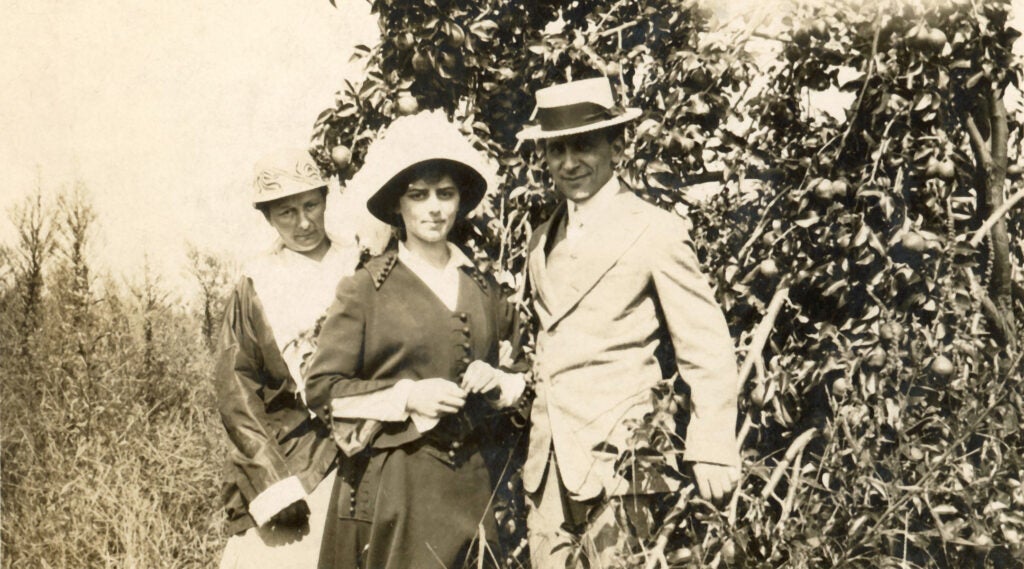
This loss is at the center of Cohen’s latest work, “Oklahoma Samovar,” which is having its world premiere at LaMama Experimental Theatre Club (66 East 4th St.) through Dec. 21. The play, which spans generations and is based on Cohen’s maternal family history, traces her Jewish ancestors’ unlikely path from freeing the Russian Army in Latvia, to living in a dugout in Kansas, to farming 160 acres of land, acquired during the 1889 Oklahoma Land Run.
“There are many, many autobiographical and family history elements in the story,” Cohen said in a Zoom conversation, adding that characters’ names in “Oklahoma Samovar” are authentic.
Though the play is “a work of dramatic fiction,” as Cohen calls it, we meet many of her real-life relatives in “Oklahoma Samovar,” including her great-grandfather Jake Meyer, who embraces both opportunity and secularism of the New World, and his wife, Hattie, who comes to United States at 17, lugging her family’s samovar across the Atlantic and the Great Plains. As time passes, we meet Rose, Cohen’s grandmother and Jake and Hattie’s daughter, who is caught between her rural upbringing and life in Brooklyn’s Orthodox Jewish community, and Clara, Cohen’s mother and Rose’s daughter, who turns her back on her family’s history.
In the play, a character named Emily — who is fictional, but based upon Cohen — learns of her family’s surprising past when she discovers a mysterious note written by her mother after her sudden death: “When I die, I want my ashes scattered over Sylvia’s farm in Chandler, Oklahoma.” Emily’s journey to discover who Sylvia is, and what Oklahoma has to do with her mother, drives the play’s plot.
Sahar Lev-Shomer plays plays free-spirited Jewish pioneer Jake in “Oklahoma Samovar,” with Nadia Diamond as Emily. (Marina Levitskaya-Khaldey)
In real life, Cohen, who lives on the Upper West Side, first met her great-aunt Sylvia in 1987, 10 years after her mother’s death. Sylvia, who lived to 103, ”was a very, very imaginative person, a natural storyteller,” Cohen said.
Learning that her family had roots in Oklahoma “was a complete surprise,” she added.
“Both of my parents were from Borough Park, Brooklyn, so that was all very familiar to me,” Cohen said. “And in movies and literature and Broadway shows, we see the classic Jewish immigrant in the Lower East Side. That was about as far as my imagination about my ancestors, about Jewish American history, went.”
Sylvia’s stories proved to be rich fodder for Cohen, whose other work includes the memoirs “The Year My Mother Came Back” and “What I Thought I Knew.” Over the decades, as she probed her family history, Cohen wrote several versions of “Oklahoma Samovar” — which won the National Jewish Playwriting Contest in 2021 — including an early draft that hewed to Sylvia’s possibly fanciful version of events.
“It’s only in these more recent iterations that it’s become a real play, where I have looked deep into the characters to find their flaws, where I’ve looked at the historical moments she described to me in the most romantic of terms, and really tried to dig deep to find the more insidious, cruel, darker sides of American history,” Cohen said.
“Whether it’s Jewish pioneers or Christian pioneers there, there was an inescapable cruelty and violence in westward expansion,” Cohen added. “Though I learned in the history books at the Oklahoma Land Run was a marvelous thing that we should celebrate, I understand now that it was a it was a despicable land grab that stole what was once called Indian Territory, which is where so many thousands of Native Americans were forced to relocate on the Trail of Tears, and promised that it would be theirs forever.”
And while “Oklahoma Samovar” touches on some major, and horrific, world events — including the dispossession of Native Americans, pogroms in Russia and the Holocaust — ultimately, the two-hour play is an intimate story about a Jewish family.
“In some ways, this play is the most important piece I’ve ever written,” she said. “I feel it is foundational to me; it is part of that kind of core question that I keep on asking in many different ways, which is about mother-daughter relationships, and the profundity of mother-daughter relationships, and the sorrow of losing a mother.”
Then again, while “Oklahoma Samovar” may have been 40 years in the making, Cohen acknowledges that some of the play’s themes are especially timely today. “When my great-grandparents came over,it was relatively easy to immigrate to this country. The Statue of Liberty was a beacon and a welcome, and they could come here and find their way,” Cohen said. “Today, immigrating here is either impossible or a life-threatening challenge, and I hope the audience will think about immigration and its complexity.”
“Oklahoma Samovar” is playing at The Downstairs theater at La Mama Experimental Theatre Club (66 East 4th St.) through Sun, Dec. 21. There will also be a livestreamed performance on Thursday, Dec. 18. For tickets and info, click here.