

This article was produced as part of the New York Jewish Week’s Teen Journalism Fellowship, a program that works with Jewish teens around New York City to report on issues that affect their lives.
On a freezing December day in Chicago, an elderly woman sat in a chair in a small downtown auditorium, speaking in measured tones about her family’s liberation from a Nazi detention camp in Vittel, France, at the end of the Second World War. High school students leaned in, listening intently and asking her to explain what her day-to-day life in the camp was like, what was the most distressing thing she witnessed and how she coped with losing so many family members.
She patiently answered every question in detail, telling the students that after she and her family moved to Skokie, Illinois, they rarely spoke outside the home about their experiences during the war. Once, her mother mentioned the camps, and a neighbor responded, “It was hard for us too, we couldn’t get nylon stockings.” After that, they only discussed it with other survivors, she said. The woman urged the students to remember her story and the lessons of the Holocaust, so that they can use them to transform the future.
The speaker, Rodi Glass, was actually in Florida at the time, but the students were interacting with an interactive hologram at the Illinois Holocaust Museum & Education Center’s temporary location in downtown Chicago. The hologram, one of 12 survivor testimonies created in collaboration with Steven Spielberg’s USC Shoah Foundation, is a pre-recorded program designed to respond to students’ prompts.
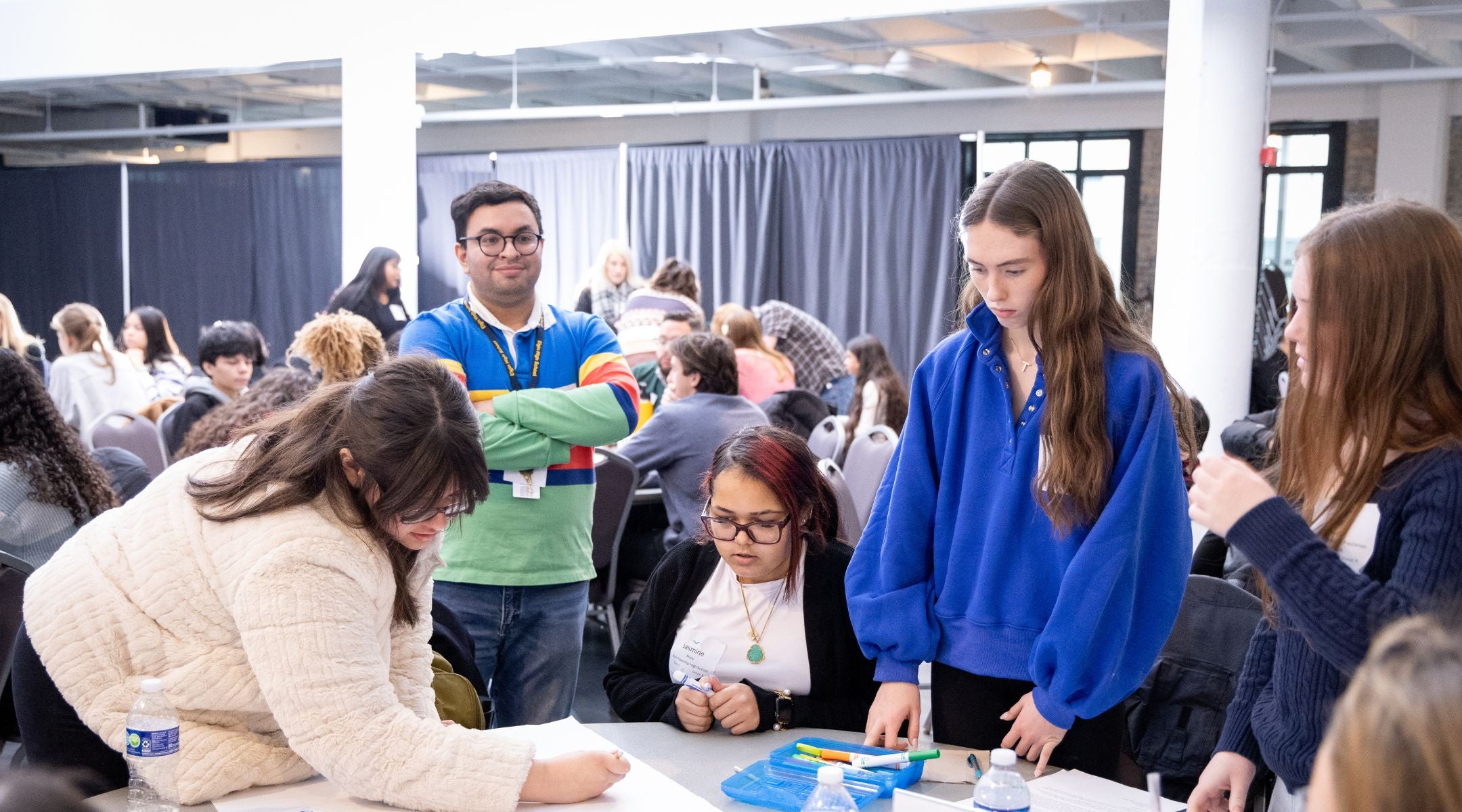
The interaction is part of the museum’s Student Leadership Day, a program in its 17th year that emphasizes the lessons of the Holocaust as a framework for young people to become “upstanders” and leaders in their communities. One-hundred and thirty students from 15 Chicago public and independent schools — this year none of them Jewish day schools — attended the event in early December. Students are nominated to attend the event by their teachers.
This year’s leadership day had a new element. In response to the rise of Holocaust denial and distortion, especially via online platforms, students reflected on the constitutional rights they value most and created posters for social media. “Our rights are consistent no matter the distance,” ran one slogan created by a student group, while another urged, “Let’s have motivation for education.”
Students taking part in Student Leadership Day reflected on the constitutional rights they value most and created posters for social media. (Kathleen Hinkel)
Amanda Friedeman, the museum’s associate director of education, has led the event for the past 15 years. The program is intended to introduce students to the issue of human rights and how they can address challenges in their own communities, she said.
“We bring together really diverse groups of students from a wide array of backgrounds — different geographical areas, different types of schools and communities,” Friedeman said. “We give them opportunities not just to sit in a room together, but to actually collaborate and get to know each other, to engage and find common ground with people who at first may seem very different.”
Among Holocaust educators and Jewish scholars, debate continues over the goals of Holocaust education. Some educators and Jewish leaders argue it must remain focused squarely on antisemitism and the systematic genocide of Europe’s Jews, while others insist that curricula and museums should sounda universal warning about the dangers of dehumanization, injustice and the moral cost of being a bystander.
The Illinois Holocaust Center insists it can do both. According to its website, it offers programs on “the diversity of Jewish identities and the variety of forms antisemitism has taken,” as well as programs like Student Leadership Days, which aims to provide teens with the “tools to stand up against injustice and bigotry.”
At the end of the recent SLD, participants come up with an action plan to carry out in their school. The museum provides a small startup grant for these initiatives, and supports in-school follow-up programming. While the activity did not relate directly to the Holocaust, its themes of social justice and making a positive impact on their communities were consistent with the museum’s goals, said Friedeman.
“Holocaust distortion is a serious problem,” said Friedeman. “It has been increasing over the past several years. This activity helps students see the ways that they can use social-media accounts as a tool for good — a vehicle for spreading awareness and positive messages.”
In the museum’s main exhibit, the students learned about the Holocaust through the holograms and installations.
“It was a really good opportunity to learn about some stuff that maybe wasn’t taught in school because this is a huge topic and school only carries so much information,” said Wesley Sternowski, 15, a sophomore at Saint Charles East High School in the western Chicago suburbs. “Reading all the stories around here really made me emotional. When I read about people’s families, it makes me think about my family – and I just can’t imagine that happening.”
Fellow Saint Charles East sophomore Emerson Garcia, 15, said the exhibit made the horrors of the Holocaust more real. “In 8th grade, my class read ‘Night’ by Elie Wiesel,” she said. “When you think about the Holocaust, you don’t tend to think of it on a personal level. The people who went through it didn’t think that they were going to lose their family members or their homes. It makes you cherish your life a little more.”
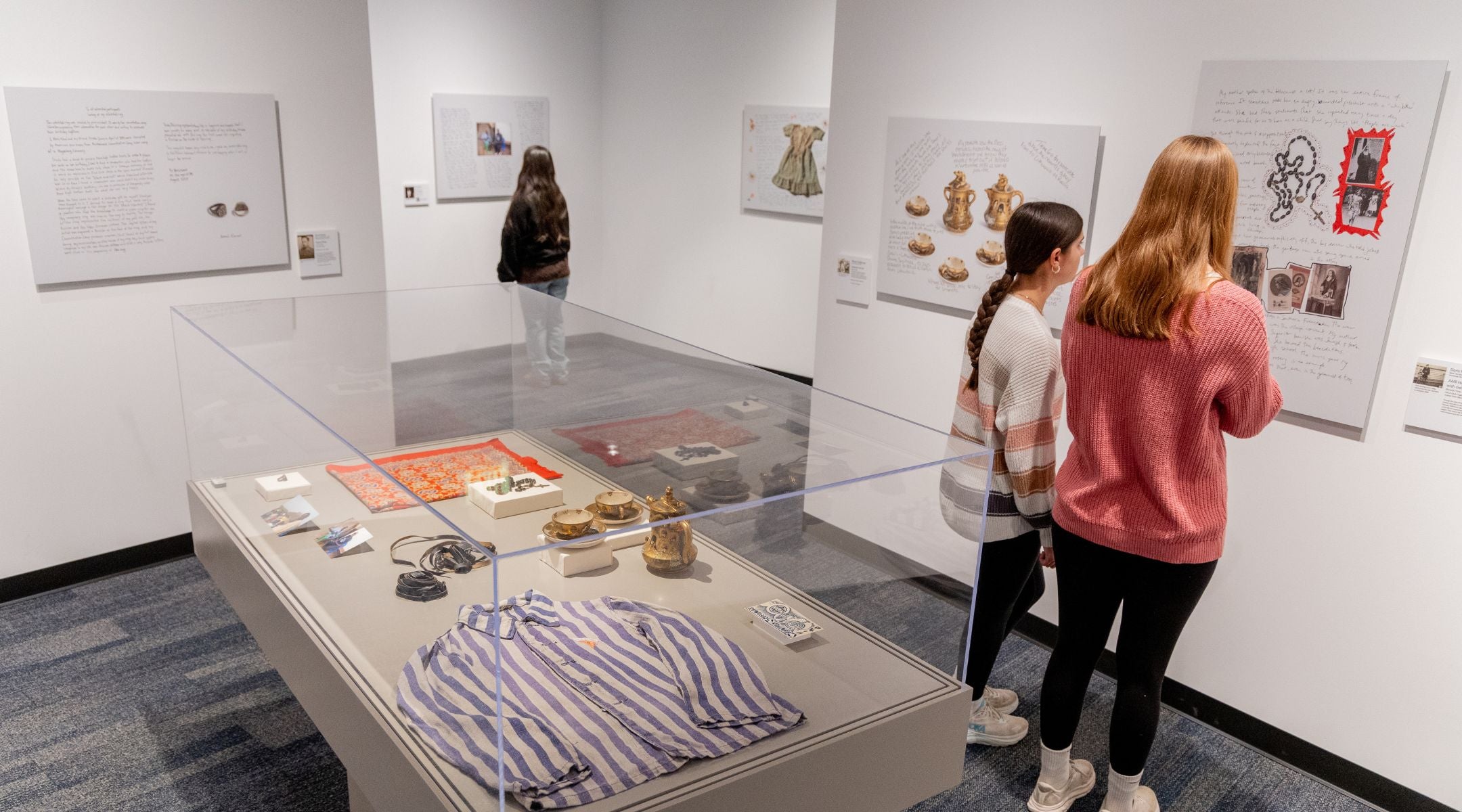
In the museum’s main exhibit, the students learned about the Holocaust through holograms and installations. (Kathleen Hinkel)
Lyka Mulit, 14, a freshman at Lakeview High School in Chicago, said the museum had enriched her understanding of the Holocaust, which she had previously learned about through short units in her history classes, as well as from information online. “Something that struck me while I was at the museum was seeing everyone’s personal belongings, especially the baby clothes and the small clothes from the children,” she said. “It showed me how tragic and also personal the Holocaust was.”
The leadership day is usually held at the Illinois Holocaust Museum’s main site in Skokie, in Chicago’s northwest suburbs. However, in August 2025 the museum opened Experience360, its downtown presence, while the Skokie building is being renovated to include a new visitor welcome center, a redesigned auditorium, and a reflection space.
The downtown location enables the museum to stage Holocaust programming for groups that might not make it to Skokie, said Amanda Berman, the museum’s communications manager. Berman said the temporary site had exceeded expectations, pushing the museum to reconsider its original plan of closing it in the second half of 2026, when the Skokie site is due to reopen. “We had intended to operate the Chicago museum only for one year,” she said. “However, we are seeing extraordinary demand for lessons from history as told by our museum. We will know what that means for our long-term plans sometime in the spring.”
Allie Niese, an AP government and politics teacher at William Howard Taft High School in Chicago, has brought her students to the program for several years. She said she particularly appreciates how it not only aims to educate them about the Holocaust, but also to direct them to action.
“To be leaders in their communities is not just the person who stands on the soapbox for everybody to see,” she said. “That’s what is important about a day like this: experiencing and understanding the stories of the Holocaust. Leadership can come in small moments. You don’t have to be the person with a megaphone to make a difference, but you can be the person who stands up to somebody next to you and encourages conversations that are welcome, honest and inclusive. Leadership is not just the person leading the line, but the person who is amongst everyone else too.”
Along with several other students, Lyka followed the event by putting into place the action plan she designed on the day, aimed at combating homelessness. “We chose this issue because we noticed a large number of people that are unable to afford housing, and that number is only growing,” she said. “We found ways to donate to homeless shelters, such as creating fundraisers and starting up class competitions for donating clothes. We hope this will have an impact on our community, even if it’s a small one.”
Lyka noted the importance of Student Leadership Day in inspiring her to break down a large issue through small actions.
“I feel more confident in taking initiative in my community,” she said. “Student Leadership Day showed me that I have a voice that matters. Knowing that others are also taking initiative and making a difference makes the work easier and less frightening.”
For her part, Emerson’s project was to bring into her school people affected by alcohol or drug addiction, to share their personal stories with students. She noted that substance abuse affects over a million people in Illinois alone and said she hopes her initiative will educate her peers about it.
Since Hamas’s attack on Israel on Oct. 7, 2023, Israel’s response has been a contentious issue at some Chicago public schools, prompting student demonstrations and walk-outs. The leadership program does not discuss Israel, and Friedeman says the museum has not considered changing that because of the war. “The model of the program is just as effective post-Oct. 7 as it was before,” she said.
Natalie Rodriguez, 16, a junior at Curie Metro High School in Chicago, said that the program reinforced the importance of standing up to injustice: “A lot of people when they see things happening, don’t say anything. They keep to themselves,” she said. “Rodi Glass said herself that she would never speak about her experience outside of her house because people would brush her off. So speak up, speak out and use your voice to help others.”


