

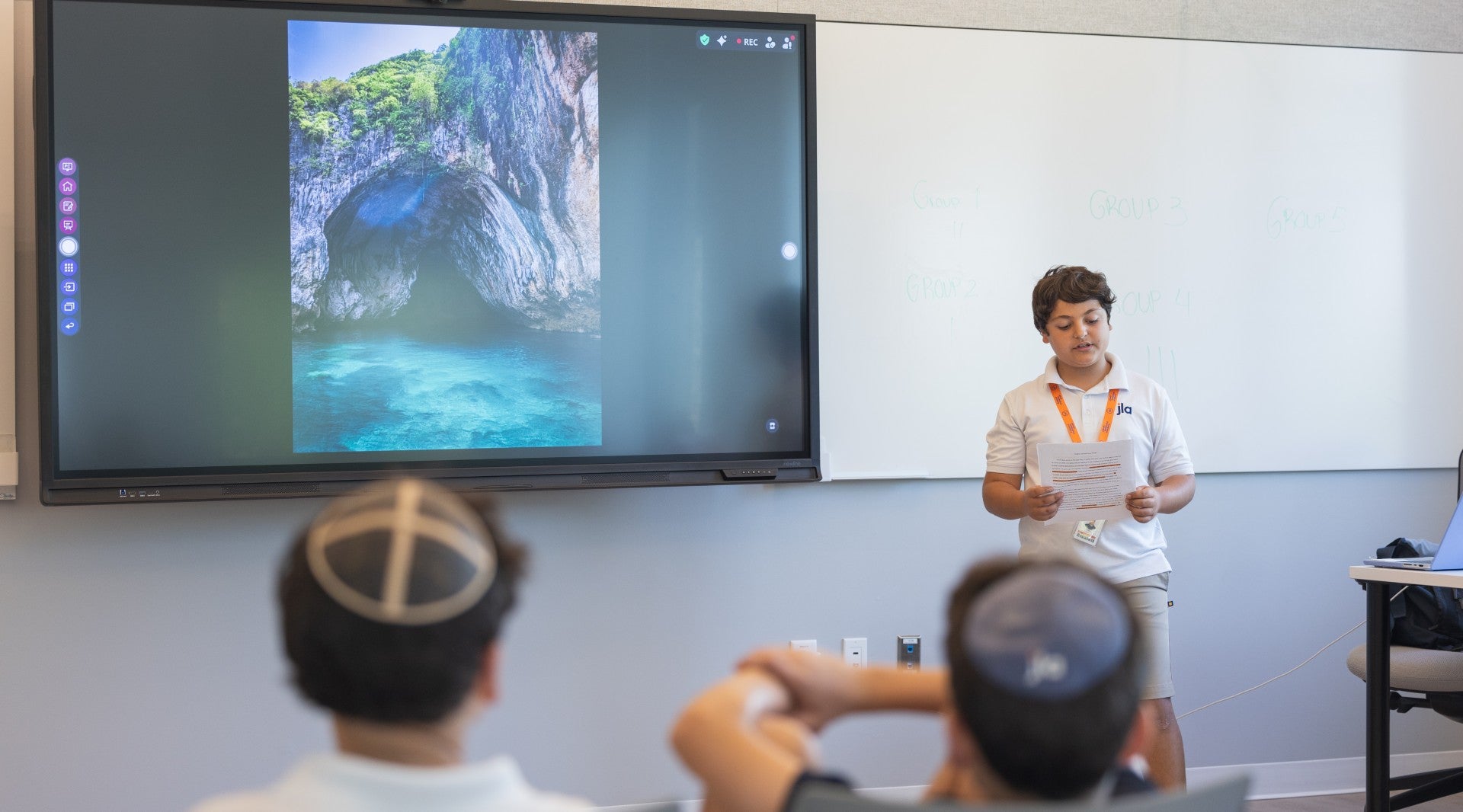
In one classroom, students create a podcast featuring an “interview” with the prophet Elijah. In another, instructors teach Jewish prayers using AI-created songs with rhyming lyrics.
Elsewhere, Jewish studies classes are automatically recorded and translated into multiple languages for a multilingual student body.
Welcome to Jewish day schools in the age of artificial intelligence.
With AI opening up new ways to work, learn and play, Jewish schools around North America are finding creative and unexpected methods to use the technology — and in a fraction of the time it would have taken in the pre-AI era.
“There are things that creative teachers used to do, and it would take five hours,” said Rabbi Binyomin Segal, instructional technology coordinator at the Ida Crown Jewish Academy near Chicago. “Every teacher knows the next 10 things they would do if they had time, and now AI can help them do some of them.”
AI adoption varies greatly across Jewish day schools. Some haven’t incorporated its use too much into the curriculum, while other schools are using the technology intensely.
At the Jewish Community Day School (JCDS) outside Boston, many students prepare for tests with AI-powered games. They use the AI tool NotebookLM to create study guides, flash cards, and practice quizzes, and use AI-powered chatbots, which can simulate conversations with humans, to quiz themselves in preparation for upcoming Mishnah tests.
“Creating a bot with a personality brings some extra fun and engagement to the routine of studying for a quiz,” said Rabbi David Winship, a Judaic studies teacher at the school.
At the Gideon Hausner Jewish day school in California’s Silicon Valley, the school’s assistant head of innovation turned a lobby area into an AI Tinkery space. Students use it to explore ethical issues around the role of AI in their lives. The space features a rotating set of hands-on activities, from games and manual computer science puzzles to a whiteboard filled with student questions. Students can practice how to distinguish AI-generated images from human-made photographs.
“We realized we needed to integrate AI into our school’s culture and values, not just teach it as a tech subject,” the educator, Smita Kolhatkar, who previously worked at Oracle for 15 years, told j. weekly in an interview. “That includes bringing it into the Jewish realm, into Hebrew and into ethical discussions.”
To avoid over-reliance on AI, Rabbi Tzvi Hametz, director of STEM education and innovation and director of education technology at Berman Hebrew Academy in Rockville, Maryland, said humans need to stay very involved.
“I push hard that it should be human-AI-human; I call it the human sandwich,” Hametz said. “We should never use AI for our first stage and our last stage. We need to see where AI was involved in your process, the way math teachers always made us show our work.”
AI adoption varies greatly across Jewish day schools. (Courtesy of Jewish Leadership Academy)
At JCDS, Winship employs a little trick to steer students away from plagiarizing from AI. He created a chatbot that students may use when working on summaries of Jewish texts, but the chatbot introduces a line of gibberish into its responses to students so they can’t simply copy/paste AI-produced text and claim it as their own.
At the same time, educators warn that focusing too much on plagiarism sends the wrong message, especially when teachers are using AI as a shortcut, too.
“Students will smell the hypocrisy,” Hametz said.
The Jewish Education Innovation Challenge (JEIC), whose mission is to improve the quality of Jewish education in day schools across North America, will feature several sessions on AI at its annual Innovators Retreat, scheduled for April in Atlanta. Among them: a session on using AI in chavruta (paired) Jewish learning and a session on the importance of balancing AI use with human interaction in the classroom. Said Sharon Freundel, managing director of JEIC, “At the 2026 Innovators Retreat, we will engage in interactive, hands-on sessions to explore how Jewish education evolves its methods—but not its mission—of fostering wisdom, identity, and humanity through thoughtful teaching, even in the AI era.”
The Jewish Leadership Academy in Miami, which serves approximately 235 students in grades 6-12 and was built right after the COVID pandemic, designed its classrooms in collaboration with Zoom to be fully equipped for hybrid, high-tech learning. Every class is recorded, and students can access translations of lessons into multiple languages using an AI tool called Flint built specifically for school use. (Many Jewish day school students in the Miami area come from Spanish- or Hebrew-speaking homes and speak English as a second language.)
Rabbi Gil Perl, the academy’s head of school, said it’s understandable if some teachers are reluctant to use AI, either out of fear of the unknown or out of a concern that AI might eliminate their jobs, but AI is fast becoming an integral teaching tool.
“In two years, I don’t think I would hire a teacher who can’t leverage AI in the classroom,” he said.
Sarah Rubinson Levy, an educational consultant and author of the book “Crafting the Future: AI and Jewish Education,” says teachers will still be needed in a world dominated by AI use, but their role will change. Rather than merely serving as purveyors of information, teachers should help students acquire social-emotional skills such as grit and perseverance, help facilitate how students acquire knowledge, and teach them to think critically.
AI “is the catalyst we desperately need to allow us to rethink and reimagine what education is, should be and can be,” Rubinson Levy said in a recent TEDx Talk.
At Jewish schools, the focus on AI use shouldn’t just be adoption, but how educators can use the technology as a tool to support students’ connection to their Judaism, said Ida Crown’s Segal.
“If you can do this in such a way that can bring people closer to God,” said Olivia Friedman, a Judaic studies teacher at the Jewish Leadership Academy, “then why wouldn’t you use it?”
Pretty soon, AI-literate educators will be the new baseline in Jewish day schools. By embracing these tools today, experts say, Jewish day schools are ensuring not just that they keep pace with the rapidly changing high-tech world, but that their students are equipped to navigate this new reality in a way that upholds and even reinforces Jewish values.