
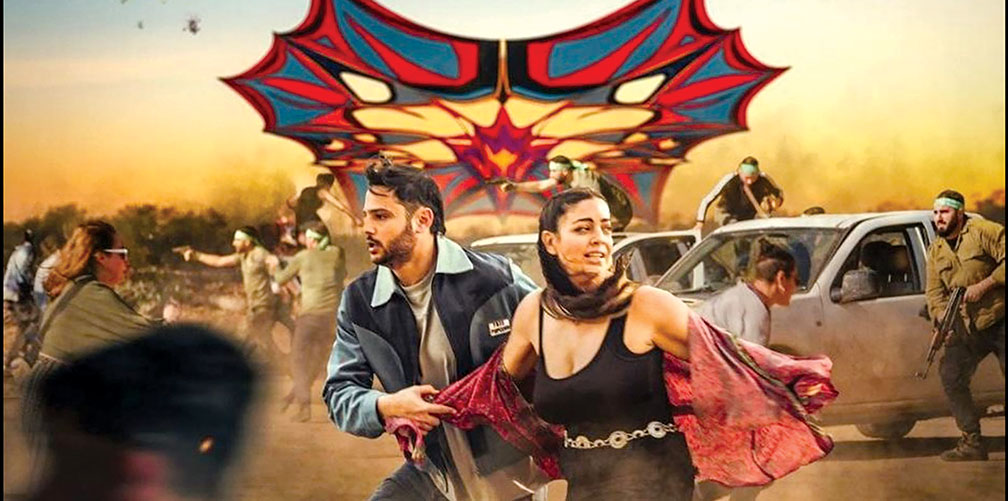
There have already been several documentaries and one television series about the events of Oct. 7, 2023. Now, there is also a feature film, “12 Hours in October,” directed by Danny A. Abeckaser.
The film portrays the horrors of that day through the perspectives of several fictional characters as they face the terror and chaos of the first 12 hours of the attack. Naturally, the question arises: Why is there a need for a feature film about these events? There are already hundreds of hours of footage available — filmed by the terrorists themselves, captured by security cameras, and documented through interviews with survivors and with families who lost loved ones. Much of this material is accessible online.
In an interview with The Journal, Abeckaser who goes by his nickname, Danny A., explained that the film was not intended for an Israeli audience, but rather for American viewers and the broader international community. “There was never a feature film about the events,” he said. “I decided to make a feature film in English — a reenactment with actors — because it’s never been done before in that way. I feel like I’m the only one who did it. When you watch a documentary, you mostly see the aftermath. You don’t see the fear in people’s eyes or what they went through in real time.”
Although the characters in the film are fictional, the events depicted are based on real occurrences. Abeckaser said he deliberately avoided portraying real individuals out of concern for the victims’ families. “I didn’t want families to watch the film and be hurt by seeing what their loved ones went through,” he explained. “We took stories we had heard and read about, changed the names, and altered certain details.”
The cast includes several familiar faces from the popular Israeli series “Fauda,” among them Doron Ben-David and Yaakov Zada-Daniel, as well as singer, dancer and social media influencer Montana Tucker.
“Montana Tucker is a strong activist for Israel,” Abeckaser said. “She has a large following and a powerful voice. I asked her if she would be interested in acting, and she immediately said yes — especially because the film is about Oct. 7. I was thinking about who could help bring audiences to the film. That’s why she was cast, and the same applies to the ‘Fauda’ actors. They are recognizable, and they understand this world.”
The 80-minute film tells the stories of festivalgoers at the Nova music festival and families trapped in their homes near the Gaza border. The film opens with a chilling phone call: a little girl reaches out to her mother, terrified, as she tells her that Hamas has just killed her father and brother. The mother tries to comfort her while hiding in their home, setting the tone for the fear and chaos that unfolds throughout the day.
At 6:29 a.m., the massacre at the Nova music festival begins. Among the festivalgoers are a young couple dancing in celebration of their recent engagement, a married couple sharing the news of an unexpected pregnancy, and another couple going about their morning in a nearby kibbutz. Suddenly, alarm bells ring as a massive barrage of rockets is launched from the Gaza border. As people scramble for shelter, a group of Hamas terrorists breaches the festival, targeting anyone attempting to flee and gunning down those who remain.
The terror extends beyond the festival. Another group of terrorists moves into the nearby kibbutz, going from home to home, dragging residents into the streets before executing them. Meanwhile, the film also follows one of the Hamas leaders as he trains his son, teaching him to embrace violence and seize the spoils of war, illustrating how the cycle of terror is passed down.
In one particularly harrowing sequence, the film depicts a young Israeli woman who is attacked and raped by a terrorist before being stabbed. Mortally wounded, she manages to reach the terrorist’s pistol and shoots him. The rape itself is not shown visually, but the sounds and context are disturbing enough to convey the horror of the act.
“Some people say it’s not graphic enough,” Abeckaser said. “Everyone has their own opinion. Listen, I didn’t go into politics or anything like that. I wanted to show what happened on that day and what they did. That was the goal — to start a conversation. So someone in middle America might watch it and say, ‘I didn’t realize what happened exactly. I thought it was a war between the people of Israel and the people of Palestine.’ Some people refuse to understand what really happened. I wanted to educate the world about it.”
Abeckaser was born in Israel and has lived in Brooklyn since he was nine years old. He was a club promoter and later a nightclub owner before becoming an actor, appearing in films such as “Alpha Dog,” “You Don’t Mess With the Zohan,” “Holy Rollers,” “The Wolf of Wall Street” and “The Irishman.”
The Israeli American director married his Israeli wife, May Almakaies, in May 2022 at Soho House in Israel. Many local and international celebrities attended the wedding, including Leonardo DiCaprio and singer Omer Adam. The couple reside in Los Angeles with their children.
Recently, Abeckaser released his crime drama “The Perfect Gamble,” in which he stars alongside David Arquette and Danielle Pick Tarantino.
Over the past 10 years Abeckaser has released seven films. “The truth is, I didn’t want to make this one,” he admitted. “My films are usually very different, although 90% are based on real stories like this one. It’s not easy to watch. However, I was approached a few times about it and felt it was important for the world to see and understand what happened that day.”
The film is available to buy or rent on Apple TV, Amazon, Dish and pay-per-view platforms.