
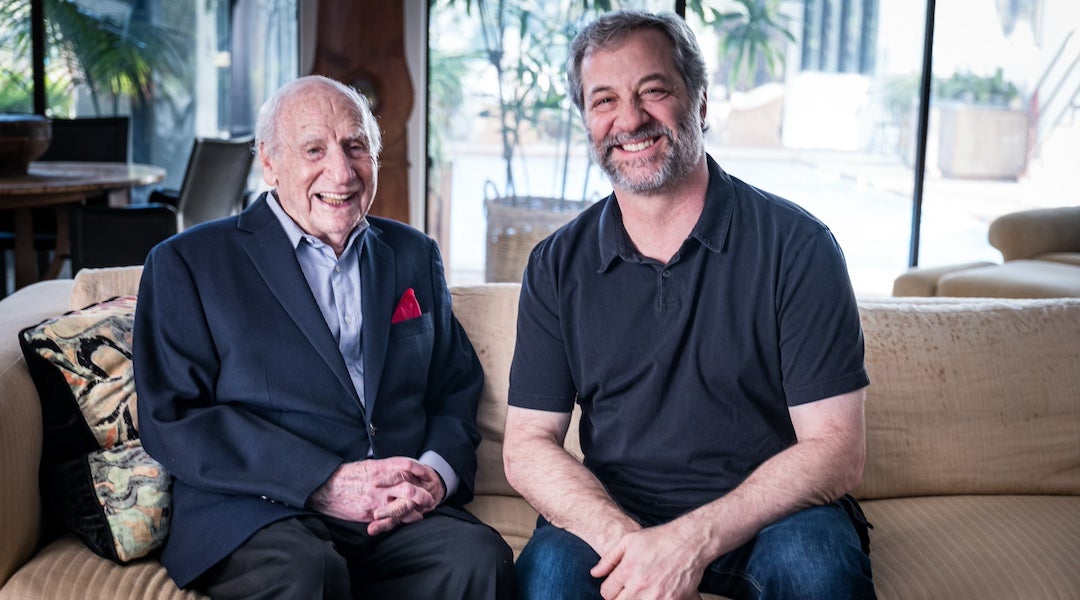
When Judd Apatow was growing up on Long Island, there was no debate about who ruled the comedy world.
“Nobody was funnier than Mel Brooks,” Apatow once wrote. “Mel Brooks was the king.”
Decades later, after himself becoming a prolific Jewish filmmaker and comedy impresario, Apatow has turned that childhood certainty into a sweeping tribute. “Mel Brooks: The 99-Year-Old Man!,” a two-part HBO documentary debuting this week, is a career-spanning portrait of one of American comedy’s most influential figures.
“A lot of us looked up to him as someone who was brilliant and funny and succeeding in multiple fields, writing, directing, producing, performing, and he was an inspiration,” Apatow told the Jewish Telegraphic Agency. “I think so many of us, like Adam Sandler and Ben Stiller and Amy Schumer, went into the business because they saw him and thought, ‘Oh, it’s possible.’”
He continued, “They loved his style and sense of humor, and his morality that, beneath the comedy and so much of his work, are a lot of very ethical ideas. And he’s using riotous laughter to inject people with things that are important to learn.”
Co-directed by Apatow and Michael Bonfiglio, the film traces Brooks’ life from his Brooklyn childhood to his work on Sid Caesar’s “Your Show of Shows” and “Caesar’s Hour,” his run of landmark films like “The Producers,” “Blazing Saddles” and “Young Frankenstein,” to later success that included the blockbuster Broadway version of “The Producers,” his guest arc on “Curb Your Enthusiasm,” and his update to “History of the World.”
The anarchic Borscht Belt tummler and comedy writer of the 1950s is shown evolving into a beloved elder statesman, praised by generations of Jewish admirers and disciples who include Jerry Seinfeld, Adam Sandler, Sarah Silverman, Ben Stiller and Nick Kroll, all of whom are featured in the documentary.
“There’s not anybody our age or up that didn’t have the pride of Mel being Jewish,” Sandler says in the film. “‘You know that dude you quote all the time? He’s one of us.’”
That sense of Jewish pride runs throughout the documentary, which leans unapologetically into Brooks’ Jewishness — from the “Jews in Space” sequence in “History of the World, Part 1” to the Yiddish-speaking Indian in “Blazing Saddles,” from musical numbers about the Spanish Inquisition to the audacity of staging a comedy about Hitler.
The film lingers on Brooks’ marriage to the actress Anne Bancroft. (Mel Brooks/HBO)
The comedy legend’s approach to Judaism in comedy and life is central to the film, which addresses everything from Jewish mother humor to deeply complex questions about whether or not it’s OK to make jokes about the Holocaust.
“It’s not so much about me, but about little, short, funny-looking Jews who are trepidatious about entering show business,” Brooks says early on. “If I can do it, you can do it.”
Apatow, whose films include “The 40-Year-Old Virgin” and “Knocked Up,” has spent much of his life interviewing comedians. As a teenager, he began collecting conversations with his heroes; decades later, those interviews and others became the book “Sick in the Head: Conversations About Life and Comedy.” Brooks looms large in that personal archive — and in Apatow’s imagination.
“I first met Mel a long time ago, interviewing him to promote one of his books,” Apatow said. “I interviewed him and Carl [Reiner] for one of Carl’s books, and then Mel asked me to write the introduction to his book about ‘Young Frankenstein.’ We had some lunches, and I basically just tried to create situations where I could be near him, the way any good comedy stalker would.”
That familiarity helped shape the documentary’s tone. Brooks sat for roughly 10 hours of interviews over five sessions — a demanding schedule for a 99-year-old subject, but one Apatow approached with care.
“I think part of it was that I love him, and he knows how much I enjoy being around him,” Apatow said. “It gave him energy to share things he hadn’t shared before.”
What surprised Apatow most was Brooks’ undulled intellect.
“He’s sharper than me,” Apatow said with a laugh. “He never reaches for a name. He’s pulling names from the ’40s.”
While Brooks has been the subject of documentaries before — including a 2013 “American Masters” film — Apatow said this one aimed to go deeper into the human side of the story. The film lingers on Brooks’ marriage to Anne Bancroft, his devotion to family, and his decades-long friendship with Reiner, who came up with Brooks as part of Caesar’s shows and with whom he famously shared nightly dinners after both men were widowed.
The documentary includes footage of Seinfeld joining those dinners, and an especially poignant segment in which Brooks recalls being present when Reiner died in 2020.
Rob Reiner, Carl’s son and a legendary filmmaker in his own right, also appears in the film. In one moment, he reflects on Brooks’ relentless mockery of Nazis.
“I think it’s what we Jews do as survival,” Rob Reiner says. “Comedy is a way to keep those Nazis at bay.”
Reiner’s appearance carries added weight: He was murdered at his home in December, allegedly by his son.
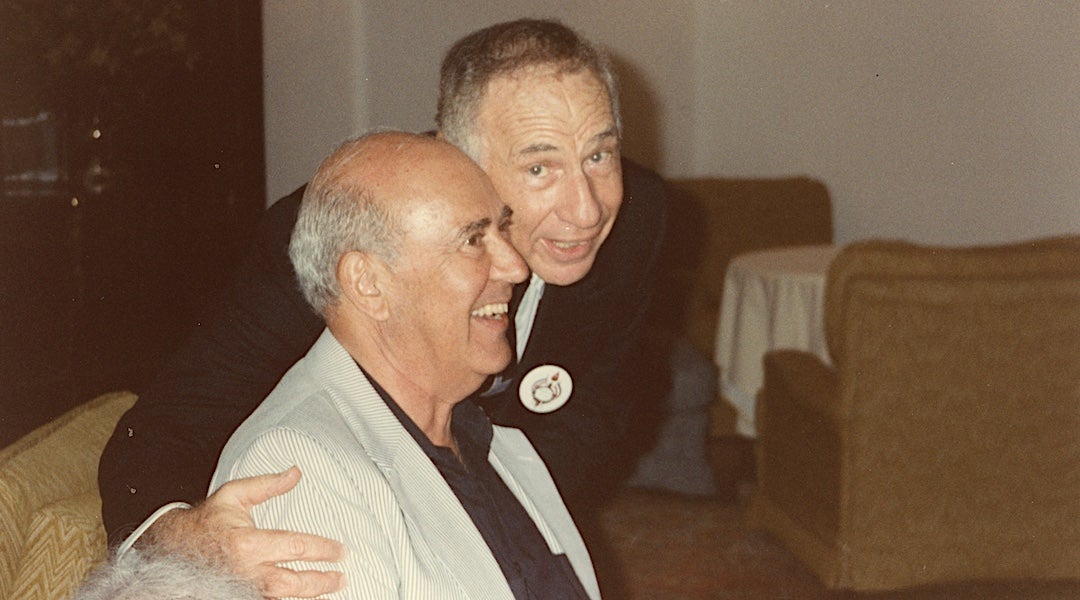
Brooks and Carl Reiner, who came up with Brooks as part of Sid Caesar’s TV shows, famously shared nightly dinners after both men were widowed. (Mel Brooks/HBO)
“It was a really wonderful day,” Apatow said of the filmmakers’ interview with Rob Reiner, which took place in early 2025. “We’d shot at his home, and he couldn’t have been kinder and more open and hilarious. It’s heartbreaking in some senses to see him in the documentary, but in another way, it’s a real, honest representation of what a great person he was.”
Another talking head who died before the release is David Lynch, whose “The Elephant Man” was executive produced by Brooks. The director had largely stopped giving interviews due to health issues, but made an exception.
“He loved Mel so much,” Bonfiglio told (JR), noting that it may have been Lynch’s last interview.
For all its emotional depth, “The 99-Year-Old Man!” is also packed with comedy. Apatow describes himself as a “comedy hoarder,” delighting in the task of combing through decades of talk show appearances and performances. The Jewish comedian and author Wayne Federman is a producer of the documentary, and his job, said Apatow, was to “watch [and] get the best clips.”
Apatow calls “The Producers” his favorite Brooks film. “It’s a remarkable Zero Mostel/Gene Wilder partnership,” he said of the film’s two Jewish stars. “It’s two people playing off each other in a way that’s never been done better.” Bonfiglio went with “Young Frankenstein.”
The title itself is a nod to one of Brooks’ most famous routines, “The 2000 Year Old Man,” performed with Carl Reiner beginning in the 1950s. In the film, Sandler compares listening to the bits — an elderly Jew talking about his romps through history — to hearing his own Jewish uncles talk in Florida.
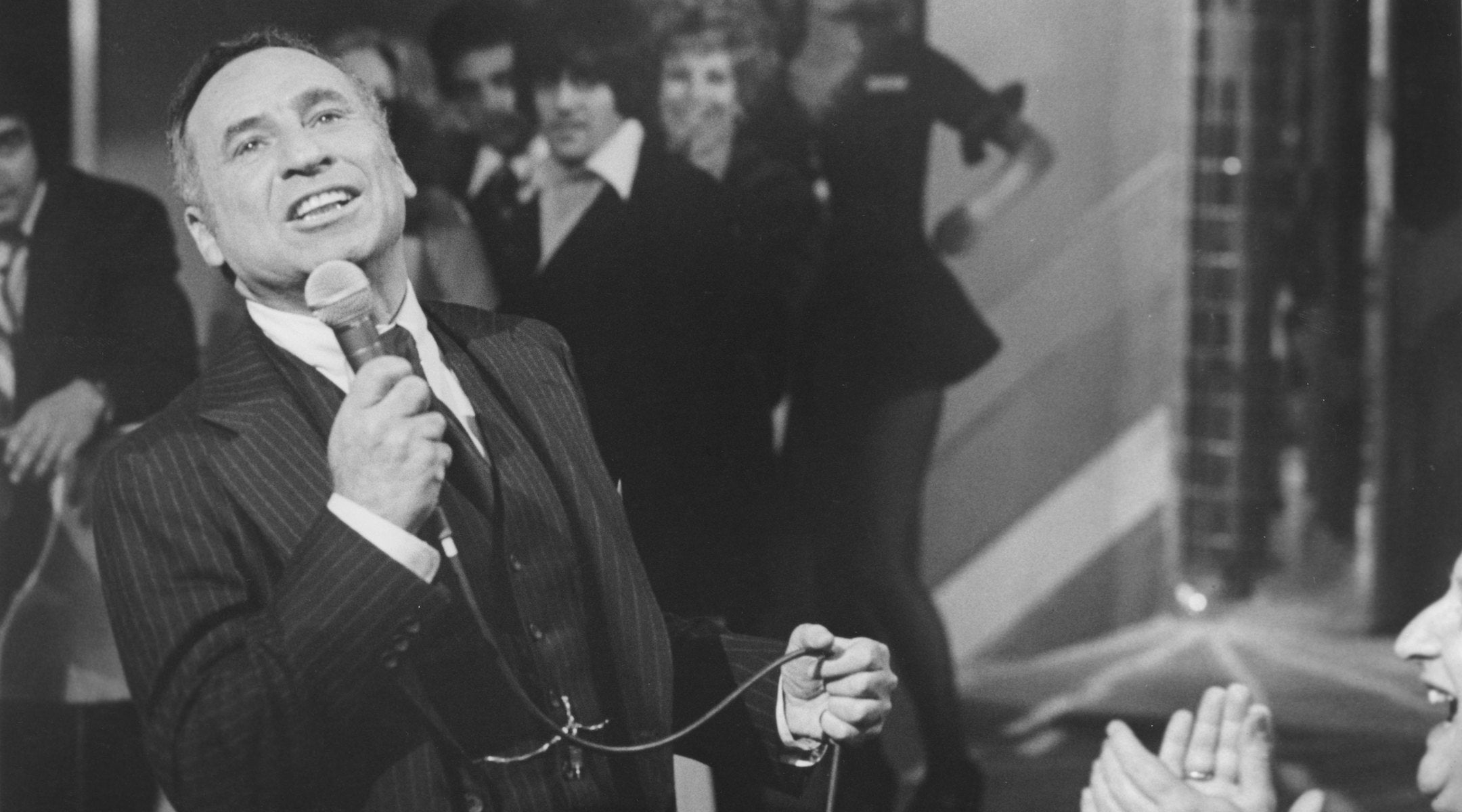
Mel Brooks sings the title tune in his movie “High Anxiety,” which was released in 1977. (Michael Ochs Archives/Getty Images)
Brooks’ 100th birthday is in June — a milestone that suggests that he has outlived nearly all his contemporaries, but not his relevance. A “Spaceballs” sequel is officially in development with Amazon MGM Studios, and a TV series inspired by “Young Frankenstein” is nearing a pilot order at FX. A children’s picture book, “Blazing Humor:
“Most of the people who were important to him in his working life are gone,” Apatow said. “But he has a big family, and a new generation of people who admire him.”
For Apatow, that admiration is rooted in something simple.
“I think he appreciates when the world recognizes that he made them laugh,” he said. “Because that’s all he ever set out to do.”
“Mel Brooks: The 99-Year-Old Man!” premieres on HBO Max on Jan. 23, with Part 1 airing on HBO at 8 p.m., followed by Part 2 on Jan. 24.