


When Pennsylvania Gov. Josh Shapiro wrote in his new memoir that Kamala Harris’ vice-presidential vetting team asked whether he had ever been a “double agent” for Israel, many Jewish leaders heard something painfully familiar.
“These questions were classic antisemitism,” Deborah Lipstadt, the former U.S. special envoy on antisemitism, wrote on X, a view shared by, among others, Jonathan Greenblatt, the CEO of the Anti-Defamation League; Abraham Foxman, the ADL’s former leader, and Josh Gottheimer, the Democratic congressman from New Jersey.
These critics agreed that the question put to Shapiro echoed the “dual loyalty” charge: that Jews — especially those with visible ties to Israel — have divided allegiances, loyal first to their people and only conditionally to the countries they serve.
Other Jewish commentators insisted that the questions put to Shapiro by the Harris team were routine, similar to those asked of anyone being vetted for top security clearance. “So please,” Shaul Magid, visiting professor of Modern Jewish Studies at Harvard Divinity School, wrote on Facebook. “Can we just calm down and stop looking like hysterical conspiracy theorists.”
But as the reactions rolled in, so did a quieter, more complicated debate — one that goes to the heart of American Jewish identity. Does the normative American Jewish attachment to Israel — Israeli flags in synagogues, Zionist education in day and Hebrew schools, pride in the young American Jews who serve in the Israeli military — invite accusations of dual loyalty? And if so, should Jews do a better job of explaining how their often fierce attachment to Israel does not compromise their loyalty to America? Should they even have to?
Shapiro, 52, has been open about his connections to Israel, which represent a not unusual arc for a day-school-educated Jew of his generation: a high-school volunteer program affiliated with the IDF, a six-month stint working at the Israeli Embassy in Washington after college, and outspoken views during the Gaza war that combined criticism of Israeli government policy with condemnation of some pro-Palestinian protests.
Those ties, Jewish leaders argue, are well within the American Jewish mainstream — and far from evidence of disloyalty. “No one ever accused Irish Americans of dual loyalty for caring deeply about Ireland,” Foxman wrote. “This reflects something very troubling about our political culture.”
The Alfred Dreyfus Statue in the courtyard of the Jewish Museum in Paris honors the Jewish army officer who was falsely convicted of treason in an ordeal that exposed how antisemitism and accusations of Jewish disloyalty could override evidence, justice and citizenship. (Flickr Commons)
In his memoir, “Where We Keep the Light,” Shapiro wonders whether he was singled out as “the only Jewish guy in the running,” and says he told Harris’ team the questions were offensive. After the New York Times reported the exchange this week, Harris’ team sought to control the damage, telling CNN that every finalist was asked whether they had ever acted as an agent of a foreign government — a standard question on federal vetting forms. Minnesota Gov. Tim Walz, who was ultimately chosen, was pressed about his multiple trips to China, where he lived for a year after college, these sources told CNN.
“The crux of vetting is asking uncomfortable and even farfetched questions,” one person close to the process said. “The point isn’t that you believe it — it’s that it’s on the record.”
Jeffrey Salkin, a rabbi and columnist for Religion News Service, rejects that equivalence. Writing about the episode, he contrasted Walz’s questioning about China with Shapiro’s experience. Walz, Salkin argued, was asked about what he did, writes Salkin. Shapiro was asked about who he is.
“For Jews, dual loyalty is the oldest antisemitic charge in the book,” Salkin wrote. “The crime is all within the imagination of the accuser.”
The charge predates the creation of Israel, going as far back as Exodus when the pharaoh warns that the growing number of Israelites in Egypt “may join our enemies in fighting against us.”
The charge was revived in the modern era, when Jews were gradually granted full citizenship in exchange for renouncing their ties to a Jewish national identity. In 1789, speaking on behalf of Jewish emancipation in the French National Assembly, the Count of Clermont-Tonnerre proclaimed famously that “Jews should be denied everything as a nation, but granted everything as individuals,” warning: “The existence of a nation within a nation is unacceptable to our country.”
The promises of emancipation were nearly revoked in 19th-century France, when Alfred Dreyfus was falsely convicted of treason amid mass cries of “Death to the Jews.” Later, Hitler rose to power behind the myth that Germany could have won the First World War if it had not been “stabbed in the back” by disloyal Jews and communists.
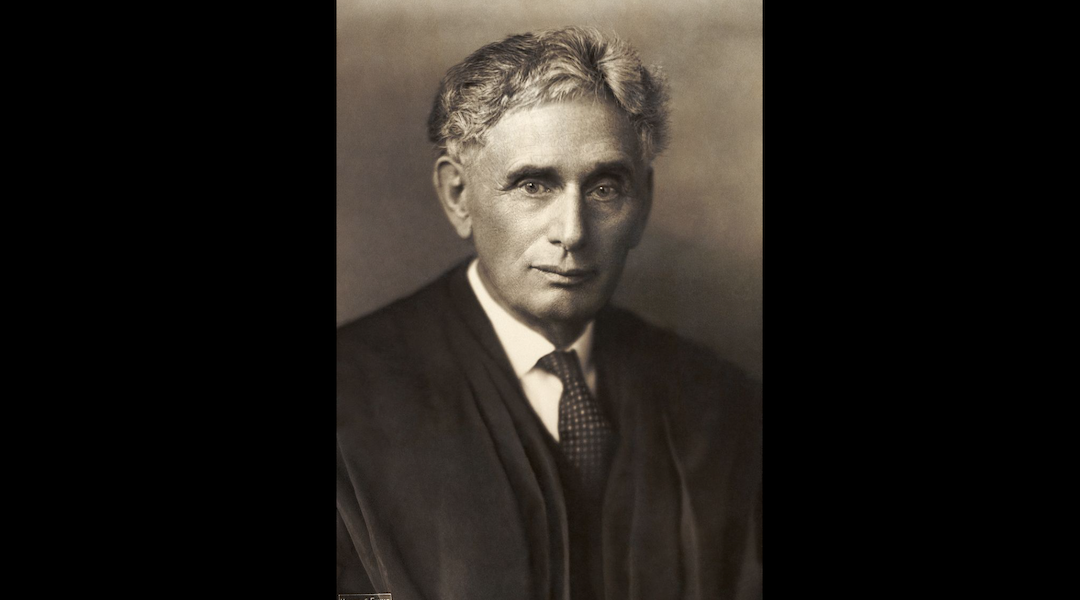
Louis Brandeis, seen here as a Supreme Court justice in 1916, insisted that there was no contradiction between being an American and a Zionist. (U.S. Library of Congress/Wikimedia Commons)
“You don’t need Israel to have the dual loyalty charge,” Pamela Nadell, the American University historian and author of “Antisemitism, an American Tradition,” said in an interview. “Think about the ‘Protocols of the Elders of Zion’ and the idea that Jews are more loyal to their people than to any state, that they are a kind of fifth column.”
In that light, Nadell said, asking a Jewish governor who has sworn an oath to the U.S. Constitution and the Commonwealth of Pennsylvania whether he had ever been an Israeli “double agent” suggested the vetter is either “utterly clueless” or something worse.
“It suggests the interviewer either didn’t understand the weight of what she was saying — or actually believes the dual loyalty charge,” said Nadell.
And yet despite the deep roots of the charge, Zionism and Israel have added new fuel to an old accusation. In the years before Israel’s founding, American Jewish leaders fiercely debated Zionism and whether a Jewish state in Palestine “would imperil our position here,” as the Reform movement’s Pittsburgh Platform put it in 1885.
Thirty years later, Louis Brandeis, the Supreme Court justice and Zionist leader, sought to quash such doubts by asserting, “Multiple loyalties are objectionable only if they are inconsistent.… Every American Jew who aids in advancing the Jewish settlement in Palestine, though he feels that neither he nor his descendants will ever live there, will likewise be a better man and a better American for doing so.”
That proposition was deeply tested in the 1980s, when Jonathan Pollard, a Navy intelligence analyst, received a life sentence for passing classified information to Israel. Richard Cohen, then a columnist for the Washington Post, called the Pollard case a “nightmare-come-true for American Jews. In Pollard, the Israelis created an anti-Semitic stereotype — an American Jew of confused loyalties who sold out his country.”
In his 1996 book “Jewish Power,” J.J. Goldberg cites sources saying that the Joint Chiefs of Staff urged a life sentence for Pollard — the first for an American convicted of espionage — as a warning to the thousands of American Jews working in the federal government.
But despite a vocal “Free Pollard” movement that preceded his release in 2015, most Jews see Pollard as an outlier, and recoil at the idea that ordinary expressions of Jewish peoplehood invite suspicion.
That idea has gained renewed urgency in the post-Oct. 7 climate. A June 2024 ADL study found that 51% of Americans agree with the statement that Jews are more loyal to Israel than their home countries. College students report being accused of caring more about Israel than the United States simply for identifying as Zionists.
In a fact sheet on the dual loyalty charge, the ADL acknowledges that many Jews have an emotional attachment to Israel, citing a 2013 Pew study showing that 87% of American Jews said that caring about Israel is either “essential” or “important” to “what being Jewish means to them.”
“But the observation that Israel is important to many American Jews becomes anti-Semitic when it is used to impugn Jewish loyalty or trustworthiness,” according to the ADL.
Magid has written how Jews sometimes leave themselves vulnerable to the dual loyalty charge, either by claiming that Israel is their true “home” — perhaps a religious assertion that can be heard as a statement of allegiances — or when American Jewish families signal that they’d rather their children serve in the IDF than the U.S. military. “If Jews reflexively claim that the accusation of ‘dual loyalty’ is anti-Semitic, we too easily ignore that it was, and remains, one of the great challenges of Jews in modernity,” writes Magid.
For Rabbi Nolan Lebovitz, the senior rabbi at Valley Beth Shalom in Encino, California, the answer is not to deny dual loyalty — but to redefine it. In his recent book, “The Case for Dual Loyalty: Healing the Divided Soul of American Jews,” Lebowitz argues for embracing Jewish peoplehood alongside American patriotism, calling it a “double helix” binding Jews in Israel and the diaspora. Once Jews accept the notion that they are part of a global people, he writes, there is no contradiction in being loyal to what both America and Israel represent.
“The State of Israel stands as the strongest symbol of Jewish Peoplehood,” Lebowitz wrote in an email exchange. “While the presence of the flag of Israel in our congregation and schools represents the ideal that we are connected to our Jewish brothers and sisters in Israel, the flag also represents the bond that we share with our brothers and sisters in places such as Australia’s Bondi Beach. All American Jews should maintain a loyalty to our country, the United States, and loyalty to our people across the world.”

Jonathan Pollard, right, who spent 30 years in an American prison on espionage charges, bumps elbows with Israeli Prime Minister Benjamin Netanyahu at Ben Gurion Airport near Tel Aviv, Dec. 30, 2020. (GPO)
The historian Gil Troy, who was raised in Queens and now lives in Israel, also insists that loyalty to America and the Jewish people is not contradictory — and that Jews face suspicions not placed on other groups.
“The accusation says much more about the accuser than the accused,” Troy said in an interview. “Which is the oldest story in the book with antisemitism.”
Troy, a senior fellow in Zionist thought at the Jewish People Policy Institute, recalls growing up with the hypothetical question, “If the U.S. and Israel were to go to war, which side would you be on?” His answer, then and now, is “it’s inconceivable.”
“Again and again, although I had to ultimately choose an address, my liberalism, my Americanism, my Zionism, have converged much more than they’ve clashed, and if anything, one has reinforced the other,” said Troy, who moved to Israel in 2010.
Troy’s assertion is similar to that of Ruth Wisse, the Yiddishist and conservative thinker, who in a video last year for the Tikvah think tank said she “never could understand this concept of dual loyalty.”
“It becomes a conflict when the two countries … that you stand for are in conflict,” she said. “But in the case of Israel and America, which share the same basic values, and in fact, stem from very much the same traditions, it’s really a doubled loyalty. The people who feel most loyal to America should be those who feel most protective of Israel, which is the greatest ally that America has, certainly in the Middle East, and possibly … the entire world.”
For now, anyway. For many Jews, cracks are showing in that vaunted relationship, whether it is liberal Jews who warn that Israel is drifting toward the illiberal, undemocratic right, or conservative Jews warning that the Democratic party is being coopted by an increasingly anti-Israel left. (Jonathan Tobin, editor-in-chief of the conservative Jewish News Syndicate, suggested that Shapiro may have told the vetting story in order to distance himself from Israel’s critics and “to save the soul of a party that has been badly compromised by Jew-hatred since Oct. 7.”)
Both sides have looked on anxiously as President Donald Trump has threatened or shredded alliances with other allies around the world.
Whether the questions put to Shapiro were normal vetting, clumsy phrasing or something darker, the reaction to them reveals how fragile the boundary remains between Jewish peoplehood and American belonging. More than 200 years after emancipation promised Jews full acceptance as individuals, the old suspicion still flickers — ready to be rekindled whenever Jewish identity and power become visible at the same time.