

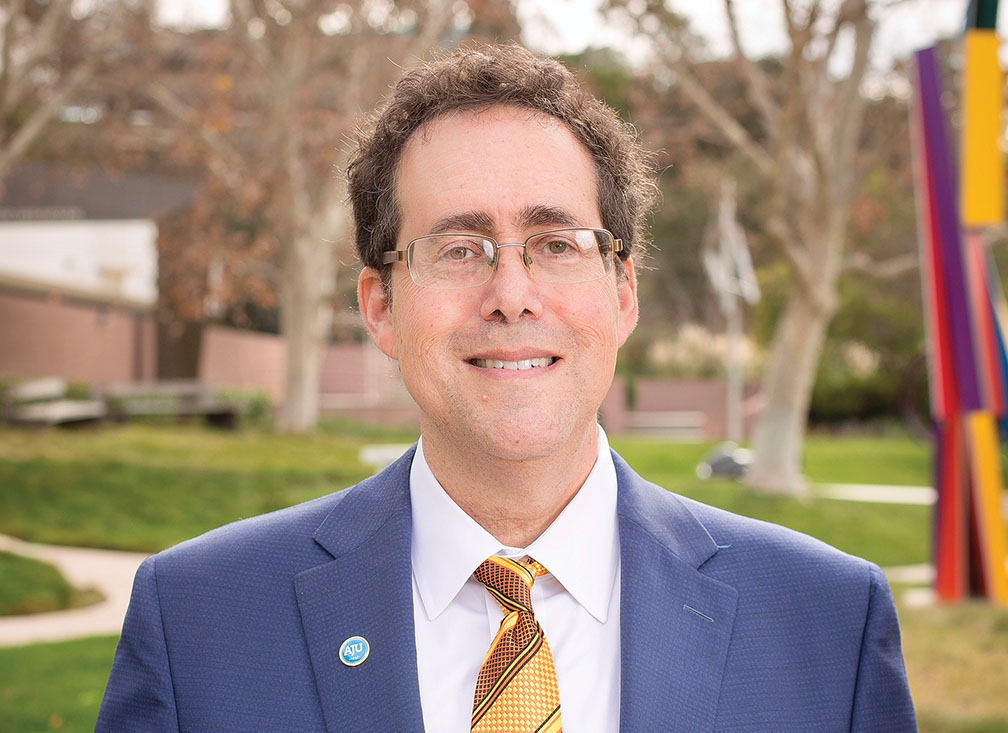
After a quarter century shaping generations of rabbis as dean of the Ziegler School of Rabbinic Studies, Rabbi Bradley Shavit Artson is stepping into a new role at American Jewish University (AJU) — one that reflects both his enduring influence and his forward-looking vision for Jewish life.
AJU has announced that Rabbi Artson will be named the Mordecai Kaplan Distinguished Scholar, effective July 1, a position that places him at the heart of the university’s intellectual, spiritual and public-facing life. Reporting directly to AJU President Jay Sanderson, Artson will serve as a senior partner to the university’s leadership, a guiding Jewish voice across AJU’s diverse programs and a representative of the institution on the national and international level.
“I love to teach, I love to speak, I love to counsel, and that’s what this job will be — all the time,” Artson said during a recent interview at his home in Pico-Robertson. “So, it’s really an invitation to get on the balcony and articulate a broad vision of the ways that Judaism can serve looking forward into the future, and the ways that it can still augment its relevance for a new generation. That feels like an amazing next chapter.”
For Artson, the new role builds naturally on 25 years devoted to teaching, scholarship and Jewish leadership at AJU’s Ziegler School.
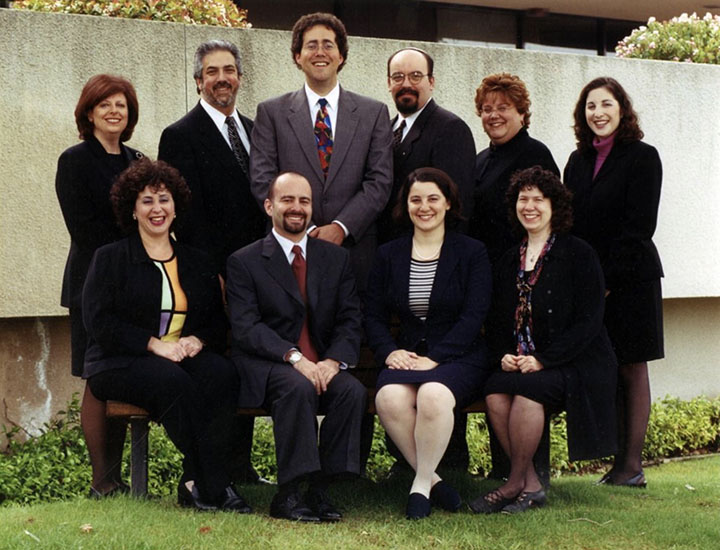
His stepping away from the Ziegler School, a leading seminary for the Conservative movement, to begin this new position as Distinguished Scholar marks a new beginning — not just for Artson and AJU but for the entire Jewish community.
“As we begin a reimagination of American Jewish University and everything we do as both a university and a living laboratory of Judaism, Rabbi Artson is taking a pen and underlining the word ‘Jewish’ in American Jewish University,” Sanderson said. “Brad Artson in this new role, as Mordecai Kaplan Distinguished Scholar, is going to be sitting at every table at AJU, thinking about how we can add more depth of Jewish knowledge, of Jewish learning, in everything we do, no matter who the audience is, no matter what the program is.
“Brad Artson in this new role, as Mordecai Kaplan Distinguished Scholar, is going to be sitting at every table at AJU, thinking about how we can add more depth of Jewish knowledge, of Jewish learning, in everything we do, no matter who the audience is, no matter what the program is.” – Jay Sanderson
“He’s going to be the Jewish conscience of this university as it reimagines itself, which honors his 25-year legacy as the dean of the Ziegler School but also signals that our future is going to be deeply entrenched in what it means to be a Jew for the next generation of Jewish life,” said Sanderson.
As AJU’s leadership works toward this reimagining of the university, it also remains focused on honoring and saluting Artson. On May 19, AJU is feting the outgoing Ziegler dean during a gala slated to take place at Stephen Wise Temple. The event, AJU leadership says, will “recognize both his remarkable accomplishments and this exciting new chapter in his leadership and teaching.”
A Transformational Tenure at Ziegler
Artson has served as dean of the Ziegler School since 2000, making him one of the longest-serving rabbinical school deans in North America. Before joining Ziegler, he served as a pulpit rabbi for 10 years at a Conservative congregation in Mission Viejo, where he helped grow the synagogue’s membership from 200 to 600 families. This was followed by a stint as executive vice president of the Southern California Board of Rabbis. But when Ziegler’s founding dean, Daniel Gordis, made aliyah, then-University of Judaism President Bob Wexler invited Artson to breakfast and made Artson an exciting offer the young rabbi couldn’t refuse.
“I thought, and I think, that if someone offers a rabbi the chance to be the dean of a rabbinical school, there’s only one correct answer to that,” Artson said.
During Artson’s tenure, Ziegler ordained nearly 300 rabbis who serve communities across North America, Europe, Israel and Africa, including Uganda. Today, some of the most dynamic and influential congregations in the country, from Los Angeles to Houston to Washington D.C., have Ziegler alumni.
“I am a rabbi to a great extent because Brad took a chance on me,” said Rabbi Aaron Alexander, spiritual leader of Adas Israel Congregation in Washington D.C. Before taking on the pulpit role in D.C., Alexander, a graduate of the Ziegler School, served as an associate dean at Ziegler, working closely alongside Artson. He said Artson possessed rare gifts and has been both the public face and the “blood running through the Ziegler School. It was pumped from his very unique heart.”
Rabbi Sharon Brous, another close colleague and friend of Artson’s, called Artson a “generational talent.”
“A whole generation of rabbis have been transformed by his teaching, thinking, his theology, by his modeling of the rabbinate,” Brous, senior clergy member of IKAR, said in an interview.
“A whole generation of rabbis have been transformed by his teaching, thinking, his theology, by his modeling of the rabbinate.” – Rabbi Sharon Brous
Under Artson’s leadership, the Ziegler School has expanded its reach, reimagined its curriculum, strengthened its Israel program and become a pioneer in inclusion — welcoming LGBTQ students, dramatically increasing the number of women in the rabbinate and embracing a broader and more innovative vision of Jewish leadership.
Artson has also been candid about how the rabbinate’s demographics have changed during his tenure. Citing a recent, widely-reported study that found 51% of students enrolled in non-Haredi rabbinical programs identify as LGBTQ, he noted that while Ziegler’s numbers are somewhat lower, the impact has been profound.
“We’re not quite at that level,” Artson said, “but it’s a significant number of LGBTQ rabbinical students who have enriched the community and made us better — so I’m very proud of that.”
Norman Levine, a Los Angeles-based attorney who served as chair of the Ziegler School Advisory Committee for four years, said Artson’s effect on the university has been immeasurable. In a phone interview, he called Artson a “great force for good in rabbinic education and the Conservative movement. Because of his leadership, Ziegler has become a model for rabbinic education and produced rabbis serving across the country who’ve really had an impact.”
“I’m looking forward to the contributions he’ll make in this new role with the university,” Levine said.
Artson’s influence is felt just as strongly among rabbinic colleagues. Rabbi Ed Feinstein, emeritus rabbi of Valley Beth Shalom and a longtime adjunct member of the Ziegler faculty, described Artson as both a thinker and a mentor.
“He’s a visionary and a philosopher and a scholar — a visionary as a community leader and a mentor to so many of us,” Feinstein said. “Students, colleagues — we all look up to him. He’s a true believer in the message of Conservative Judaism and the future of the American Jewish community. He’s devoted enormous energy to protecting and sustaining that community, and I’ve learned a tremendous amount from him.”
Feinstein further described Artson as “thoughtful and imaginative” and an “optimistic Jewish leader.” He credited him with building Ziegler into the respected institution it is today.
“The whole vision of the school was Artson,” Feinstein told the Journal. “The vision of a school that takes seriously not only scholarship and preparation but the deep individual spiritual growth of each student.”
Ziegler also emerged as a global force during Artson’s tenure. Artson helped launch the Abraham Joshua Heschel Seminary in Germany, the first Conservative rabbinical school in Europe since the Holocaust. “To stand in Berlin and ordain rabbis felt historic,” Artson reflected. “It felt like a way to fight Hitler.”
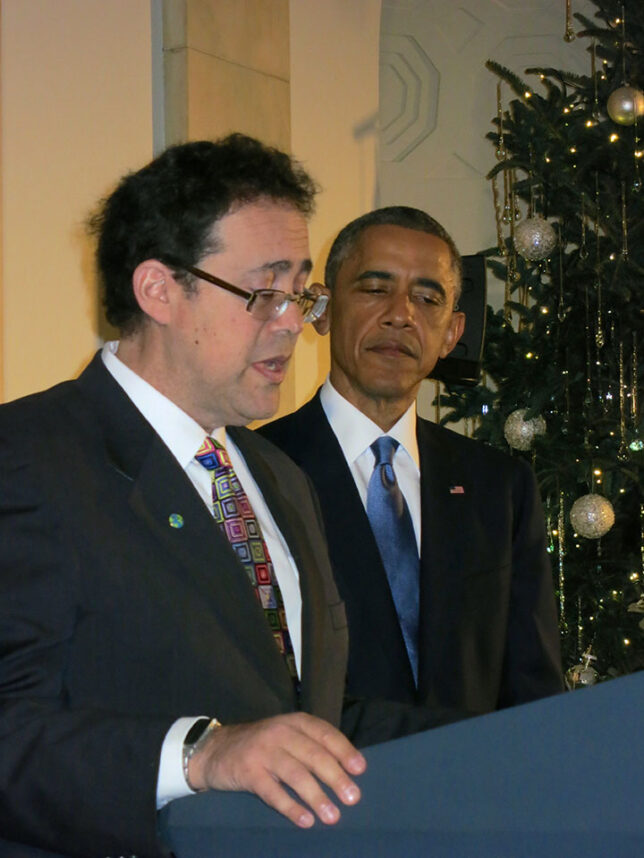
Another defining chapter was Ziegler’s relationship with the Abayudaya Jewish community in Uganda, including the ordination of Rabbi Gershom Sizomu. Artson traveled to Uganda for Sizomu’s installation — an experience he describes as one of the most powerful of his rabbinate. A tiny wooden throne — a memento from that 2008 trip to Uganda — still sits in Artson’s living room today.
Sizomu called Artson “a great teacher with a voice of reason heard in every statement coming out of him, and I admire his clarity in teaching Torah and in explaining the realities of life.”
Beyond institutional leadership, Artson has maintained a deep, visible presence in Jewish life. For more than two decades, he has led High Holy Day services at Sinai Temple, forging relationships that span generations. “I now see people who were once babies bringing their own children,” he said. “It feels like a family reunion every year.”
Rabbi David Wolpe, emeritus rabbi of Sinai Temple, has seen how successful Artson can be in inspiring not just students — but Jews in the pews. The two have known each other since they were enrolled at the Jewish Theological Seminary (JTS), the Conservative seminary in New York. Even then, Wolpe could see Artson’s obvious talents.
“He was always outstanding,” Wolpe said. “There was never any question he was going to be a leading rabbi as far back as when we were students. He has a unique combination of empathy and intellect, which, you know, those two don’t always go together.”
Like many of Artson’s colleagues, Wolpe said that the Ziegler School and Artson have been inextricably linked. “He has been the principal magnet for people coming to the rabbinical school at AJU for many, many, many years,” Wolpe said.
A Scholar Rooted in Judaism’s Moral Vision
Artson’s own journey to the rabbinate began as an undergraduate at Harvard College, where a growing fascination with theology and Jewish thought — sparked by encounters with theologian Franz Rosenzweig and lived religious experience — led him from a promising path in politics to rabbinical school at the JTS.
That intellectual foundation has shaped a prolific scholarly career. Artson earned his doctorate from Hebrew Union College while serving as dean of the Ziegler School and has authored 12 books on theology, spirituality and Jewish ethics, many of which are widely taught and discussed. His forthcoming book, “The Water Wants You to Float,” explores the idea that people already possess what they need to live expansive, meaningful lives.
“In an age of loneliness and anxiety,” Artson said, “Judaism has the solution. We have community. We show up for people in every moment of their lives.”
A New Chapter for AJU
As Mordecai Kaplan Distinguished Scholar, Artson will remain an intellectual force within the denomination as he continues teaching across AJU’s schools and campuses, from rabbinical and educational programs to business and leadership initiatives. He will also continue serving on AJU’s senior staff, helping shape the university’s long-term vision.
The title itself carries particular resonance. Mordecai Kaplan, the founder of Reconstructionist Judaism, championed an evolving, people-centered Judaism — an approach that has animated Artson’s work.
Virginia Maas, a past AJU board chair and current member of the Ziegler School advisory committee, has known Artson for decades. Their collaboration dates back to when AJU conceived of the Intro to Judaism Program, which reconnects Jews with deep Jewish learning and introduces non-Jews to the possibilities of leading a Jewish life. She told The Journal she has always found Artson to be an open, empathetic ear, both steeped in the specifics of the Conservative movement but also not overly ecumenical.
“He’s a great scholar,” Maas said. “He’s thoughtful, bright and respected around the community, the U.S. and internationally as well. People gravitate to him because of his warmth, and I’m confident he’ll be an excellent ambassador in this new role for AJU.”
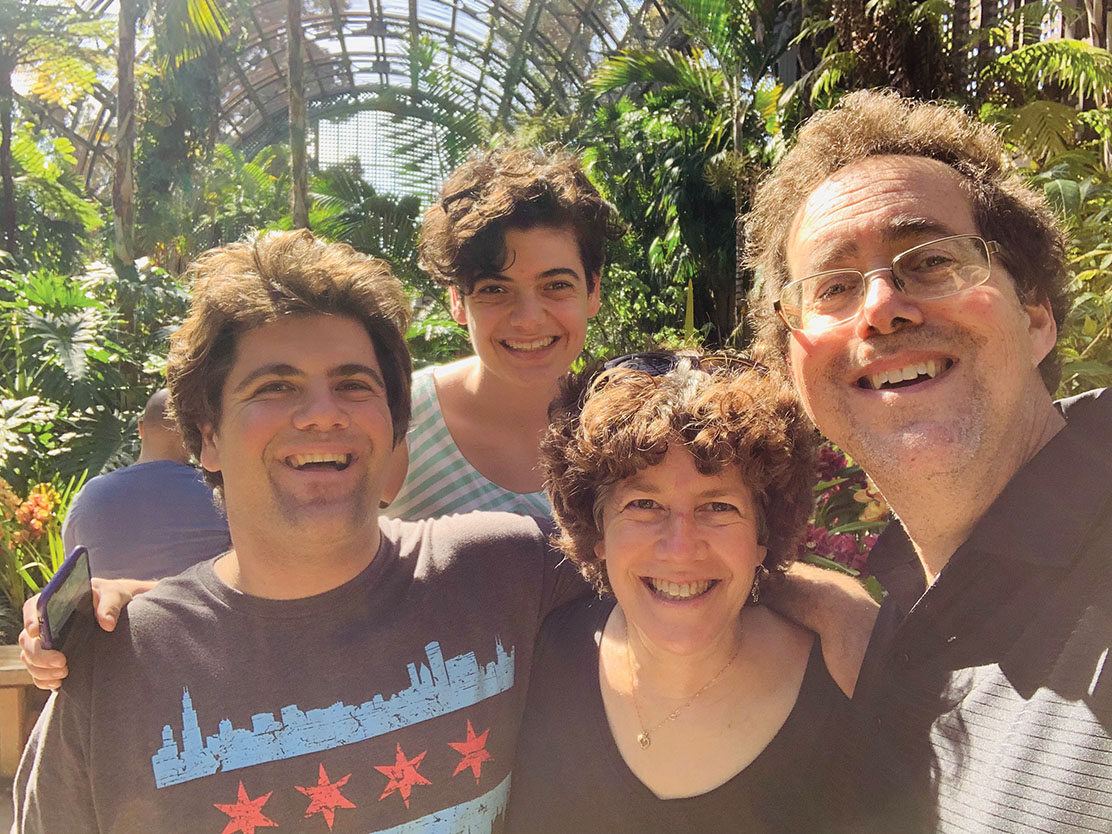
Artson, 66, and his wife, Elana Shavit Artson, have twin children, Jacob and Shira. Shira and her husband, Asher, recently welcomed a baby boy—the Artsons’ first grandchild.
As his family enters a new generation, Artson is also embracing a new chapter in his professional life. He sees the appointment at AJU not as a capstone, but as a new beginning. “Not many rabbis at my stage get invited into a moment of great expansion,” he said. “But that’s what I’ve been invited into—and I’m thrilled to be a partner in shaping what comes next.”
In naming him Mordecai Kaplan Distinguished Scholar, AJU affirms Artson’s lifelong commitment to Jewish thought, peoplehood and possibility — positioning him to help articulate what Jewish life can become in the years ahead.
“I’m very proud of the alumni of the Ziegler School,” Artson said. “I think they’ve made a real difference in Jewish life. I see their creativity and their energy in all kinds of ways, and I forged really close relations with them. And so that feels really beautiful and now feels like the right time to take on the next challenge and let someone else take over.”