
This article was produced as part of (JEWISH REVIEW)’s Teen Journalism Fellowship, a program that works with Jewish teens around the world to report on issues that affect their lives.
In the summer of 2025, Habonim Dror North America, a progressive Labor Zionist youth movement, implemented a new principle, or pillar, welcoming non–Zionist and anti-Zionist perspectives into their summer camp programming.
In response to this decision, Joanna pulled her teenage daughter out.
“I just wanted everybody to feel comfortable that Israel would be supported,” said Joanna, who only gave her first name to protect her family’s privacy. “The reason why we would send her to Jewish camp is to get that foundation and nurture her love of Israel.”
Joanna ended up receiving a refund and sending her daughter to Camp Ramah, a Jewish camp in Colorado affiliated with the Conservative movement.
Others have criticized the new pillar, which Habonim Dror leaders say was meant merely as a statement of inclusion, and not as a repudiation of either the liberal or Zionist principles of a century-old movement whose followers were instrumental in settling and building Israel.
But following the Hamas attacks of Oct. 7, 2023 and Israel’s devastating response in Gaza, many young Jews, including current and former Habonim Dror members, have become increasingly disillusioned with Israel and its government, with some insisting that justice for the Palestinians is not possible if Israel persists as a Jewish state.
The pillar, called “Collective Liberation of the Peoples in Israel-Palestine,” was an effort to acknowledge the pain of these members and let them know they had a place in Habonim Dror, said Lara Dutta, incoming co-chair of Camp Gilboa’s board. Adopted by all six of Habonim Dror’s North American summer camps, it defines “collective liberation” as freedom “from nationalism” in an Israel-Palestine context, aligning it more closely with non- or anti-Zionist political frameworks than with traditionally nationalist Zionism.
“The only thing that [the pillar] says that everybody freaked out about was that we are accepting of all people: Zionist, non-Zionists and anti-Zionists,” Dutta said. “And I don’t think that that’s far from what Habonim has always been, which is a place for everybody.”
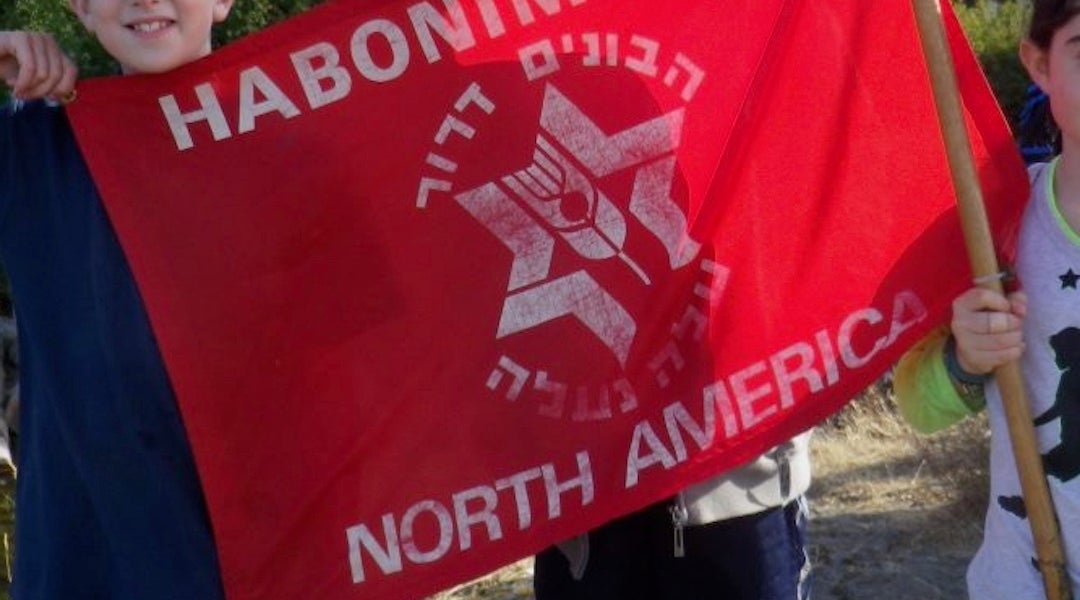
Formed in the early 1980s through the merger of two established Zionist youth movements with roots in Europe, Habonim Dror operates in more than 20 countries worldwide, with its North American branch serving more than 1,500 campers ages 8-17 each year. It has propelled generations of alumni into social justice- and Israel-oriented organizations, where many go on to hold leadership positions. The announcement of the new pillar came just before the summer session began and gave some parents second thoughts about their involvement.
Although initially drawn to the Habonim Dror movement because of its youth-led aspect, Joanna, who lives in Los Angeles, felt concern over the lack of information available regarding the pillar.
“We found out after the last refund date,” she said. “When we had signed up for camp and registered, there was nothing on their website about it. So we didn’t have that knowledge before we signed up for the camp.”
Dutta acknowledged that the timing of the pillar’s announcement was not ideal. “We should have had a better understanding ourselves of the pillar before we rolled it out,” she said.
While Joanna’s was one of only two families that ended up withdrawing their enrollment from Gilboa, concern around the new pillar was not isolated.
After word got out about the change in mid-May, parents circulated a petition to postpone its implementation. The petition, named “Anti-Zionism at Camp Gilboa,” gained 80 signatures in less than a day. The petition has since been removed from Change.org but (JEWISH REVIEW) reviewed an email from the petition organizers who highlighted the “reversal of the camp’s longtime Zionist philosophy” and “last-minute switch in curriculum” as driving reasons for the postponement request.
Habonim Dror campers take part in an annual end of season ritual. Habonim Dror North America runs educational programs at six camps in the U.S. and Canada. (Wikipedia)
Dutta said the petition reflected a “100% misunderstanding of the pillar.” After her conversations with the parent who authored it and a letter clarifying the camp’s commitment to Zionism, it was taken down.
The teens who authored the original pillar did not respond to (JEWISH REVIEW)’s request for interviews. The parents who started the petition declined to comment.
As for the campers within Habonim Dror, the pillar sparked a range of responses as well.
Micah Lotan, a 17-year-old camper from Santa Monica who identifies with Reform Judaism, has attended Gilboa since 2019. He has long connected to the camp’s emphasis on social justice and Jewish values such as hagshama (“actualization”) and avoda (“labor”), as well as its commitment to open dialogue. For him, the pillar was just an extension of that commitment.
“If you think about it, having all forms of thought be equally included seems pretty nice, you know?” Lotan said in regards to the expansive language of the pillar. “Everyone’s allowed to express their opinion, freedom of speech, First Amendment, whatever. Those are both values that I hold very deeply to my heart.”
In terms of the way in which the pillar was implemented, however, Lotan felt there was room for improvement.
In particular, he recalled a camp educational program during which the campers read “The Iron Wall” by Ze’ev Jabotinsky, a right-wing Zionist leader influential in the first half of the 20th century. Historically, Jabotinsky and Habonim Dror sat on opposite sides of the Zionist spectrum, yet Lotan felt that some of the youth staff (known as Tzevet) were drawing on the essay merely to discredit Zionism.
This shift from educational programming toward more ideologically driven messaging was one he noticed in recent years, particularly during the summer of 2025.
“It felt like Tzevet were presenting only certain information on Zionism and trying to form an entire belief system off of that information alone rather than looking at the whole picture,” Lotan said. “It felt like they were cherry picking the information and trying to present [it] in a biased way to have us think a certain way.”
Reflecting on claims of advocacy and bias, Dutta said she “wouldn’t be surprised if that’s the case” since “we don’t have a lot of control over what Tzevet do…There’s no question that Tzevet were excited about the pillar. They may have run with it.”
“Everything that we’re looking at has a bias and everything that we’re looking at is not neutral,” said Gilboa’s youth education director Gigi Weisberg regarding Lotan’s concerns. “So I think that it’s actually a positive thing that [campers] are questioning what their Tzevet says because we’re not perfect. We’re all youth just trying to figure out how to run a camp.”
Dutta added that the pillar was also a way for the movement to acknowledge the growing divergence between its progressive values and the current right-wing Israeli government. The intention behind the pillar, she observed, was to take a moral position rather than a political one. “[The youth staff] are seeing it through the eyes of morals, like, ‘we’re Jewish. We believe everyone has a right to freedom. People are dying — who cares what the politics are?’”
Habonim Dror has always educated youth on the liberal side of Zionism, which believes in a Jewish state but also calls for accommodation and justice for Palestinians living in territory controlled by Israel.
Especially since Oct 7, as leftist critiques of Zionism and Israel have grown louder, some in the movement have been challenging its Zionist principles.
“[The pillar] is making room for people who don’t know what to do with the pain,” said J.J. Goldberg, editor emeritus of the Forward and an author who has chronicled Habonim’s history for decades.
“This pillar is kind of a desperate attempt to stay inside the Jewish people’s consensus while still being this movement of chaverut [comradeship], this intense community that it is,” Goldberg said. “It’s almost like a distilled capsule of what’s going on in the Jewish community at large. You’ve got two warring factions, and there’s very little communication between them. And here’s Habonim, that is almost alone, looking for a way to bridge them.”

Members of the Dror Habonim youth movement in the Indersdorf displaced person’s camp, Nov. 29, 1946. Habonim and Dror, separate movements before their merger in the early 1980s, were closely associated with Zionist activism in Europe and the subsequent building of kibbutzim in Israel. (Ghetto Fighters Museum Archive)
At Gilboa, the pillar also reshaped the camp’s atmosphere in a more positive way. Dori Bachrad, a 16-year-old camper from Los Angeles who identifies as non-denominational, appreciated changes brought to the educational programs.
“They just brought us a new kind of comfortability with staff members and kids and just, like, no conversation is off the table and reassurance that all voices are heard and welcome,” she said.
In her eight summers at Gilboa, Bachrad said the staff encouraged different ideas and kept a hands-off approach during most programs. “[This year] there was just generally a lot more conversation, a lot more feelings, a lot more tension,” Bachrad said. “But I think if there’s anywhere for that to happen, it’s Gilboa.”
That tension was reflected in an incident where the “Zionism log” in a camp log circle — a traditional installation in which each log represents one of Habonim Dror’s pillars — was removed by a staff member overnight.
“They just, like, took the log away in the middle of the night. We literally woke up one morning and the Zionism log was gone, and we were like, ‘Hello, this is kind of crazy’,” Lotan said.
Bachrad believed that the backlash over the log removal came from people attached to the Zionism pillar who were concerned about the introduction of the new one.
The traditional Zionist pillar and the new one “are meant to coexist,” she said. “They’re not meant to be mutually exclusive whatsoever and I think that people were upset because they felt that the new pillar was replacing the Zionism pillar in a really inappropriate way.”
For campers in another Habonim Dror camp, however, the new pillar wasn’t mentioned at all. Eliana Wallach, a 17-year-old New Yorker who identifies with Reform Judaism, had never heard of the pillar before. “I don’t know, I just think that it’s interesting that, like, I had no idea that this even existed,” said Wallach, who attended Camp Moshava in Hartford County, Maryland.
Wallach, Bachrad, and Lotan all noticed differences in the programming throughout Habonim Dror post-Oct. 7. Bachrad and Lotan noted both tension and polarization as well as deeper understanding and meaningful results, with Bachrad calling the experience a “double-edged sword.” For Wallach, it was “just different”, as she mentioned hearing from friends that the guided discussions were “less ‘Israel yay’ and more ‘Israel wrong.’”
For Bachrad, however, this tension was a natural result of aiming for change. “The discomfort is definitely a valuable part of the experience and is kind of something we know is going to happen and that happens for a reason…If we wanted to just have easy conversations we would.”
Despite referring to the summer as the most polarized of any year she had attended, Bachrad was firm in her belief that political programming belongs in Jewish summer camps as a form of “acceptance and community rather than tension and animosity.”
For Dutta, the biggest takeaway from the pillar’s first year was that the adults of Habonim and the youth camp members have very different definitions of what Zionism means. While she personally understands it as Jewish self-determination alongside Palestinian self-determination, she noted that others associate the term with Israel’s occupation policies or locate its moral rupture in different historical moments, making it a term she finds increasingly imprecise without clarification.
As a result of this, Camp Gilboa started a language committee to make sure that the organization is on the same page when using politically charged terminology. Currently this committee is specific to Gilboa, but Dutta hopes it will be taken up by the other Habonim camps.
“The lesson from what happened after the [new pillar] was that we have to do a better job explaining to parents what Habonim is,” Dutta said. “This isn’t just summer camp. There is a robust thing that can happen if your kid chooses to go this route.”