
The first time I saw swastikas in my local park, they stopped me in my tracks. But now antisemitism has become a daily occurrence, so common and brazen that my shock has diminished. Two Israeli Embassy staffers were murdered with 21 bullets. In Boulder a group of older Jewish women were set on fire by a man shouting “Free Palestine,” with one dying later in the hospital. Two Jews were killed attending a Yom Kippur service at a synagogue in Manchester. Then came the horrific massacre on Bondi Beach at a Chanukah celebration, where two gunmen murdered 15 and sent 40 others to the hospital. In Canada, Jewish schools have been the target of multiple drive-by shootings. These violent attacks come on top of increasingly violent rhetoric: Kanye released a song praising Hitler, and early this month, protesters outside a synagogue shouted “Say it loud, say it clear, we support Hamas here.”
For Jews, the rising Jew-hate is chilling. Yet many of my colleagues and friends don’t see it. Or worse, they excuse it. “He just let his hatred of Israel go too far,” my friend of seven years and former officemate told me after Karen Diamond was murdered in Boulder. She said, “I do not agree that this is simply hatred toward Jews.” After the murders in Manchester, she only replied with photos of starving Palestinians to my post of the attack. The message was clear: Murdered Jews in the diaspora are at best irrelevant, at worst excusable.
As an astrophysics professor, I teach classes on the wonders of the universe. Working in the physical sciences insulated me from antisemitic libels that had crept into academia over the past several decades. I’m embarrassed that the explosion of Jew-hate in the last two years took me by surprise. How worried should we be? How quickly does anti-Jewish rhetoric and libel lead to vandalism and violence?
I posed these questions to Irene Kurtz, a 97-year-old Holocaust survivor in Toronto. Irene remembers the antisemitism in 1930s Poland, when it built gradually enough that many Jews didn’t panic. Her parents had had the opportunity to move from Poland to Russia, but the hassle didn’t seem worth it. They stayed, never imagining that they and 90% of Polish Jews would soon be murdered.
I met Irene for Shabbat dinner, after we both heard the news. That morning, for the third time this year, a Jewish girl’s school had just been shot at in Toronto. Girls aged four to 14 attend Bais Chaya Mushka Elementary School—the same age Irene had been in Poland.
Irene grabbed my hand, “You can’t forget.” The hum of her hearing aids lilted in the background. “I don’t like what I’m seeing. It reminds me of the time before the war.”
“I won’t forget. I’ll tell your story,” I promised her.
“It’s not enough to know about it,” she pleaded. “You have to do something.”
I don’t know what to do.
I feel powerless. Hopeless. Bais Chaya is not the only Jewish school in Canada that has been shot at since Oct. 7, 2023. Belz YK and Talmud Torah followed. Yeshiva Gedola in Montreal was hit twice in one week.
How would you tell your kids? There’s been another shooting, but it’s okay to go to school today. Bais Chaya opened that morning as planned.
Likely these shooters would not have wanted Irene to survive the extermination camp Majdanek, nor to be a refugee to Israel after liberation. Irene’s entire family was murdered, save two brothers who had escaped to Russia a few years before the war.
“I cannot tell you what I saw in Majdanek,” she said as we tore challah. She spoke often of the hunger. That night there was so much food—hummus, tabbouleh, mushroom strudel, chicken schnitzel, and more. My favourite was our host Annie’s rich bone marrow soup. Annie’s mother and aunt were the only survivors in her family.
“I don’t know how I survived,” Irene said.
I don’t know either. In the Warsaw Ghetto, rations were eventually restricted to a mere 180 calories per day, roughly two tablespoons of peanut butter. In the first year in Warsaw alone, more than 90,000 Jews died of starvation and disease. After deportation to concentration camps, even those not selected for immediate extermination survived an average of just two months.
I once read a diary from the Łódź Ghetto describing the intense hunger Irene spoke about. The entry on Aug. 19, 1942 reads: “There’s no food. I feel faint. … My child is asleep, emaciated, flies swarming on his lips. I am afraid he wakes. I have nothing to give him … I can’t feel my arms and legs, but the end isn’t here yet.” The next day she wrote, “In a moment of frenzy I wanted to eat both servings, I must leave the food for my child, God don’t abandon me.”
Twenty days later she and her son were murdered in the Chełmno extermination camp. The shards of victims’ bones still surface there after heavy rain. Was it hers I picked up for burial when I was there?
I asked Irene that night, “How fast did it happen? How fast did it go from schoolyard bullying to mass murder?”
I keep asking this question because in 1938, over 70% of Germans opposed Kristallnacht, yet most said nothing. A few years later people had changed their minds or no longer cared enough to object to the escalating violence against Jews. A few years ago, 26% of people globally believed at least six antisemitic tropes. Now it’s 46%.
I keep asking this question because in 1938, over 70% of Germans opposed Kristallnacht, yet most said nothing.
Bondi Beach wasn’t about gun laws. It was normalized Jew-hate. It’s no surprise that the hate feels relentless to Jews. What’s surprising is how invisible to it remains to most of my friends and colleagues. In 2024, one Toronto synagogue was vandalized eight times in nine months. Ten people were injured in a self-described “Jew hunt” in Amsterdam. Governor Shapiro’s house was set on fire while his family was inside during Passover. In Melbourne, a synagogue was burned down during morning prayers. In January, Beth Israel synagogue in Mississippi was set ablaze, a repeat of a Ku Klux Klan attack in 1967. Eight elderly Jews in Boulder were attacked with a flamethrower.
Burning attacks are a common theme against Jews. In Warsaw in 1943, Irene fled a bunker into a burning building. Stella, a family friend, pulled her out through a window. Outside they faced the barrel of a gun. The Nazi soldier pushed them toward the Umschlagplatz, the train station, with thousands of others to be deported in packed cattle cars. When guards tried to take Stella’s two children away from her, she clung to them. The soldier shot her and both children on the spot in front of Irene.
Irene still feels responsible. Stella appears often in her stories. After telling them, Irene can’t sleep. Still, she keeps speaking.
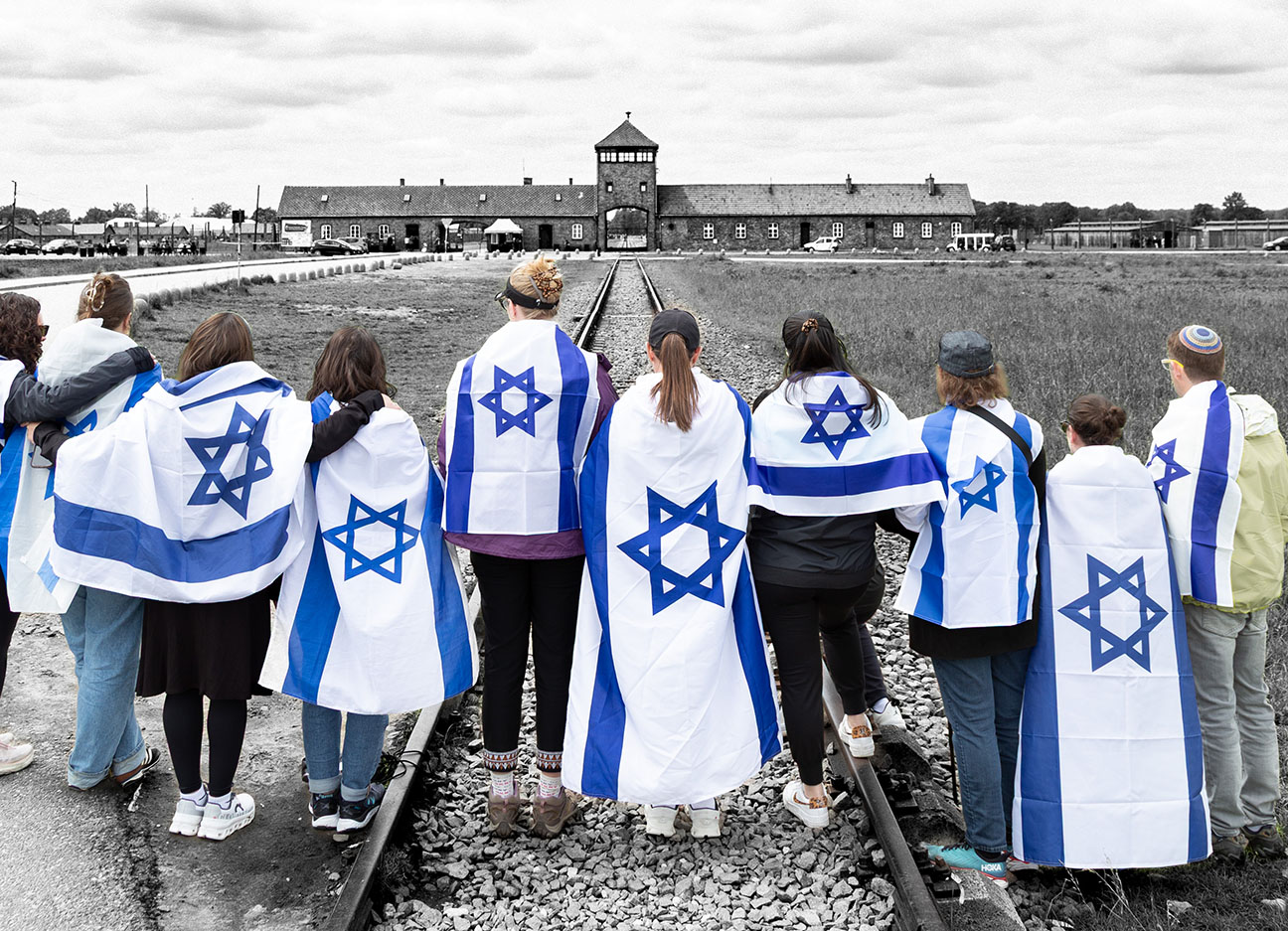
Last May, I went to Poland with two Holocaust survivors. Irene had planned to come but felt too unwell. But I needed to see the earth where Irene slept, where she survived.
Irene lived in the Warsaw Ghetto from age 12 to 15 before being transported to Majdanek. She was lucky, selected to work rather than be gassed immediately. But the barracks weren’t ready. The Nazis left them outside with no food or water for days. Irene survived by rainwater, and she slept in the cold and mud. Each day she woke up to death.
Eventually the barracks were ready, but food was a mere fraction of subsistence—one chunk of bread and a bowl of thin soup per day. Irene tried to eat grass.
Irene recalls that right after they arrived in the barracks, she heard the sharp sound of a whistle.
“Juden, raus!” Jews, out!
She was forced to leave the shelter to stand in the cold rain for hours.
By that time, Irene’s mom and sister had been murdered. Irene heard in the camp from former neighbors that her dad was nearby in Lublin. He would watch the trains, looking for her and she regrets she missed her last chance to see him.
Eventually, Irene was transported out of Majdanek to a factory to make bullets for the Nazis, so they could kill more Jews.
Five months later, during Operation Harvest Festival, the Nazis shot 42,000 Jews in just two days. Himmler ordered this killing spree to exterminate all remaining Jews in the Lublin district. The Nazis forced the prisoners to dig mass grave trenches and then had them lie in a row before being shot. For maximal sardine packing efficiency, the next prisoners had to lie on top of the bodies already in the trenches. Repeat. Repeat. Repeat.
Irene doesn’t know when her dad died, but I wonder if he was murdered in this slaughter festival.
Not everyone died immediately. A few survivors from other mass grave sites said people tried to claw out, but the pressure and suffocation killed them in the end. Operation Harvest Festival is the single largest slaughter of Jews in the Holocaust in a single day, with 18,400 murdered in the first evening alone.
At Auschwitz, I saw 40,000 pairs of shoes in a huge pile. These are just one week’s worth of shoes from the gas chambers. In 1944, the Nazis murdered over 400,000 Hungarian Jews in just 56 days. The war was already lost. Still, the order stood: “All Jews without exception are subject to liquidation.” The scale is unfathomable.
In the next room lay hair shaved from the dead—black, blonde, red, brown. In most camps, hair was shaved before the gas chamber to dehumanize. In Auschwitz, bodies were shaved after death. Less fuss that way. Zyklon B poison still clings to the strands as testimony.
Irene risked her life repeatedly to save others. She once faced reselection, risking torture and certain death, to save her friend Franka. Both survived.
At dinner, I tell Irene, “You are the bravest person I know. By far.”
I keep coming back to this question: How long did it take for Jew-hate to become normal and acceptable? The change seemed slow and then all at once.
Am I overreacting? Some friends think so.
“What antisemitism?” an acquaintance asked in a group chat. “Has there been a rise?”
He was responding to a Jewish friend who had said, “It’s scary to be a Jew right now.”
Someone else replied “It’s just the ADL inflating the numbers.”
“Yeah, look at this report, many are not real instances of antisemitism.”
“Antisemitism is being weaponized.”
None of the speakers were Jewish.
How did they not know? FBI hate crime statistics show that anti-Jew hate per capita is more than anti-Muslim, anti-Arab, and anti-Black hate combined. FBI doesn’t include incidences of discomfort; these are hate-motivated crimes. This group text exchange disturbed me enough that I spent several hours constructing a reply. I limited it to things I had seen personally or that had happened in Toronto. I drafted:
“During walks in the ravine by my house, I’ve seen dozens of hostage posters defaced with swastikas and drawn in the snow on campus. All disturbed me, but the worst was the swastika painted over the 9-month-old infant hostage’s head. A Hamas red triangle (signifying their next target) was on a sign outside my building. Someone scrawled “Fuck Kykes” on a nearby bus stop. In a public statement, students at YorkU said the October 7 attacks on civilians were ‘justified and necessary.’ Those words have rung in my ears every day since. I’ve seen Jews likened to parasites in a post that echoed 1930s Nazi era. A Jewish deli was burned down in Toronto. The list goes on. I’ve read similar instances in the UK, the US, and Europe. Like any hate crime, many are unreported. Did I report each instance? No. After the first couple of swastikas I didn’t bother. There were too many.”
Before I could reply another person, a non-Jew in the group, added his own observations of rising antisemitism. Immediately the group attacked and dismissed him. He was accused of being manipulative, misleading, and dishonest.
The Jew who’d made the original statement said, “Horrible group. I’m out.” I stayed silent and never sent my message. I am a coward. I don’t see the point.
In the 1930s and 1940s, signs in Europe told Jews to go back to Palestine. Today, I see signs telling Jews to go back to Europe.
Juden, raus!
After three non-Jewish friends posted questionable things, I reached out to them for one-on-one conversations about my fears of unchecked Jew-hate. One exchange goes well. One goes so-so. One goes horribly. All take hours.
As a professor I know many students I teach don’t know about the Holocaust. In the days of TikTok, misinformation and Holocaust inversion, history is being erased. Sixty-three percent of millennials and Gen Z don’t know that six million Jews were murdered. More disturbingly, 11% believe the Jews caused the Holocaust. Even in 2018, nearly one in five Europeans said antisemitism was a response to the everyday behavior of Jews. One of my friends told me that the sexual assaults of Oct. 7 were debunked, and that Jews focus too much on the Holocaust.
As a professor I know many students I teach don’t know about the Holocaust.
Last year on Holocaust Remembrance Day, I posted a video from Auschwitz, and trolls flooded my account. One wrote under an unrelated workout video: “Your arms look like soap 😂.”
I am not afraid of gas chambers returning. But Jew-hate always reinvents itself. Each generation convinces itself that this time it’s justified. That it’s not about Jews, just the “Zionists.”
Yet when Jews are murdered thousands of miles away, people invariably make it about something else, anything other than Jew-hate.
That is the reason I went to Poland before the remaining survivors are gone. Jewish history is being erased and rewritten to suit a new antisemitic narrative.
During my visit to the death camps I heard stories, many too graphic for me to bear writing. They combine with stories Irene told me. I’ve now met many other Holocaust survivors to hear their stories while they are still with us. Sometimes when I wake in the darkness of night, all those images come back. I carry them now. It’s a long time before I can fall back to sleep. I can’t imagine Irene’s nights.
“You can’t forget,” she tells me again.
I know. People are forgetting. Or worse, co-opting, inverting.
“It’s not enough to know, you have to do something.”
But what? I don’t know what to do.
She grips my hand tighter and says, “All we have is Israel, Israel, Israel.”
For how long?
Juden, raus!
Sarah Rugheimer is Chancellor’s Fellow at University of Edinburgh and an Associate Professor at York University in Toronto in astrophysics.
Living Legacy partners with JRoots to take Toronto Jews to Poland with a living Holocaust survivor. If you enjoyed this essay, please consider a donation to the Living Legacy. To order Irene Kurtz’s memoir, “Sound of the Whistle” click here.