
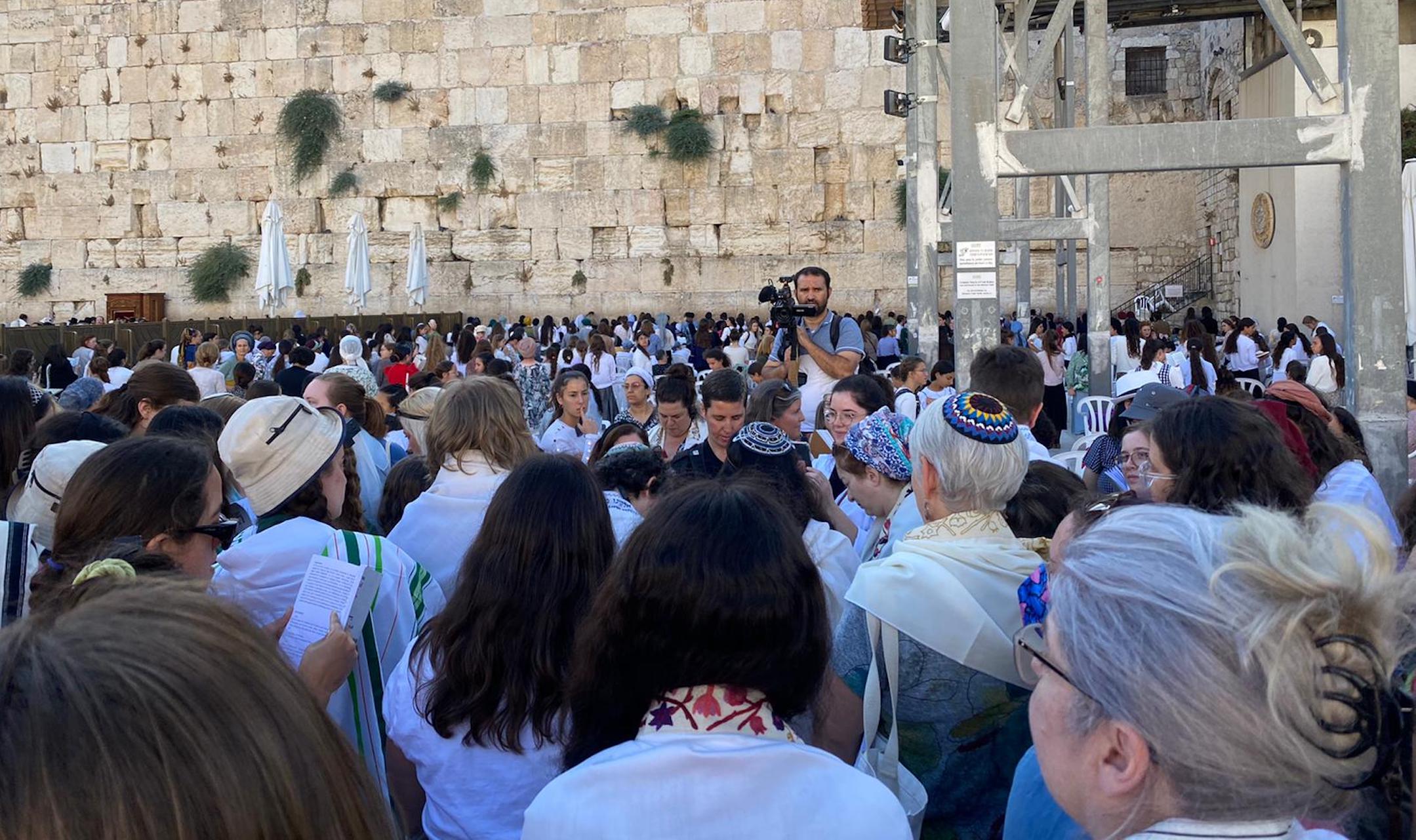
JERUSALEM — Israeli police detained two Women of the Wall activists on Wednesday morning after their monthly Rosh Chodesh prayer service at the Western Wall was disrupted by demonstrators, escalating tensions at the Jerusalem holy site a day after the High Court of Justice heard petitions accusing the government of stalling upgrades to its egalitarian prayer section.
Police said the women — Yochi Rappaport, Women of the Wall’s chief executive, and Tammy Gottlieb, vice chair of its board — were detained on suspicion of obstructing access at a security checkpoint, an allegation Women of the Wall denied.
The detentions came a day after a rare, seven-justice hearing at Israel’s High Court of Justice in response to petitions by the Masorti Movement, the Reform Movement and Women of the Wall that have been pending for years. The groups are challenging the government’s delay of promised infrastructure work to the egalitarian prayer section known as Ezrat Yisrael.
The case has become a proxy battle over who controls prayer at Judaism’s holiest site, whose main plaza is essentially run under strict Orthodox supervision, and whether Israel will deliver on the decade-old compromise meant to accommodate non-Orthodox worship.
Judge Dafna Barak Erez questioned why, if tensions persist at the main northern plaza, authorities have not ensured that the egalitarian section is properly developed. Lawyers for the state and the Jerusalem Municipality blamed each other for years of delays of the promised compromise. Government representatives argued that certain planning and construction steps fall under municipal authority, while city officials pointed to the state’s role in advancing and funding the project.
The petitioners alleged discrimination at the site, saying that dozens of Torah scrolls are made available for use in the men’s section while none are accessible to women. The Western Wall Heritage Foundation, which oversees the plaza under Orthodox guidelines, bars visitors from bringing private scrolls into the compound. Women of the Wall’s monthly services have long drawn confrontations, both from protesters and from Western Wall Heritage Foundation staff, including efforts to intercept Torah scrolls the group brings in, sometimes carried discreetly in bags.
Yizhar Hess, vice chairman of the World Zionist Organization and a senior representative of the Masorti movement, accused the state and the municipality of “mudslinging” at the hearing.
“They are playing a game. Each one is taking this hot potato and pushing to the other. They could have solved it in one telephone call between the prime minister and the mayor,” he said.
Hess said the delays were not bureaucratic but political, arguing that the government has avoided implementing the compromise to preserve a fragile coalitionand avoid confrontation withharedi Orthodox parties that oppose formal recognition of non-Orthodox prayer at the site.
“It never happened because of a reason,” he said. “They prefer the extremists of the government.”
Hess said the Reform and Conservative movements had made a “huge concession” in accepting the 2016 arrangement that left the main Western Wall plaza under Orthodox control, in return for a formalized egalitarian section, but that the state has reneged on its commitments.
The impasse is widening Israel’s rift with Jewish communities abroad, he said. “Instead of celebrating the fact that so many millions outside of Israel, millions that are associated with the two liberal movements, are yearning to celebrate Jerusalem, the government of Israel is doing whatever it can to create damage and not to solve something that so easily could be solved.”
The justices did not issue an immediate ruling at the conclusion of the hearing but are expected to do so within the next few days.