
At first glance, “Papillon” (Butterfly), the 15-minute Oscar-nominated animated short by veteran French filmmaker Florence Miailhe, may appear like a meditative journey through water and memory. An elderly man swims in a hand-painted sea, flashing back to childhood memories of being bullied and a loving mother who makes it all right.
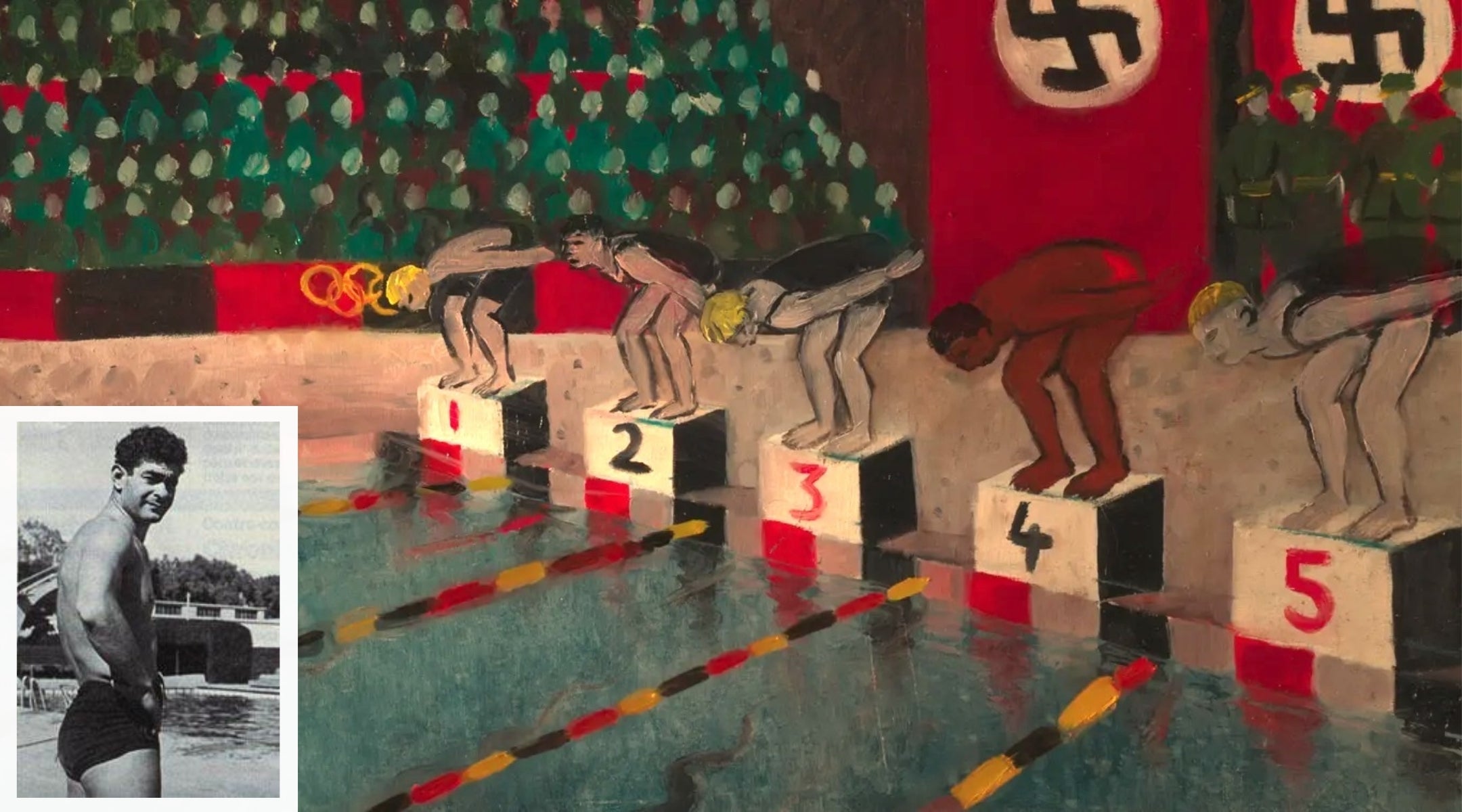
As he cuts through the water and moves through time, the fuller context emerges: The sun-soaked beaches appear to be North Africa, the boy becomes a champion swimmer, a swastika tells you that he is competing in the 1936 Berlin Olympics, and the soundtrack echoes with taunts of “Jew” and “kike.”
The film is based on the extraordinary real life of Alfred Nakache, a Jewish athlete whose story of resilience under Nazi persecution has previously been told in two French documentaries but is seldom remembered today.
Born in 1915 in French Algiers (his family immigrated from Iraq), Artem “Alfred” Nakache became one of France’s most celebrated swimmers in the 1930s, specializing in the butterfly stroke — a full-bodied lunge that looks like a bird, or butterfly, in flight. His success brought him to the 1936 Berlin Olympics, where he competed under the shadow of rising antisemitism in Nazi Germany (and was part of a freestyle relay team that didn’t medal, but finished ahead of the Germans).
Under Vichy, the Nazi puppet regime, Nakache was stripped of his French nationality and forced out of Paris. He joined the resistance underground while still competing for Vichy. On Nov. 20, 1943, Nakache and his wife and daughter were arrested by the Gestapo, and the family was separated at Auschwitz. Only Alfred survived. He later endured the death march to Buchenwald before liberation.
Despite these unimaginable losses, Nakache returned to swimming after the war, competing at the 1948 London Olympics. (He, gymnast Agnes Keleti and weightlifter Ben Helfgott are the only known Jewish survivors to have competed in the Olympics after the war.)
Nakache remained a swimmer the rest of his life, and died of a heart attack after a swim in the sea near the Spanish-French border in 1983.
Miailhe, a 70-year-old animator known for her labor-intensive oil and pastel on glass technique, has a personal connection to Nakache’s legacy. As a child, she took swim lessons with his younger brother Bernard and heard stories of his triumphs long before she understood their full historical weight. The end credits explain that her father also knew Alfred, whom he met in the resistance during the war.
“I hope people will be moved by Alfred Nakache’s story and rediscover it, because it’s not well-known in France,” Miailhe said in an interview with Deadline. “Also, we are living in some very troubled times in a world where racism and antisemitism are back.”
Produced by Oscar-winning animator Ron Dyens alongside Luc Camilli for Sacrebleu Productions and XBO Films, Papillon took roughly 100 days to animate — a testament to the craftsmanship that makes every frame an essay on the various qualities of water. The film has earned a César nomination (the French Academy Award) and a nomination at the Annecy International Animation Film Festival, and won the International Competition for best animated film at the Grand Prix at Stuttgart.
Amid the horrors of the Holocaust, the animated short also depicts the camaraderie among the athletes who swam — and stood — by Nakache’s side before and after the war.
“Some people denounced the Nakache family [to the Gestapo], but others saved Alfred when he returned from the camps,” Dyen told Deadline. “The whole tragedy of human duality is ultimately reflected in Nakache’s story.”