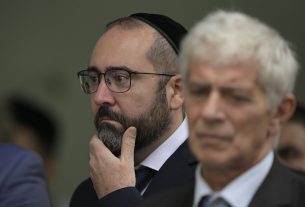

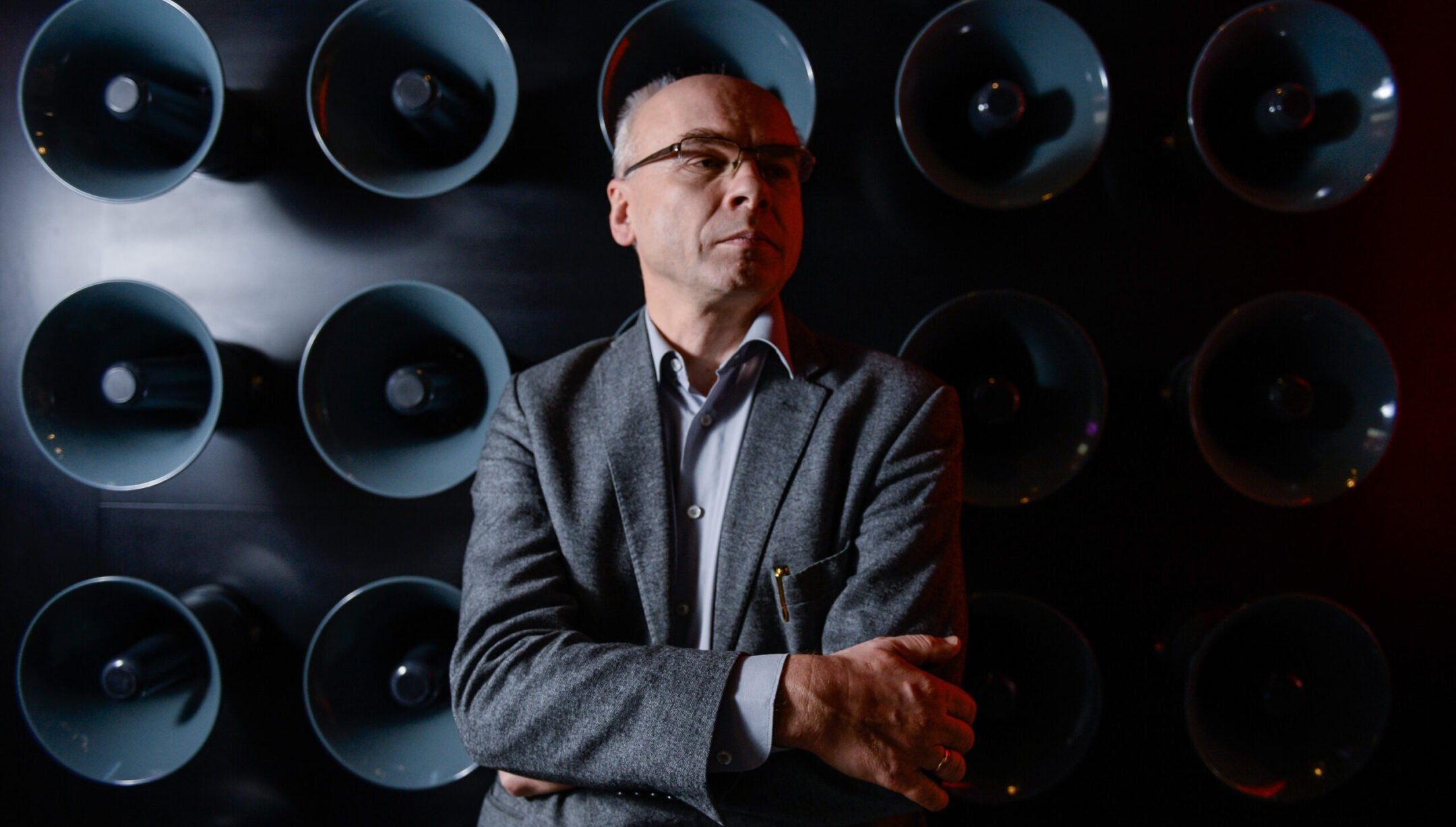
The first director of Poland’s leading Jewish museum, squeezed out seven years ago by a nationalist government, is returning to the helm in a symbolic reversal.
Dariusz Stola steered the Polin Museum of the History of Polish Jews in Warsaw from its founding in 2014 to become a breakthrough in Poland’s recognition of its extinguished Jewish past.
But he clashed with the right-wing Law and Justice party, which governed Poland from 2015 to 2023. The former culture minister accused him of “politicizing” the museum through explorations of antisemitism in Poland, and in 2019, he was pushed out despite winning a competition to extend his tenure.
Now, Stola has been reinstated by the new culture minister Marta Cienkowska, who was appointed in 2025 by centrist Prime Minister Donald Tusk. His new term begins on March 1.
“In 2019, the then minister [Piotr] Gliński decided to ignore the results of the competition,” Cienkowska tweeted. “That appointment should have taken place six years ago. Dear Professor, good luck.”
Dariusz Stola receives the appointment as the Museum of the History of Polish Jews’ director from Marta Cienkowska, the Polish minister of culture and national heritage, in February 2026. (Danuta Matloch/MKiDN)
Stola, a historian of Polish-Jewish relations and professor at the Polish Academy of Sciences, called his return to Polin “a victory of justice and rule of law.” When he was not reappointed in 2019, he chose to withdraw so that his deputy director Zygmunt Stępiński could take over. Stępiński will once again be his deputy.
“This confirms that the strategy we took in 2019 was right,” Stola said in an interview. “I lost only temporarily, and we have preserved the autonomy of the museum despite heavy political pressure.”
The Law and Justice government has made controlling Polish-Jewish history a core part of its platform, promising to revive Poland’s pride in its past and eradicate a so-called “pedagogy of shame.” That narrative stifled research on Polish antisemitism and Poles who killed Jews during and after the Holocaust.
Stola drew particular ire from party officials with a 2018 exhibit that documented Poland’s state-sponsored antisemitic campaign of 1968, which purged Jews from their workplaces and forced about 13,000 to emigrate. Former culture minister Piotr Glinski said afterwards that Stola imposed “very aggressive politics” on the museum.
In 2018, the country passed a law that outlawed accusing Poland or the Polish people of complicity in Nazi crimes. The infraction was later downgraded from a crime punishable with prison time to a civil offense, but critics say it had a chilling effect on historical research.
Stola’s reinstatement represents a gradual shift back to investigations of Polish-Jewish history, across cultural and academic institutions, that were dashed by the previous government. Only in the 1990s, after the Soviet Union fell, did Poland begin efforts to reconcile with the murder of 3 million Jews there and the intertwining of Jewish and Polish history.
Though a centrist coalition led by Tusk has governed Poland since 2023, Law and Justice clawed back a sweeping victory with the election of Karol Nawrocki as president last year. Nawrocki, a right-wing historian, has played a crucial role in the party’s efforts to rewrite Poland’s Holocaust history — making Stola’s reappointment a rebuke of the country’s largest political party by its governing coalition.
“The mission of the museum is even more important today, in the face of the dark forces distorting the memory of the Polish-Jewish past,” said Stola.