

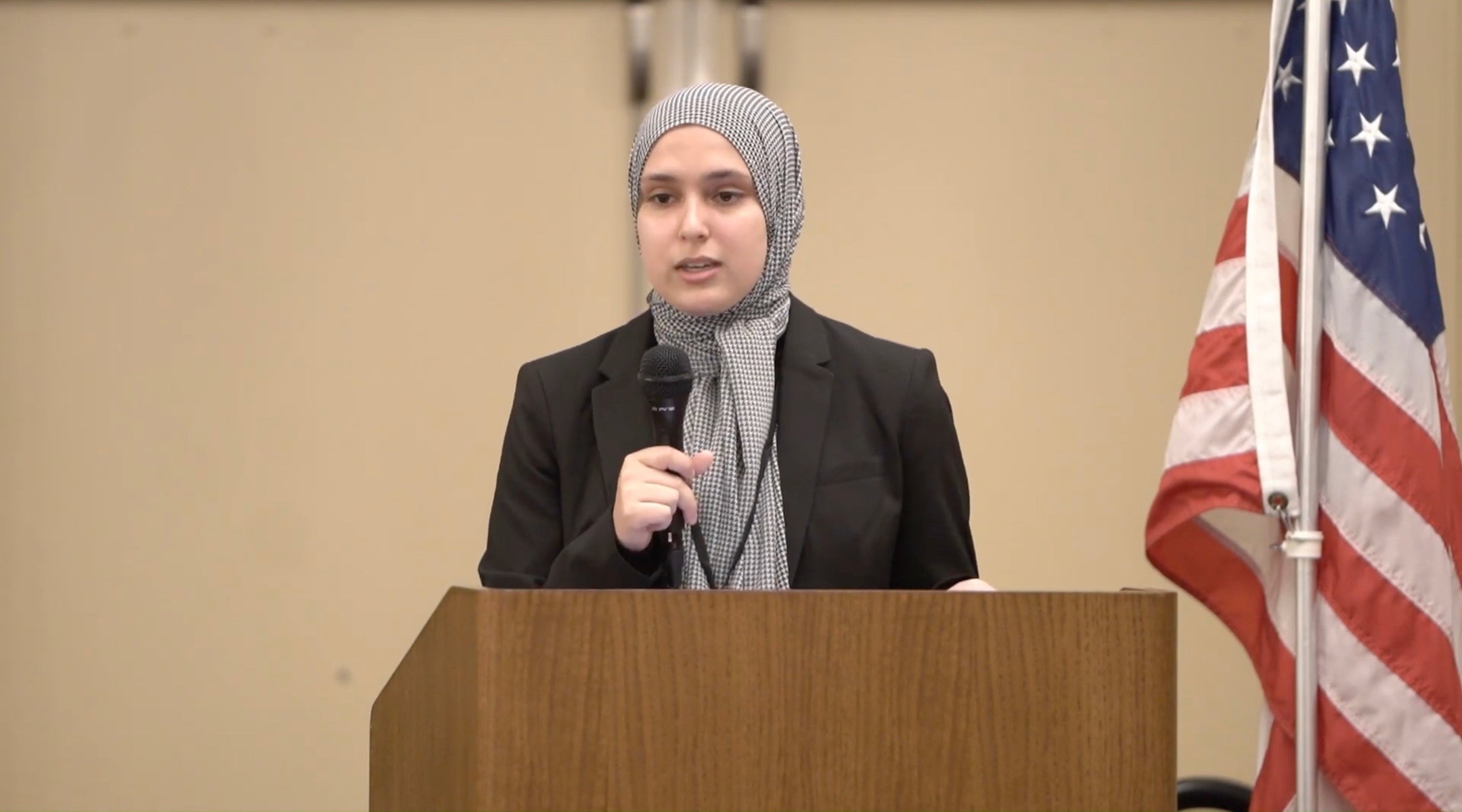
The Trump administration’s Religious Liberties Commission was wracked again this week over anti-Israel sentiment, as a second affiliated individual has exited while claiming it had been hijacked by a “Zionist political agenda.”
Sameerah Munshi, a Muslim member of a board that advises the commission, announced late Thursday that she would be stepping down. Her reason, she said, was to protest the dismissal of commissioner Carrie Prejean Boller, who was ousted last month after she used a hearing on antisemitism to expound on her objections to Israel and Zionism.
“In this country, people of faith are having their free expression stripped away, and even their lives put at risk, because of their deeply held beliefs about Palestine, all for the sake of a Zionist political agenda,” Munshi wrote in a resignation letter she posted to Substack. “The removal of a Catholic commissioner for expressing dissenting views grounded in her faith is the exact affront to free expression and religious liberty that I spoke out against.”
Munshi posted her resignation to X just before 10 p.m. Thursday, hours after an attacker drove a car into a Michigan synagogue while a preschool was in session. She did not mention the incident in her letter, which she said instead was timed to Prejean Boller’s formal ousting by Trump earlier that day.
The Council on American-Islamic Relations praised both Munshi and Prejean Boller on Friday for their “courage.”
“Ms. Prejean Boller and Ms. Munshi fulfilled the commission’s stated purpose by opposing all forms of anti-religious bigotry and standing up for every person’s right to express their religious beliefs, including opposition to Israel’s genocide in Gaza,” the council said in a statement. “The commission is now clearly meant to protect Israel from criticism, not to protect religious freedom for the American people.”
Munshi is a recent Brown University graduate and onetime director of the Muslim organization Coalition of Virtue. She was embraced by the Christian right after publicly opposing a change in a Maryland public school system’s policy allowing parents to opt their children out of curriculum, including LGBTQ material, that went against their religious beliefs. The policy Munshi protested was eventually taken to the U.S. Supreme Court, which ruled in favor of parents who had challenged the school.
Munshi’s biography on the commission’s website was still active as of Friday. It states, “Sameerah has courageously spoken out against forcing children to learn radical gender ideology in schools.”
Munshi had been outspoken for weeks about her support of Prejean Boller, with whom she was ideologically aligned on Israel, after Prejean Boller’s remarks during the antisemitism hearing caused a firestorm.
Donald Trump and Carrie Prejean Boller attend a press conference at Trump Tower on May 12, 2009 in New York City. (George Napolitano/FilmMagic)
Like Prejean Boller, Munshi is also a follower of Candace Owens, the right-wing pundit who has embraced a number of antisemitic conspiracy theories. She praised Owens’ conversation with Jewish pro-Palestinian academic Norman Finkelstein last fall, writing on Instagram that Owens had a “rare willingness to confront uncomfortable truths head-on,” and suggested future guests for Owens to interview.
Munshi has been aligned with Prejean Boller since the fall, when Prejean Boller approached her after Munshi testified to the commission in favor of public schools’ rights to protest Israel. “Carrie has been wonderful. We’ve become pretty good friends at this point, and we’ve shared a lot,” Munshi told Middle East Eye.
On her Instagram before last month’s antisemitism hearing, Munshi wrote that the two of them had pushed the commission to invite “fair witnesses” to the hearing that would have reflected their own perspectives, including Finkelstein, left-wing Israeli academic Miko Peled, anti-Zionist rabbi Yaakov Shapiro, and David Spevak, an American Jewish activist and descendant of Holocaust survivors who has compared Jewish summer camps and cultural programs to the Hitler Youth.
After Prejean Boller’s performance at the hearing, during which she told Jewish witnesses that her Catholic faith compelled her to oppose Israel and Zionism, Munshi defended her from blowback from Jewish groups and the Trump administration. The Wall Street Journal wrote in an editorial that the two “left together and appeared to be texting amid the hearing,” appearing to allege collusion in Prejean Boller’s line of attack.
“Christian views and beliefs were targeted as ‘antisemitic’ for merely expressing concerns about the ongoing conflation between criticism of the state of Israel and anti-Jewish animus,” Munshi wrote on her Substack in February. “During the hearing, an attempt was made by a collection of ‘Israel First’ actors to redefine antisemitism to include all criticism of Israel, smear many concerned citizens as bigots, and even gatekeep what counts as ‘real’ Judaism by confining it to Israel-first Jews.”
Trump established the Religious Liberties Commission last year, with the order’s text stating that it would “offer diverse perspectives on how the Federal Government can defend religious liberty for all Americans.” Munshi was one of three Muslims on the commission and the only Muslim woman; all three were chosen to serve in an advisory capacity, rather than as full commissioners.
In her resignation letter Munshi also said she was resigning in protest of the Trump administration’s war with Iran, which she wrote was being done “at the urging of a genocidal state.”
“I support America over Israel, and unfortunately that means I cannot support Trump or this government,” Munshi continued.
Reporting the stories that define our era. When history unfolds in real-time, the Jewish world turns to (JEWISH REVIEW). Your support ensures we can document the complexities of war and the resilience of Jewish communities with integrity.