
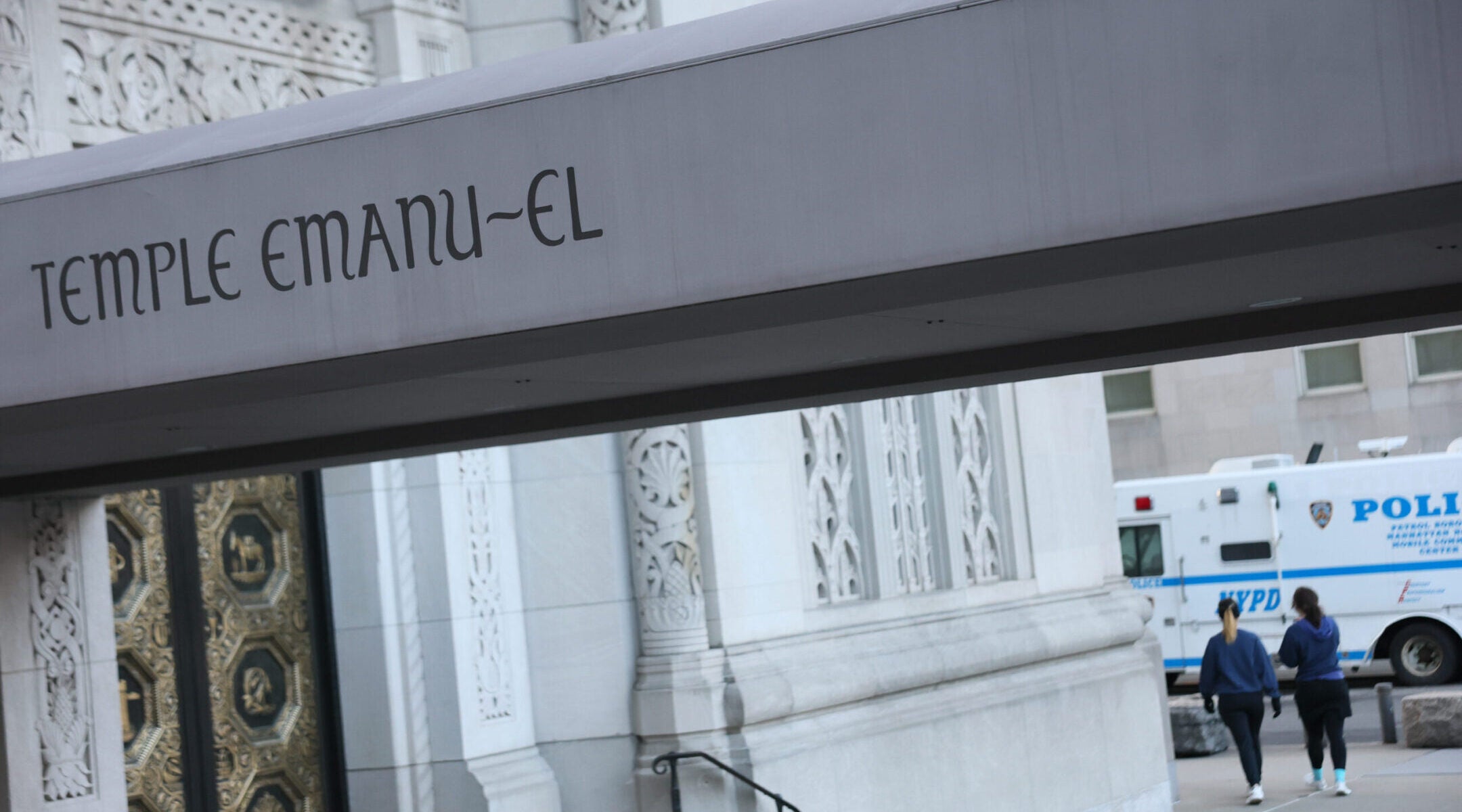
A string of recent synagogue attacks across North America and Europe has left security officials sounding the alarm bells.
“We are in the midst of the most elevated and complex threat environment the Jewish community and this country has seen in modern history,” said Kerry Sleeper, chief of threat management and information sharing for the Secure Community Network, a Jewish security organization.
Sleeper’s comment came during an SCN webinar on Friday, held in response to the previous day’s attack on Temple Israel in West Bloomfield, Michigan, where an assailant rammed into the synagogue armed with rifles and smoke bombs.
Though the attack was successfully thwarted by existing security measures, Mitchell Silber, executive director of the Community Security Initiative, said in an interview that Jewish institutions may now need additional layers of protection.
“This might be a bit of a tipping point where we’ve gone to a new level, where really what’s required to secure a Jewish institution in the U.S. starts to look like almost a Europeanization of security,” Silber said.
That would include posting multiple armed guards outside entrances and requiring increased screening before entry, he said. Many European synagogues also require attendees to go through security screening at some distance from the building, rather than at their doors.
“Unfortunately that seems to be where we are right now — the Jewish community has to up its game in terms of the external security of its locations,” he said.
Currently, a shutdown at the Department of Homeland Security since Feb. 14 is halting the review of millions of dollars in security funding for nonprofits, constraining the ability of Jewish institutions and other vulnerable groups to upgrade their security infrastructure.
The Temple Israel attack came within two weeks of attacks in Austin, Texas, and at Old Dominion University in Virginia. Those other attacks were not on Jewish institutions, but Sleeper, a former FBI assistant director, said the “various motivations of the attackers appear to be affiliated with the war between the U.S., Israel and Iran.” He added that the assassination of Ayatollah Ali Khamenei in Iran, and President Donald Trump’s stated desire to facilitate a regime change, have “contributed to the extremely high threat environment.”
Meanwhile, things have escalated outside the United States. Three Toronto-area synagogues were hit with gunfire over the last couple of weeks, and a synagogue in Rotterdam was targeted by an arson attack early Friday morning, allegedly by a group that has also claimed credit for an explosion at a synagogue in Belgium.
The flurry of attacks has the entire Jewish world on edge going into Shabbat — and some watchdogs say things could soon get worse.
“It is not entirely shocking to those of us who’ve watched this space for a long time,” said Mike Jacobson, a senior fellow at the Washington Institute for Near East Policy who served in the State Department’s Counterterrorism Bureau. “I would think things would continue to ratchet up again, at least in the short term.”
He pointed to the Iranian Revolutionary Guard Corps’ activation of sleeper cells — their agents lying in wait until called to action to commit an attack — across the West, as a danger to vulnerable targets, which includes Jewish communities.
Another source of danger, Jacob said, comes from copycat attacks.
“There’s also this mix that makes it really hard to sort out in the initial stages, where you’ve got people, not only who may be directly tied to Iran, but people who are so-called ‘inspired’ by this,” Jacob said. “Those are often really hard for law enforcement to get advance notice on.”
Not always does the threat come from direct orders from Iran, he said. “It’s often difficult to tell: Is this something that is directly tied to the organization, or is this something that is more by someone inspired [by the IRGC]?”
He added, “They are trying to inflict pain in as many directions as they can.”
As security organizations encourage increased caution and awareness of suspicious activity, they are also emphasizing that those measures shouldn’t come at the expense of gathering in communal Jewish spaces.
“We’re not going to let the terrorists take away our confidence or the ability to embrace our religion,” said Michael Masters, SCN’s national director, during the Zoom webinar.
Masters’ sentiment is also shared by congregational leaders like Rabbi Adam Roffman, of Congregation Shearith Israel in Dallas.
“Sure, security is something we think a lot about, and we’ve done our best to protect ourselves,” Roffman said. “And at the same time, the life of this community goes on.”
At Temple Israel, Shabbat services are being streamed from the nearby country club that served as a reunification center for families after the attack. The synagogue wrote on Facebook: “We’re so glad you’re joining us tonight as our community comes together to welcome this much needed Sabbath.”
Reporting the stories that define our era. When history unfolds in real-time, the Jewish world turns to (JEWISH REVIEW). Your support ensures we can document the complexities of war and the resilience of Jewish communities with integrity.