
Four days after an attacker drove a car filled with explosives into her synagogue, Rabbi Jen Lader called a trusted photographer.
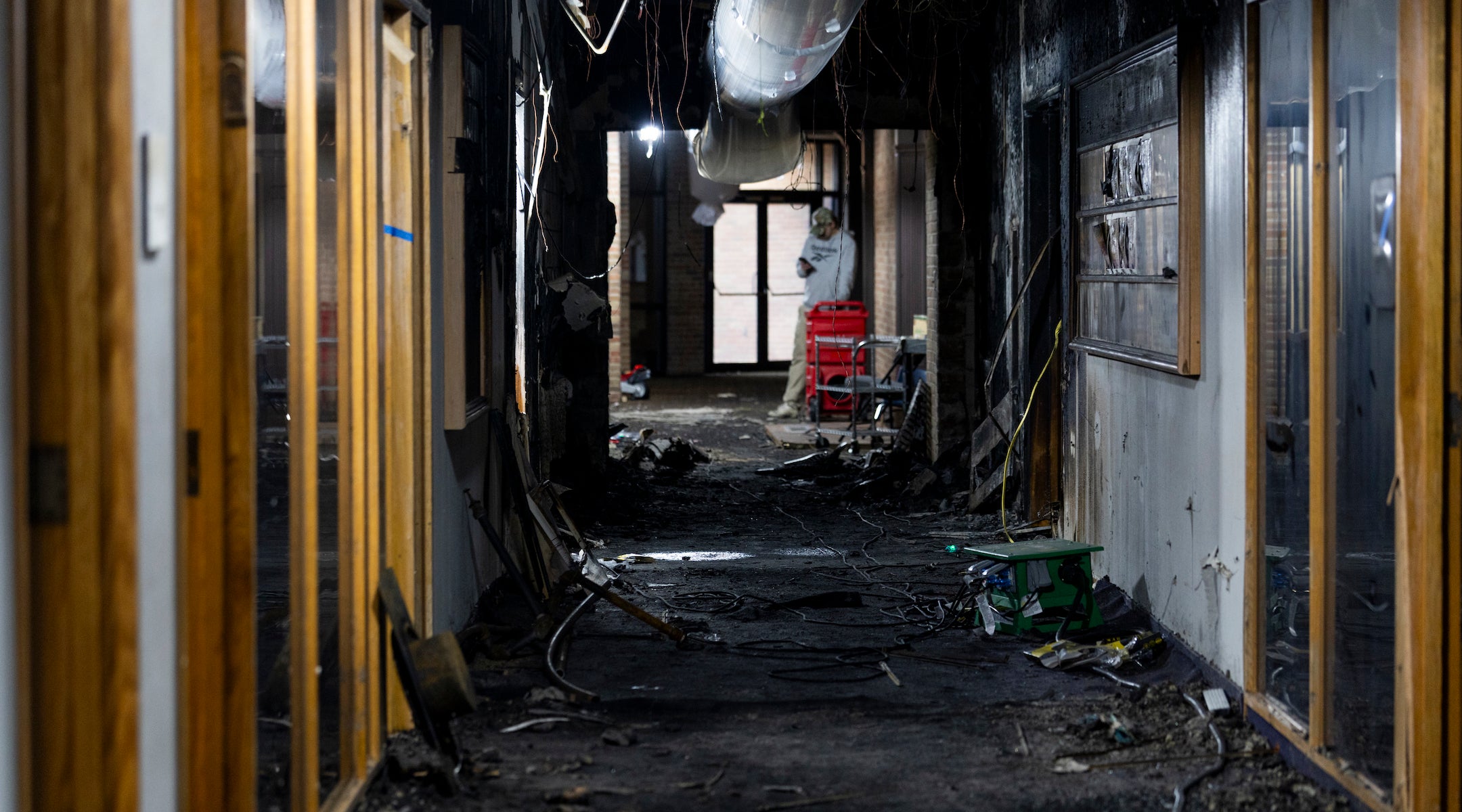
Emily Iris Elconin took what would become the first official photos of the aftermath of the attack on Temple Israel in West Bloomfield, Michigan. On Thursday morning, one week after the attack, the synagogue posted Elconin’s photos to social media, revealing for the first time the true extent of the destruction: a hallway entirely caked with ash, bits of shrapnel littered on the floor, confirmation photos burned beyond recognition, a preschool frozen in time when its staff and children evacuated.
“It was very hard to stomach being there, taking the images,” Elconin, who is Jewish and grew up in West Bloomfield, told the Jewish Telegraphic Agency. “And all I could hope was that it would come through in the images themselves.”
Elconin is a freelancer who has published her work in The New York Times, The Washington Post, CNN and other national platforms. She grew up attending Temple Shir Shalom down the road from Temple Israel and now serves on the Detroit Jewish federation’s young-adult board.
In sharing her photos, Temple Israel said it wanted “to take back control of our narrative” after photos and videos of the damage had been leaked to social media and caused harm to the attack’s survivors.
“We share these images because our community deserves to see our building through eyes of love, not through the lens of spectacle,” the temple’s post reads. “This is our sacred space, and we will be the ones to tell its story.”
Serving as those “eyes of love,” Elconin told (JEWISH REVIEW) which details of the aftermath stood out to her and what she hopes the photos can accomplish.
This conversation has been edited for length and clarity.
Confirmation photos scorched in the hallway where the attacker drove through Temple Israel last Thursday in West Bloomfield, Michigan, U.S., on Monday, March 16, 2026. (Emily Elconin)
(JEWISH REVIEW): Tell me how these photos came to be.
Elconin: I got a call on Monday from Rabbi Jen Lader, and she asked me if I could come to the temple and photograph the aftermath of the destruction. I’m a photojournalist, and she wanted me to bring that storytelling approach to capturing these images in a way that captured time standing still, but also just in a way that people can better understand and connect to the imagery.
I’m a West Bloomfield Jewish native myself. I grew up about three miles from Temple Israel and belonged to Temple Shir Shalom. So I’ve always been very interconnected in the Jewish community. Last year, Rabbi Jen actually hired me to photograph the Women’s Rabbinic Network convention, which was here in Michigan.
I knew the importance of having this documented. As horrible as the destruction is, and how sickening these images are, it’s very important for people to see what happened and to just have a better understanding of the destruction.

Lunches left behind by children inside a classroom at Temple Israel after an attacker drove through the entrance next to the early childhood care center last Thursday in West Bloomfield, Michigan, U.S., on Monday, March 16, 2026. (Emily Elconin)
You were one of the first people outside the temple staff and law enforcement to see the condition of the temple after the attack. What were your impressions?
It smelled like a burning building — we were wearing N-95s the whole time. When you’re standing inside of there, you get the full understanding of what happened, where the car drove through, where the car stopped, where the car exploded, seeing the bullet holes on the windows. I think that it will probably take me a while to fully process the scope.
There were these moments just frozen in time, like someone was warming up their soup, and there’s, you know, a napkin over the soup. And then there’s all the food from the kids, like a yogurt with a straw in it still. When you see all the toys and everything, and all the shoes and things flipped over, you kind of are transported back to the scene when this was happening. Where the car came through, on the right side is directly where the preschool classrooms are. So that’s instantly where the car drove by.

A damaged stroller is seen inside Temple Israel next to the hallway where an attacker drove his vehicle into the building entrance next the early childhood center last Thursday in West Bloomfield, Michigan, on March 16, 2026. (Emily Elconin)
I was reporting from the scene, I was attending the press conferences and following all the updates. But I had no sense, even from reading the descriptions of what had happened, just how extensive the damage was, until I saw your photos.
Right, I don’t think any of us really understood. The temple is trying to process things themselves. There were pieces of the car; he was driving a Ford F-150, and a piece of one of the side mirrors was on the ground. There’s ash everywhere. One of the first offices on the left that the car went by — it’s a metal car, and it’s just burned all the way through, down to the bottom. And you can just see where people stopped in those moments. They were trying to get people out, and there’s broken windows.
It’s a really long hallway. There’s lots and lots of classrooms. I mean, the whole temple had damage too, because the water system was activated. So you walk on the floor and you hear the little squishy noise because the floors are sopping wet. So while the most immediate damage is in that first hallway, there is damage pretty much everywhere.
Tell me how you approached taking the photos. What were you looking to communicate?
I was trying to approach this how I would approach anything else, and trying to capture moments in time that could elicit some of the same emotions and feelings that I was feeling in that moment. I just really wanted to convey to people what it felt like for these people, these kids, teachers, to be in there in those moments: the food left untouched, art projects left unfinished, the chairs flipped over. There’s Ritz crackers on the floor, Oreos.
There were papers all over the ground, and there were some really powerful words written on one of the papers: “Overflow with love.” I captured that — it’s covered in ash. There are no people in the photos. It doesn’t matter, right? It’s like time stood still.

Classroom artwork lays next to shattered glass on the ground inside the early childhood care center near where the attacker drove his vehicle into the building entrance next the center at Temple Israel in West Bloomfield, Michigan, U.S., on Monday, March 16, 2026. (Emily Elconin)
Your photos are going to become the definitive record of what happened here – meanwhile, people online have been claiming this attack was a false flag, or that it was somehow not everything it was reported to be. What do you hope your images can accomplish here?
I hope they can get people a better understanding of what happened, of the destruction. What I can hope for people to take away is that antisemitism is a real threat to all of our communities. Obviously injuries and casualties were prevented, which is a miracle, right? But there’s still this damage. Even when the temple is renovated, this is going to be something that our community remembers forever. It could have been any of us, any of our synagogues. And I think it’s just a very real reality for Jewish communities.
Reporting the stories that define our era. When history unfolds in real-time, the Jewish world turns to (JEWISH REVIEW). Your support ensures we can document the complexities of war and the resilience of Jewish communities with integrity.