
The publisher Hachette recently canceled a horror novel, “Shy Girl,” after it was revealed to have been written with the help of AI.
OpenAI shut down its social media app Sora after complaints that users were sharing inflammatory deepfake videos of Michael Jackson, Martin Luther King Jr. and Mister Rogers, among others.
In January, the streaming platform Deezer reported that over 60,000 fully AI-generated tracks are being uploaded to its platform every day (although only a fraction actually stream).
And earlier this year, a contestant in Kveller’s Passover Song Parody Contest explained that her son wrote a first draft of their entry using AI, but that she helped polish the result.
OK, one of these stories may not be as dire as the others. But the possibility that AI could also threaten the Passover song parody is not just a tech story and a cultural story, but a deeply Jewish story.
Just when we learned to rhyme “Lady Gaga” with “Had Gadya,” will chatbots undermine a niche that gives amateur songwriters a chance to shine, and offers the average seder-goer an opportunity to skip a particularly verbose section of the haggadah? If OpenAI and Anthropic have their way, will we be deprived of future classics as brilliant as “Take My Bread Away” by Adam Libarkin and Leslie Frie?
I recently investigated the issue, and subjected myself, John Henry-style, to a person-vs.-machine songwriting duel with a chatbot.
But first, a little history. Eddy Portnoy, academic advisor and director of exhibitions at the YIVO Institute for Jewish Research, traces parodies of the Passover haggadah back to the 13th century. In the years since, the story of the Jews’ exodus from Egypt had been repurposed in pamphlets and in the Yiddish press to lampoon politicians, communists, capitalists, trade unions, management and, occasionally, Judaism itself.
Because it was a popular text with famous set pieces — four questions, 10 plagues, a Santa-like visit from Elijah — the haggadah was ripe for parody. “The vast majority of Jews — from children to the elderly — were at least nominally familiar with the text, a fact that made the gags easy to understand,” Portnoy writes.
Passover is also the rare Jewish holiday where the main ritual is performed at home, inspiring people to add their own twists to the “official” liturgy and rituals.
That spirit of familiarity, creativity and satire evolved into the modern song parody — easily digestible on YouTube and shared on social media. Modern Orthodox boy bands like the Maccabeats and Six13 produce slick videos that have spread beyond the yeshiva and college a cappella crowd. The best of these, like Six13’s “Matza Mia! An ABBA Passover” or the Y-Studs’ “Don’t Stop, We’re Leavin,’” graft insider Passover references onto a hit pop song.
The videos they produce can go viral — at least in the Jewish sense that your mother keeps forwarding them to you in the weeks before the holiday.
Rabbi Jaclyn Cohen performs in the video for “Matzah Balls,” Gordon Lustig’s parody of Miley Cyrus’ 2013 hit song “Wrecking Ball.” Lustig won Kveller’s annual Passover Parody Songwriting Contest in 2025. (YouTube)
DIY parodies are staples at many seders. My friend Abby Meth Kanter, an editor from West Caldwell, New Jersey, takes particular pride in her parodies, which she writes for Passover, Purim spiels, birthdays and other milestones.
“I worked hard on them, honing the rhymes, the scansion, the echoing of certain phrases in the original songs, but, most of all, the personal and specific references,” she told me, laying out a sort of human manifesto for the proper parody.
In a “Four (+1) Sons” (sung to the tune of the “Gilligan’s Island” theme) she relates all the elements of a seder staple in light verse. For the “Child Who Does Not Know How to Ask,” she writes: ”The tongue of the fourth son was tied; / But don’t scold or decry him. / Just say the seder celebrates / Our yitziyat Mitzrayim.”
Rhyming “decry him” with the Hebrew term for leaving Egypt is a masterstroke.
And it’s exactly the kind of precision — in both wordplay and specific Jewish content — that other makers of parodies insist AI can’t duplicate (not yet, anyway).
“You have to be a master of syllables. And I don’t trust that AI can have the nuance that is required to really dig into a song,” said Rabbi Jaclyn Cohen of Temple Isaiah in Los Angeles, who writes and performs slickly produced parody videos for Purim and Passover.
Cohen made her first video in 2019, a Purim parody of Lady Gaga and Bradley Cooper’s overwrought performance of “Shallow” at that year’s Academy Awards. Since then the production values have gotten more elaborate, but her songwriting abides by rules that she considers particularly human.
“I try to match the vibe of a pop song with the vibe of the message that I’m trying to share,” said Cohen. Her video for “Jews,” parodying Lizzo’s 2023 hit “Juice,” is a celebration of Shabbat. It features Cohen in a pink fur swanning into a Shabbat dinner clutching a challah and a bottle of wine. (Sample lyric: “We’re like Manischevitz / we get better as we age.”) Cohen said she tried to capture the “swagger that Lizzo has in her music. I really tried to match that with her lyrics. And you can’t fake that.”
Last year Cohen performed “Matzah Balls,” a parody of Miley Cyrus’ “Wrecking Ball.” Written by Gordon Lustig, the song took first place in the annual Passover Parody Song Contest run by my colleagues at Kveller (we share a parent company, 70 Faces Media). Cyrus’ breakup song becomes an angry lament by a home cook whose various Passover recipes fail to please their partner. (“You didn’t like the matzah balls / I made with all my heart and soul.”)
Molly Tolsky, Kveller’s editor, said “Matzah Balls” has all the elements that she and the other judges are looking for in a Passover parody: timeliness, clever lyrics and, crucially, distinct Jewish references that echo with the original theme of the song.
“What makes a good parody to me is the more highly specific niche references, beyond just what the plagues are and the story of Moses and the Exodus and freedom,” said Tolsky.
In the newly released “Kveller’s Passover Parody Songbook” (available here for an $18 donation), the contest winners and finalists include two main types of parodies. One tells parts of the Passover story itself (like “Evil Pharoah,” a parody of Taylor Swift’s “Anti-Hero”). The other gently mocks the seder and other Passover customs, which often translates into complaints about the length of the seder, the burden of the preparation and the gastronomic effects of the leaven-free diet.
“20, 20, 24 hours to go / I wanna shorter seder,” writes Brad Mislow, in a parody of the Ramones’ punk rock classic, “I Wanna Be Sedated.”
In her version of “Nine to 5,” Shelly Homer writes, “Seder starts at 5 / There’s no way I will be ready / I’m in overdrive / Pressure’s makin’ me all sweaty.”
Except for that one contestant who volunteered that she used AI, Tolsky can’t swear that this year’s contestants didn’t lean on AI for help crafting rhymes. But she feels that as an editor she is able to sniff out poetry and prose that seems AI-generated.
Songs like “Matzah Balls,” she said, are rooted in “human experience.”
“I don’t think AI could get down to that level of humor and specificity,” said Tolsky.
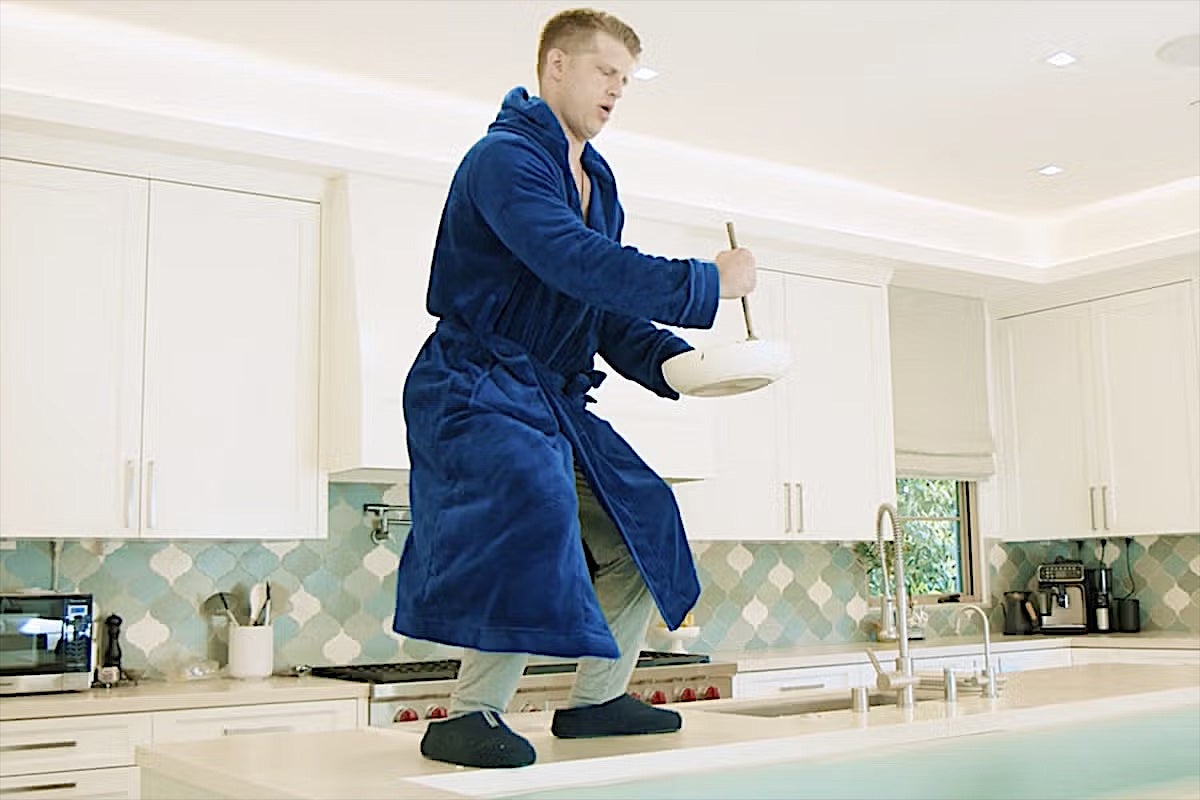
Jonah Platt performs “(Matzah) Brei Brei Brei,” Matt Slater’s parody of NSYNC’s “Bye Bye Bye.” Slater’s song won Kveller’s second annual Passover Song Parody Contest in 2023. (YouTube)
Or could it? I wrote a parody song, and then I gave ChatGPT the same prompt I gave myself: “Write a Passover parody based on ‘Born to Lead,’ a song from the Broadway show ‘Operation Mincemeat’” (not a top 40 hit, I admit, but ever since seeing the show, I can’t get it out of my head).
If you don’t know the song, it’s an upbeat, tongue-in-cheek anthem in the spirit of “When Johnny Comes Marching Home.” Its chorus includes the lyric, “For some are born to follow / and we were born to lead.”
Here are a few verses that I came up with in about 40 minutes:
You dreamed of leading seder
But it wasn’t in the cards
And despite your years in cheder
It’s your in-laws who’re in charge.
Morris breaks the matzoh
And mumbles through the text
It’s enough to make you plotz, a
Night that leaves you vexed.
You wince at every Hebrew gaffe
That he manages to misread
It’s more than you can swallow
When Morris gets to lead.
Not my best work, but I give it points for some highly specific, bilingual rhymes (“seder/cheder”) and what an English major calls enjambment ( “matzah/plotz, a…”). I also thought its subject was fresh: a family rivalry over a seder leader still stuck in the Maxwell House Haggadah era.
Given the same prompt, ChatGPT came up with verse after verse, in about three seconds. Here’s a sample:
I was raised on plagues and matzah crumbs,
On brisket dreams and bitter herbs on tongues,
With a Haggadah I barely read —
But still I knew: I’d run this Seder instead.
Uncle’s late, the kids are wild,
Grandma’s judging every child,
Four cups in and spirits freed—
And somehow I’m the one to lead!
I was born to lead the Seder,
Raise the wine and pass the plate,
Skip ahead or linger later —
Either way, we’ll celebrate!
At first glance, not a bad attempt. Some of the lines don’t scan, the “plot” is a little incoherent, and while some Mizrahi families might “pass” the seder plate, I am guessing the bot didn’t know that or care and assumed the seder plate was more like a serving platter.
On the other hand, it picked up on the leadership theme of the original song, and I give it props for recognizing the same phenomenon I addressed in my song: the tension between old-style, rote seders and the DIY spirit of modern seders.
The Passover song parody is itself a product of that tension. The modern parodies developed in an era when Jews were eager to inject more improvisation and personality into a ceremony that quite literally had followed the same script for generations. Whether leading that charge or responding to it, activists, publishers and the various streams of Judaism wrote new haggadahs to connect the story to everything from civil rights and New Age mysticism to women’s liberation and immigration.
In versions like “The Family Participation Haggadah: A Different Night,” families were taught that reading the traditional text wasn’t as important as telling the story in one’s own voice, discussing the themes of Passover and entertaining young and old with songs and skits.
My ChatGPT was not only aware of these trends, but leaned into them in its songwriting, credibly if not brilliantly. And maybe that’s the problem. AI has yet to rival Stephen Sondheim or Carole King, but it is adept at churning out passable, even slightly above-average work that is plenty good enough. It’s not that it is replacing human genius, but when it comes to poetry and prose, AI is adding exponentially to the ocean of mediocrity.
It’s the spiritual and literary version of Chipotle or Panera Bread: It’s everywhere, it’s not terrible, but you’ll never sing its praises (or, in this case, praise its songs).
The Passover song parody took off when seders became more participatory, and when a do-it-yourself ethos met Jewish tradition. Social media offered new opportunities to create and share the results. The Haggadah even gives its blessing: “The more and the longer one expands and embellishes the story,” it says, “the more commendable it is.”
I’m guessing the authors never meant the storytelling to be outsourced. The story was meant to be told, retold and, above all, made your own.
Reporting the stories that define our era. When history unfolds in real-time, the Jewish world turns to (JR). Your support ensures we can document the complexities of war and the resilience of Jewish communities with integrity.