

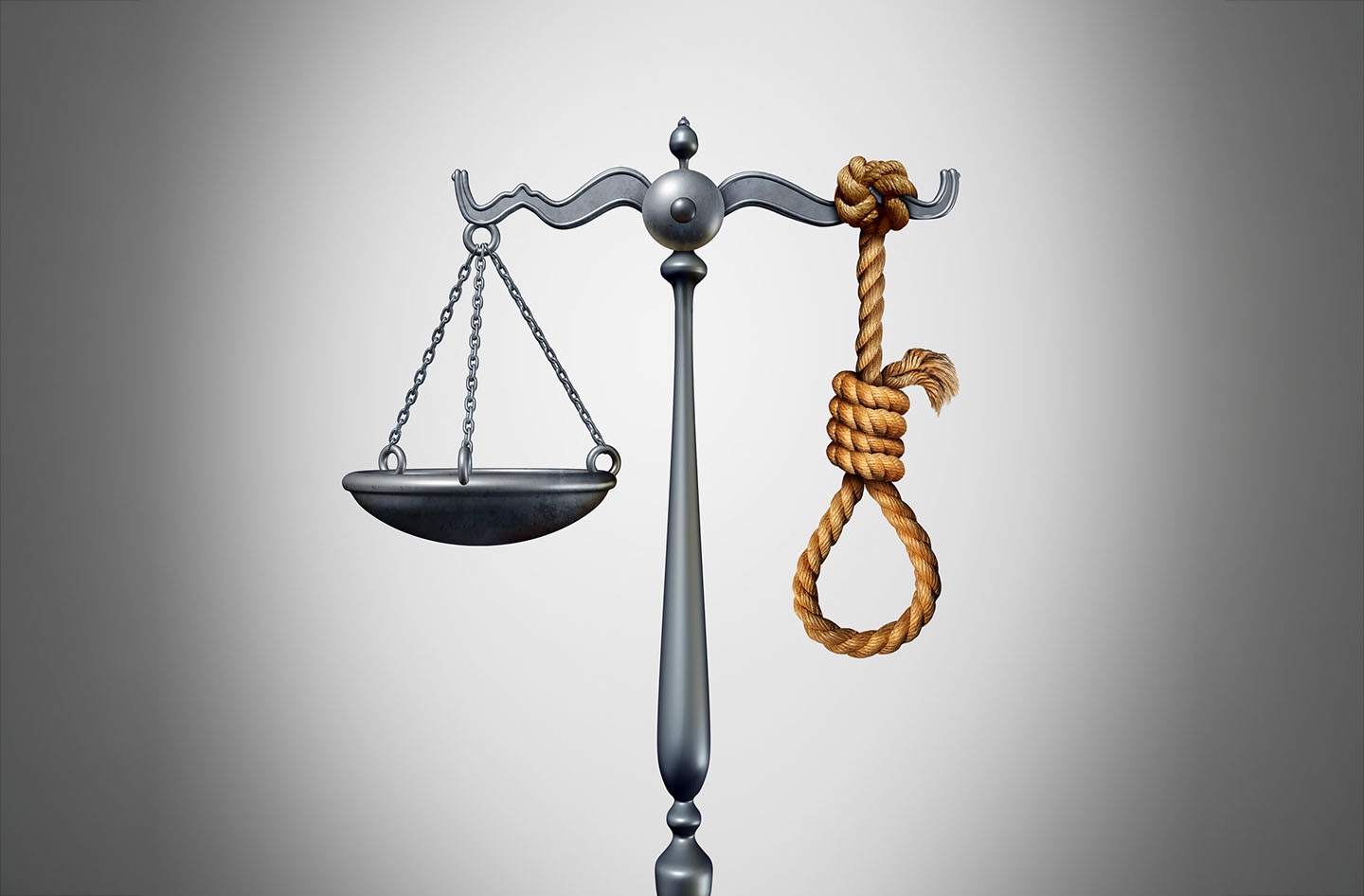
As if Israel didn’t already engender enough reasons for an antisemitic world to despise the Jewish state, its parliament, the Knesset, came up with another one last week—a real doozy.
A majority of Israel’s elected representatives voted to impose the death penalty against Palestinians—specifically, death by hanging—for acts of murderous terror intended to end Israel’s existence. The legislation is ostensibly deterrence-minded: making Palestinian terrorists think twice before killing Jews. Israeli citizens and residents are exempt from this law—including Israeli Arabs and Muslims.
As a specific anti-terrorism measure, the legislation distinguishes between ordinary criminal offenses and crimes against the state or against humanity. The problem is that it contravenes a fundamental rule of the country. In 1954, a mere six years into Israel’s modern existence, capital punishment was effectively abolished. To this day, the only person ever executed in Israel for a capital crime was Adolf Eichmann, the architect of both the Holocaust and what became known as crimes against humanity.
Eichmann set the high bar to what constituted evil. He received the ultimate punishment because his crimes were extraordinary. The Final Solution to the Jewish Question was more than mere premeditated murder. It had the ironic consequence of giving birth to an entire nation of Jews after slaughtering Six Million of them.
Had the Dr. Frankenstein of Auschwitz, Josef Mengele, been captured before his death, he, too, would have received the hangman’s noose. Until last week, capital punishment in Israel was reserved for Nazis alone.
It forces a reexamination of national first principles. Are acts of terror committed by Islamist Arabs no less culpable than the handiwork of Nazis? Shouldn’t those who torched, raped, and mutilated on October 7, 2023 receive the same punishment that was set aside for Nazis? When terrorists chant, “Death to Israel!” and then act to realize that objective, they should receive no less of a punishment than what they had sought to achieve—death.
Israel will soon showcase the separation of powers that is the hallmark of Western democracies, despite being the sole practitioner of such governance in the Middle East. Courts will weigh in on the lawfulness of this revival of capital punishment. Israel’s Supreme Court, with its long history of invalidating governmental policy by exercising the Reasonableness Clause under its Basic Laws, will determine whether the death penalty can be justified as a legitimate and proportionate way to achieve national security.
It’s a tricky question when applied to Islamists. With the afterlife as their fallback, terrorists are never truly deterrable. In committing crimes apocalyptic in nature and in the service of Allah, their motivations are decidedly unlike the calculations of ordinary criminals.
With the afterlife as their fallback, terrorists are never truly deterrable. In committing crimes apocalyptic in nature and in the service of Allah, their motivations are decidedly unlike the calculations of ordinary criminals.
Meanwhile, many Israelis have their own reservations about this law. The law could be misapplied to Palestinians merely for being Palestinian. Another measure is making its way to the Knesset that would provide greater procedural and evidentiary safeguards.
But many still believe that capital punishment is appropriate for the 250 convicted of serving in Hamas’ Nukhba unit, which was directly responsible for planning and directing the terrorist attack on October 7.
As we have come to learn, however, it makes little difference to Israel’s Western critics how the Jewish state deals with terrorists—as long as they don’t kill them, and especially not after they are captured, tried and found guilty. France, Germany, Italy and the United Kingdom swiftly condemned Israel’s new death penalty law.
Laughably, so, too, did Pakistan, Turkey, Egypt, Indonesia, Jordan, Qatar, the United Arab Emirates, and Saudi Arabia—Muslim nations where death by execution remains the law of their lands, for nearly any crime at all. Saudi Arabia, in fact, still practices state-sanctioned beheadings. The highest numbers of executions on the planet belong to Arab and Muslim nations. And, yet, they have a problem with Israel sentencing terrorists to death.
At least Europe practices what it preaches: the death penalty has been abolished on the continent—except for Belarus. Democracies have settled on the moral principle that human dignity, and the right to life, supersedes all considerations of criminal justice.
The United States, however, is a democratic outlier when it comes to free speech and capital punishment—more permissive on the former and still practicing the latter. Federal law permits the use of the death penalty; 27 states make capital punishment available under their penal codes—even though many have placed moratoriums on its use and have not executed anyone in over a decade.
The United States continues to regard the death penalty as a matter of fighting crime and not human rights.
That may soon change. Recent polling in the United States shows declining support for the death penalty—the lowest it has been in more than 50 years. Only a slight majority of Americans favor it. (In 1994, 80% approved.)
This shift in national consensus on the death penalty should come as no surprise. We are living through the golden age of consequence avoidance. Our newfound progressive politics comes fully equipped with an anti-establishment, easy exoneration ethos.
Black Lives Matter, defunding the police, cashless bail, excusing the crimes of illegal immigrants, the universal acceptance of white blameworthiness, “Globalize the Intifada!”—each has, in its own way, eroded distinctions between right and wrong, moral relativism and absolute truths, deserved punishment for criminality and resistance “by any means necessary.”
It’s utter lunacy for the muddled logic of political correctness to nullify the moral imperative of punishing crimes deemed the “worst-of-the-worst.” Capital punishment has been co-opted by cultural elites, rendering it as forbidden as racism, sexism, homophobia and Islamophobia. Just deserts is as repugnant and unseemly as American Exceptionalism, white privilege, nuclear families and “the most qualified person should get the job.”
But terrorism is the very definition of “the worst-of-the worst”—where guilt is not circumstantial but definite, and the crime committed shocks the conscience even in a world increasingly inured to shock.
Terrorism is the very definition of “the worst-of-the worst”—where guilt is not circumstantial but definite, and the crime committed shocks the conscience even in a world increasingly inured to shock.
Does anyone really have a problem with the hanging of Eichmann or the assassination of Osama bin Laden? Do Martin Luther King Jr. and Ayatollah Khamenei exist on the same moral plane? Mass murderers do not provide the essential spark of life and benefits to humankind that the world can’t live without.
Terrorists deserve what they get. Under-punishing them presents the same kind of moral asymmetries as applying international humanitarian law to the barbarian tactics they deploy in waging war. One side abides by the rules of engagement; the other weaponizes the laws of armed conflict by ignoring them.
All human life is not the same; we are not equal in moral worthiness. America’s Founding Fathers did not have the Boston Marathon Bombers in mind when they amended the Constitution to outlaw “cruel and unusual punishment.” Everything terrorists do qualifies as cruel and unusual; the punishment they are owed—the payback they receive—should not be shortchanged.
Moral blame creates an obligation of just desserts. The wrongdoer supplies the justification. Terrorists terrorize. Governments are left with little choice but to respond in kind. The moral authority to do so was set in motion by the wrongdoer’s own misdeed.
Deterring crime is not the sole reason to punish wrongdoers. A more important consideration is retribution itself—the poetic justice of just desserts. The worst-of-the-worst evoke moral revulsion and therefore deserve to be punished in kind.