
This article was produced as part of (JEWISH REVIEW)’s Teen Journalism Fellowship, a program that works with Jewish teens around the world to report on issues that affect their lives.
Quinn Fleming, a sophomore at Winter Park High School near Orlando, Florida, said her only experience with Holocaust education was reading a short text in eighth grade.
“It was just the basics, that Jews were sent to concentration camps by Nazis, and that was it,” she said. Fleming, who is not Jewish, did not come out of the lesson with a better understanding of the genocide and did her own outside research to become educated on the topic.
Even though Florida law mandates Holocaust education, Flemings’ experience is not unusual.
Despite similar mandates in 23 states, a 2020 study from the Claims Conference showed that Millennials and Gen Z members in Florida have one of the lowest “Holocaust Knowledge Scores” in the country. In one glaring example, 63% of those surveyed did not know six million Jews were murdered in the Holocaust.
Those findings, combined with rising antisemitism and the dwindling number of living survivors, have spurred both government and private institutions in Florida and elsewhere to find and deliver new approaches to teaching about the Holocaust.
The Holocaust Memorial Resource and Education Center of Florida is attempting to fill these gaps by sharing survivor stories.
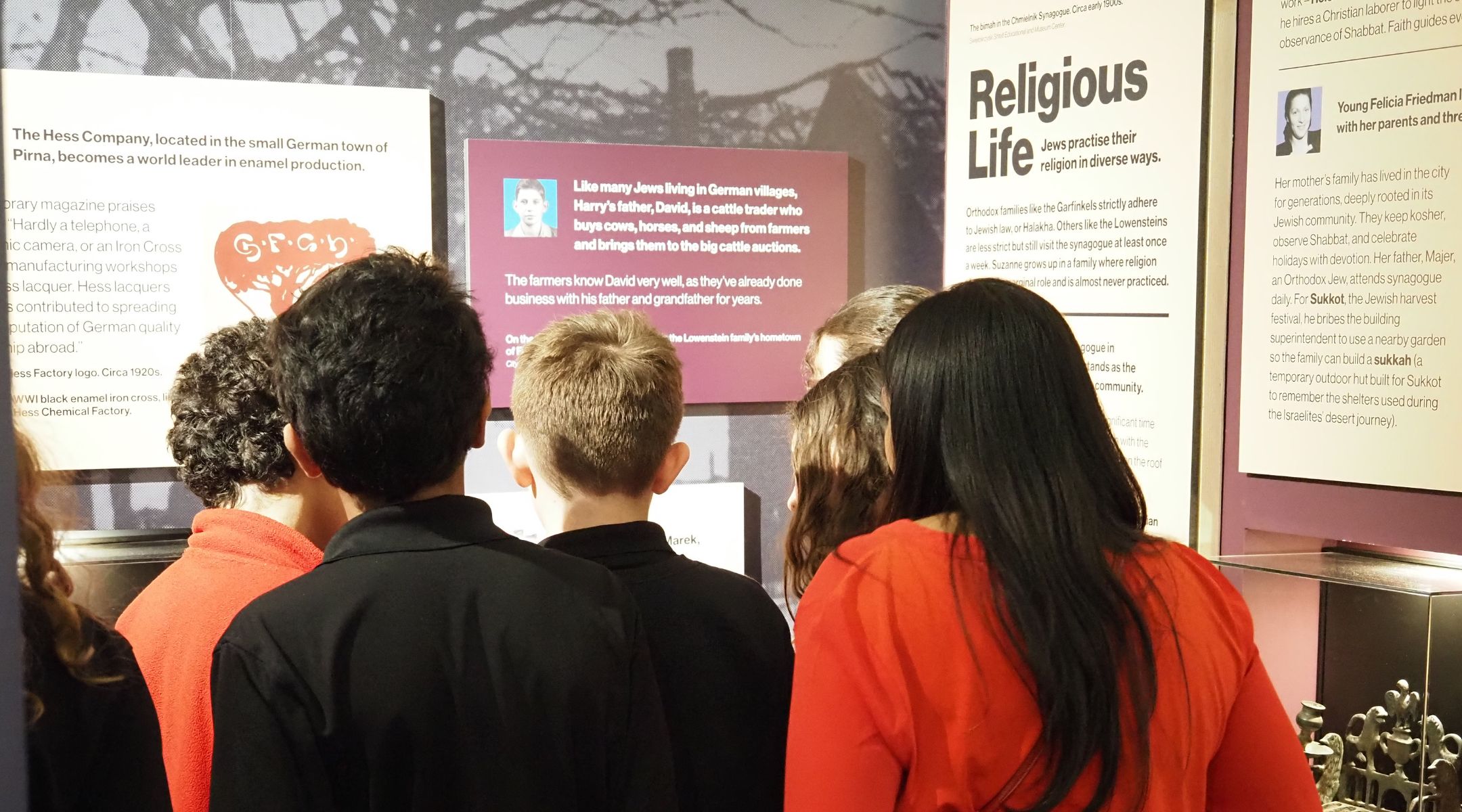
The museum’s new Hope & Humanity exhibit, which will be on display for nearly two years, focuses on telling the stories of survivors and approaching Holocaust education from their point of view. While the exhibit is currently at the museum’s Maitland location, it will remain part of a new location in downtown Orlando, set to open in early 2028 as the Holocaust Museum for Hope & Humanity.
The museum’s expansion is part of a state-wide effort to make good on the 1994 law that required students to learn about the Holocaust in school. The law requires that Florida students gain an understanding of the Holocaust and its effects on the Jewish people and that students should take away a sense of tolerance they can use in a diverse community.
According to the Conference on Jewish Material Claims Against Germany, almost all of the 200,000-plus Holocaust survivors alive today will be dead by 2040, meaning fewer and fewer young people will have the chance to meet and learn from them.
Meanwhile, the Anti-Defamation League found that antisemitic incidents in Florida increased by 277% from 2020-2024, and 161 incidents in 2024 related to anti-Israel sentiment, an increase from 2023.
To address these trends, Florida’sa Department of Education will start incorporating Holocaust education into a wider range of classes starting next school year. This includes teaching about Holocaust survivors on a more personal level, including in culinary or music classes. Florida is the first state in the country to use this method, according to Michael Igel, chairman of the Commissioner’s Task Force on Holocaust Education, which guides the department.
“A lot of times, these students are learning terrible things about Jewish people before they even get near a textbook,” said Igel. “The key is that we need to keep evolving [Holocaust education] and stay with our roots of how we’re doing it.
Last summer, young people had another local opportunity to learn about the Holocaust. The Winter Park Library hosted a temporary exhibit titled “Americans in the Holocaust.” It focused on the American perspective of World War II and the Shoah, garnering approximately 9,600 visitors in August of 2025 with a 28% increase in foot traffic compared to the previous year. About a quarter of these visitors were youths.
“What teens did seem to respond to was pretty much anything that had an interactive component,” said Rachel Simmons, an archivist at the library. These interactive elements included one-way telephones that played audio, a timeline of newspaper articles during World War II, and a map of the United States’ movement into Germany.
“They overwhelmingly gravitated to the third one, which basically had a recording of Franklin Delano Roosevelt and his progression going from ‘We don’t want to be involved in World War II’ to ‘We have to do this.’ I think they found just engaging with that specific historical audio to be very interesting,” said Simmons.
In its first few weeks, the Hope & Humanity exhibit, focusing on local Central Florida survivors and their personal experiences in the Holocaust, attracted more than 500 visitors and approximately 950 students from field trips and school presentations.
The Hope & Humanity exhibit focuses on local Central Florida survivors and their personal experiences in the Holocaust. (Courtesy HMRECF)
“We’re really using the site to introduce this concept of highlighting lived experiences of our neighbors, specifically through the lens of the Holocaust,” said Suzanne Grimmer, senior director of museum experiences. “What we wanted to do was remind people that the Holocaust is not this distant event that happened in Europe.”
Guests follow the stories of 10 survivors who experienced the Holocaust at different ages, in different places, and while practicing Judaism differently, individualizing their narratives.
“Too often, we start with the Holocaust with 1933 or they start with the camps, and you don’t really understand anything about the thousands of years of Jewish life and culture that were erased and then also what it took to rebuild that life and and culture in different places,” said Stephen Poynor, the museum’s senior director of education and community engagement.
By putting Jewish culture and history at the forefront of Holocaust education the museum hopes to build empathy in school visitors. “It’s just a different way of teaching the Holocaust, and it’s been really successful so far,” says Grimmer.
Guests also learn about hate in the present, ending their visit with a wall titled “Anti-Semitism in Florida Today.”
“We’re trying to reiterate that this was not something that was invented by the Nazis, and it didn’t go away with the end of the Holocaust,” said Grimmer. “The first time you even see a swastika in this entire exhibit is on that last wall, and it’s from a rally that happened right here in Orlando in 2023. We’re really trying to get people to understand that this is a story that might feel global and very distant in terms of location and time, but at its core, is happening in your own backyard.”
The new museum will include an AI conversational algorithm that answers questions from visitors with responses from Holocaust survivors based on their recorded testimonies. Additionally, the new location will have a learning lab, where students can connect history to their own communities. The museum will also continue its partnerships with Orange, Seminole and Osceola County Public Schools and its week-long teacher institute, where scholars from around the world provide instruction on teaching the Shoah.
Offering a variety of Holocaust education opportunities, from school curriculum to museum and library exhibits, specialists like Poynor agree that this helps reach more teens in ways that are meaningful to them.
“We want to encourage students to step into their community and to engage, and through some of these stories and through this history, we hope they can connect and engage within their own schools,” said Poynor.
Passover may be over, but your chance to support independent Jewish journalism isn’t. Help (JEWISH REVIEW) keep reporting the stories that define our era.