

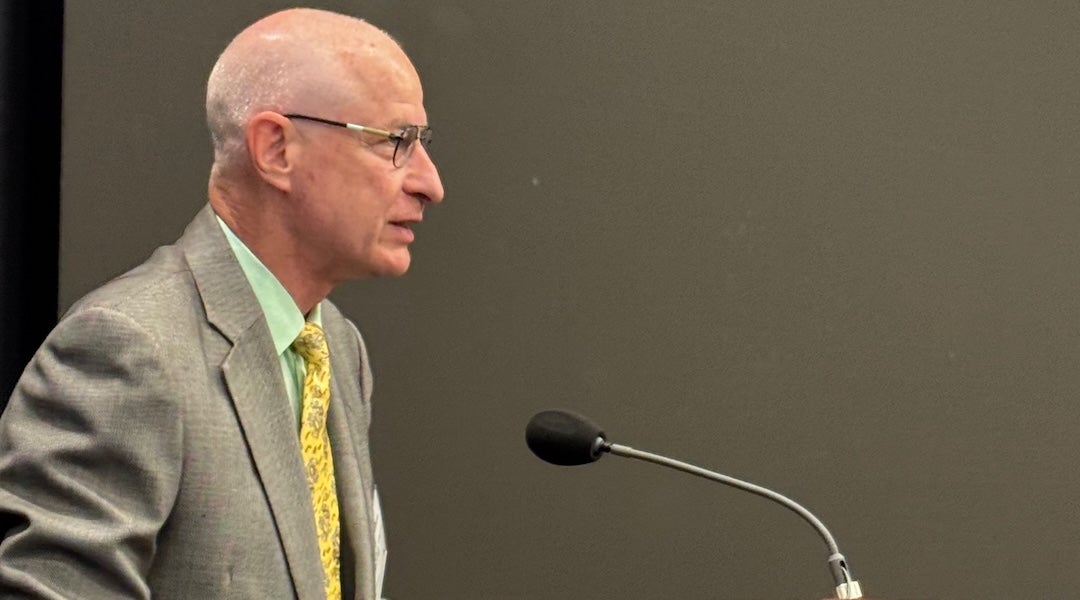
A growing number of Americans are injecting themselves with peptides they ordered online, often with no idea what’s in the vial, hoping to cure ailments and reverse aging. And for reasons that will soon be made clear, some of the peptides that make their way into the faddish and often gray-market concoctions have what appear to be Yiddish names.
But first, Pinchas Cohen, the pioneering scientist responsible for the naming quirk, wanted to say a few words about the real potential for mitochondrial-derived peptides.
Peptides represent a revolution in medicine, with potential for major new drug discoveries, the University of Southern California professor said. And the gray market fad worries him.
“These are potent biological molecules,” Cohen said. “They should be used under the supervision of a physician, and when they’re being produced in reliable manufacturing facilities — most of which is not happening right now.”
That said: about those names.
Cohen’s lab at USC has given the world SHLP (pronounced “schlep”), SHMOOSE, MENTSH, and a few others not yet published — including one called NOSH and another PUTZ. Each is a legitimate scientific acronym, carefully reverse-engineered to land on a Yiddish word.
SHLP stands for Small Humanin-Like Peptide. SHMOOSE expands to Small Human Mitochondrial ORF Over SErine tRNA. The names are light-hearted, but the science is serious. Naturally occurring SHMOOSE has been linked to a 30% increased risk of Alzheimer’s disease. MENTSH, after Cohen also named a company he founded, shows promise for treating diabetes.
Cohen has a rule that he doesn’t name things himself. That’s the students’ job. “I always give the students and postdocs the chance to name the project they’re working on,” he said. “But I get veto power. They’ve already learned that the best way to get me to say yes is to come up with something really cute.”
Not every Yiddish name comes from a Jewish lab member. MENTSH was coined by a Taiwanese-American colleague who grew up in the Bay Area. “Surrounded by Jews,” Cohen noted. “He probably knows more Yiddish words that I do.”
The first peptide Cohen co-discovered was named by someone else — a Japanese scientist who called it humanin. But the second was Cohen’s subtle nod to Jewish tradition. MOTS-c, pronounced “mots-see,” was quietly crafted to echo the Hebrew word motzi, as in the blessing over bread. “That was subtle,” Cohen said, “but it was on purpose.”
The discovery of MOTS-c and the peptides that followed represented something genuinely new in science. Researchers had known about peptides for generations — insulin, the diabetes treatment, is one — but those were found through conventional means, in glands and tissues where scientists knew to look. Cohen’s innovation was finding that mitochondrial DNA, the tiny separate genome inside mitochondria long thought to encode only energy-related proteins, secretly harbored an entirely hidden library of bioactive peptides. In places scientists weren’t looking, and in parts of the genome dismissed as structural, there were functional molecules with potential to treat disease.
His lab has now published about a dozen such peptides, with another dozen or two in preparation. The number of these microproteins that may ultimately exist in the human genome, Cohen said, could reach into the millions, transforming biology in ways that are only beginning to be understood.
Cohen, who goes by the nickname “Hassy,” was born in Israel and moved to the United States at 14, when his parents were posted to the Israeli embassy in Washington. He comes from deep Zionist roots. His father’s family has been in Israel since the 1880s, among the founders of the first Jewish community in Haifa. His grandfather studied biology in Berlin in 1904 and helped establish agricultural institutions in pre-state Israel.
Cohen did his medical training at the Technion in Haifa, then Stanford, then the University of Pennsylvania and UCLA, before joining USC 14 years ago as dean of the Leonard Davis School of Gerontology.
Though his family is Ashkenazi, Cohen didn’t grow up speaking Yiddish — his father studied at Berkeley, his mother at the London School of Economics — and his accent bears little trace of his origins. The Yiddish names, he said, are less about heritage than about fun, and about giving his team a sense of ownership over their work.
“My identity is deeply rooted in my Jewish and Israeli heritage,” he said. “I am delighted your publication took an interest.”
The key to healthfully aging, Cohen said, is diet and exercise. “And the best diet is the Mediterranean diet,” he said, noting Israel’s high life expectancy.
He belongs to a Kehillat Israel synagogue in Pacific Palisades, though the fires that swept through the neighborhood earlier this year, he said, “slowed things down a bit.”
Despite Cohens’s warnings about treatments that are so far unproven, wellness influencers keep pushing peptide treatments, and Health Secretary Robert F. Kennedy Jr. has vowed to loosen regulations on peptides. The Food and Drug Administration announced Wednesday that it will hold a meeting to weigh easing restrictions on more than a half dozen peptide injections.
Cohen is careful not to let enthusiasm for the science bleed into endorsement of the wellness industry that has appropriated it. Each peptide, he said, is its own unique compound with its own effects and risks, not a supplement to be ordered from a TikTok link. The revolution he envisions runs through clinical trials and FDA approval, not gray market vendors and cryptocurrency payments.
But he is optimistic. Somewhere in the vast molecular landscape his lab is mapping, he said, there are more discoveries waiting, and, almost certainly, more Yiddish words to find them.
Passover may be over, but your chance to support independent Jewish journalism isn’t. Help (JEWISH REVIEW) keep reporting the stories that define our era.