
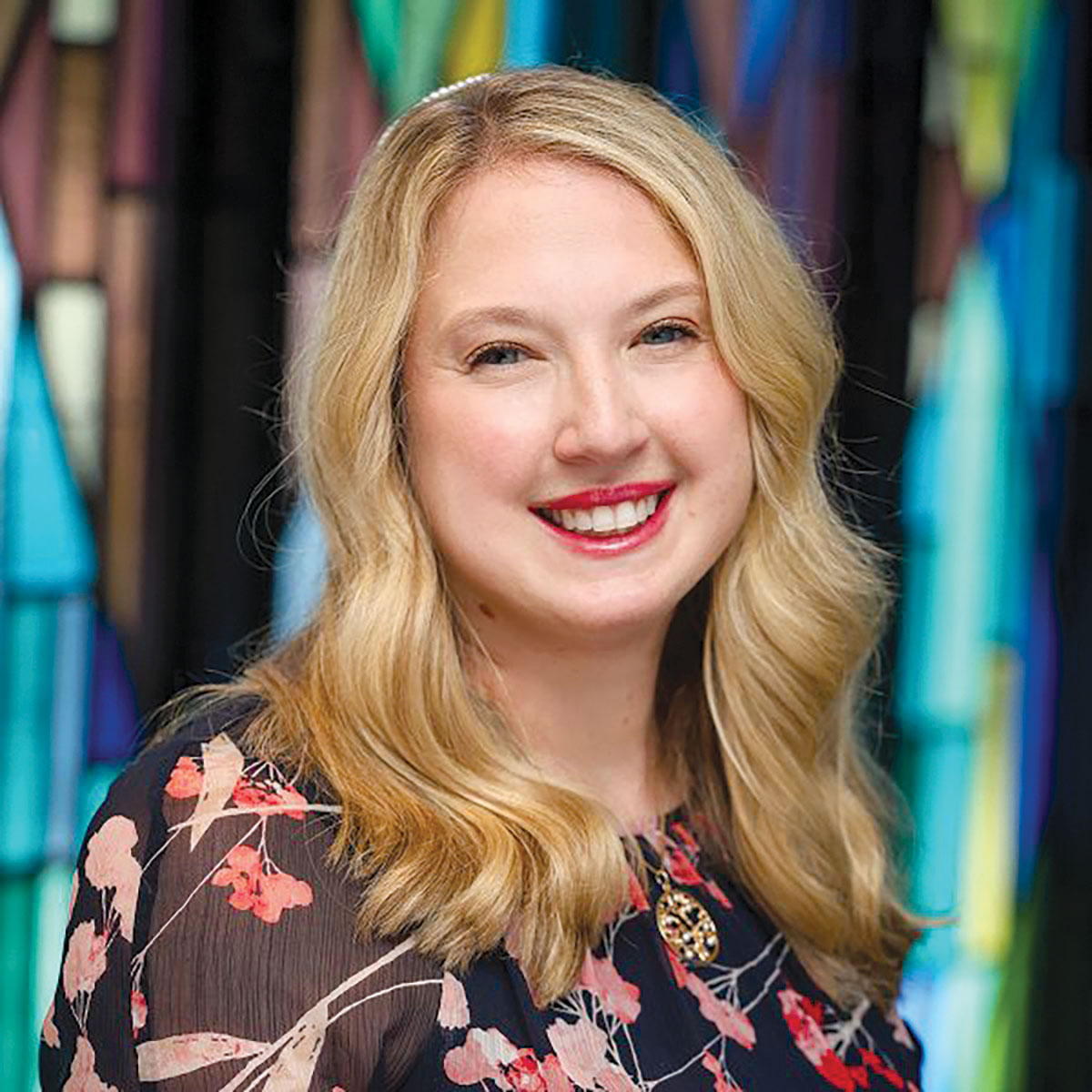
Since becoming an associate marriage and family therapist, Rabbi
Nicole Guzik of Sinai Temple never had a single doubt she made the correct decision. “I am having such a good time,” she said with a wide smile. “And I hope [my clients] are, too.”
At the popular Sinai Temple Mental Health Center, Rabbi Guzik says she sees two types of couples: Those married for years who now are encountering static and couples who are planning to marry.
But there is a sharp distinction, she learned, between married couples and the not-yets. During postgraduate training at the Maple Counseling Center, Beverly Hills, she learned that “unfortunately, when people seek Couples Counseling, it’s not that it is too late, it’s often very far down the line. … However, when people are coming to me for pre-marital counseling, that is like dessert. You can tell this is a couple – they are not far down the line – it’s not too late. It’s that they care so much about their upcoming marriage that they want to do everything they can to create a strong foundation.
“That excites me. It excites me when couples come in – and it is not that they are in crisis, but if people are in crisis, I would welcome them to meet with me, too. I don’t think it is too late. But I am so impressed by couples who say, ‘Everything is going so well that we want to make sure it continues going well.’”
And the work has changed her. “This is how I have changed,” she said. “There is something Rabbi [David] Wolpe taught me many years ago. Perhaps it is obvious to everyone, but I really have held onto it strongly. He has said over and over again that each person has a story. And within each person there are broken pieces. Sometimes they are revealed, sometimes not.
“Rabbi Wolpe is the best – the best. I think since embarking on this journey of becoming a therapist, I have had a better sense of the brokenness that exists in each person. Sometimes it floats up to the surface quicker. Maybe it is just looking at someone’s face and realizing that something is off. I think that has helped me over the last 10 years.”
Her training has given the rabbi the ability to see her clients’ brokenness more quickly. Reading their faces and studying the way questions are answered provide her with valuable insights. Brokenness, she explained, is used synonymously with hurt or anger, sometimes illness. “There is just something that is fracturing the soul, I hope not permanently. My experience has allowed me to see the brokenness quicker. … Sometimes, if it is the right moment, I am able to go up to the person and just let him or her know that I am right here for them,” she said.
What she has learned, she said is “to sit back and listen with a different sense of understanding. … So when someone is trying to share a story with me, I don’t jump in and give my quick opinion that I normally would have. Instead, I feel my job is – as I said when I first got this degree – to ask more questions. But I have to ask the right questions so that perhaps the story that the client wants to tell will come out. … I have found it interesting that the first story we tell is not always the story we want to tell,” she said.
A year after Rabbi Guzik graduated, the Sinai Temple Mental Health Center was opened, owing, she said, to the generosity of Nadine and Fred Rosen. A fulltime clinician, Carolyn Hoffman, was hired. “What we have found over the course of the last six years,” the rabbi said, “is that people really are open to speaking with her. Maybe it’s because it’s a clinician within the synagogue.”
Rabbi Guzik is convinced that placing the Mental Health Center within the Conservative temple has made a huge difference. “It’s a safe space,” she said. “It’s a place of faith, and clients have confidence in her. She’s a phenomenal human being with a fantastic resume of experience. And she also has the backing of the clergy. We put our trust in her. And our congregants trust us. It’s a beautiful synergy.
“Perhaps you have heard this expression before that often in therapy you will go through the first 40 minutes, and as you are leaving and holding onto the doorknob, that is when you start spilling out what you want to share with the therapist. I think the same thing happens in the rabbi’s office, that you really want to share something – but it’s not until the end when you feel comfortable that you are ready to share what was on your heart.
“I just feel so blessed that the combination of clergyperson and therapist strengthens me every day. I am loving it so much. As we are learning more about what social media and AI are doing, and how they are affecting us socially and emotionally, there is such a deeper need for the synagogue, a deeper need for clinicians in-person. More and more, I feel there is a need for this.”