
Four days before she would bury her only son, Rachel Goldberg-Polin stood at the edge of Israel, screaming toward the unforgiving territory where Hersh was being held hostage more than 50 feet underground.
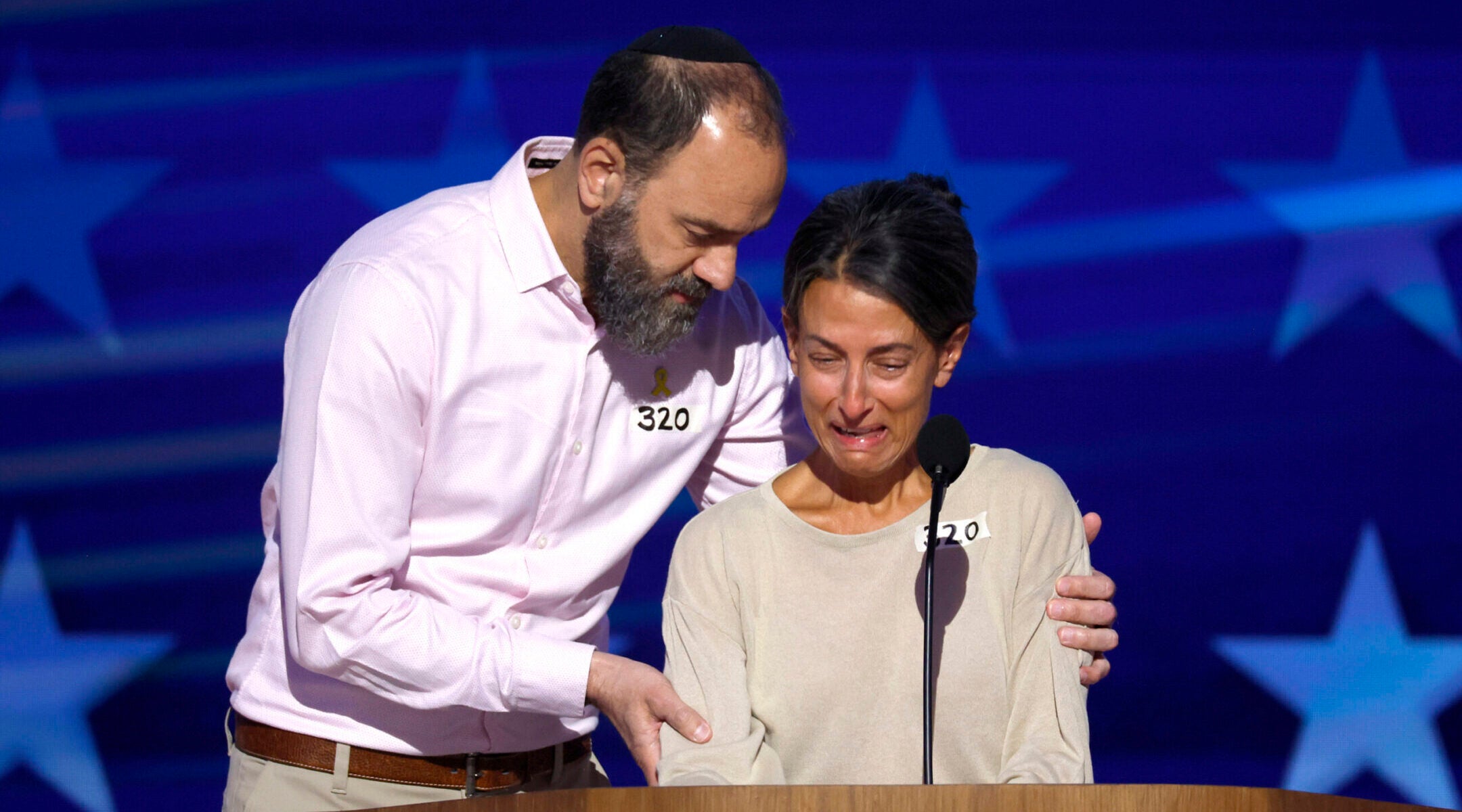
Her voice cracked as she called his name, her raw emotion shattering the facade of composure she had projected when speaking weeks earlier at the Democratic National Convention in her native Chicago about Hersh and the other Israeli hostages taken to Gaza on Oct. 7, 2023.
For 328 days, Goldberg-Polin had been a picture of self-control as she met with world leaders and the pope and anyone else she could to call attention to her son’s plight. Now, she was shrieking.
“I startled the people around us. A cameraman burst into tears. The news crews and others gathered didn’t know the event was beginning, and they didn’t know we families would be howling like wounded animals,” she writes in her new book, out this week. “We were, and are, wounded animals. I am a wounded animal. Every day. Still.”
Goldberg-Polin’s book, “When We See You Again,” offers a visceral accounting of those wounds. Written largely in real time as she and her family galvanized to save Hersh, and concluded after he was murdered in captivity alongside five other Israeli hostages, the book traverses a devastating arc and provides no tidy lessons for its readers, no clear vision of how the better future Hersh sought might become reality.
“The book is about two things and two things only, and that is love and pain,” Goldberg-Polin told the Jewish Telegraphic Agency in an interview conducted via Zoom from her home in Jerusalem. “I don’t know what people are expecting. This is not a memoir. This is not a tell-all. … This is really just pain in words.”
Hersh Goldberg-Polin with his parents, Rachel and Jon, in an undated photograph taken prior to Oct. 7, 2023. (Courtesy Goldberg-Polin family)
Goldberg-Polin describes her pain in physical, concrete ways: She was hit by an 18-wheeler, pounded like a drum, struck with a mallet. Even today, she says, she can’t understand why the people around her ask her how she is doing when there is so clearly a dagger sticking out of her chest.
“It is right here. I see it plain as day,” she said. “I am so confused that I don’t know how to respond.”
People began to exhort Goldberg-Polin to strike a book deal while Hersh was still in Gaza, an idea that she said was incongruous with her singular mission of achieving his release. When she was ready to commit, she had already filled journals with what had transpired in her life and how it left her feeling. Her agent and editors at Random House helped organize the material, but she said they urged few revisions to the content of her writing. How could they?
“They’re really not able to suggest things about how I feel having had my child stolen, maimed, tortured, starved, executed, returned to me in a bag with six bullet holes, skeletal, and I had to put him in the ground,” she said. “They were very aware that I was super sensitive.”
Now, Goldberg-Polin isn’t sure how the resulting book, whose cover recalls the masking tape that she wore marking the number of days since Oct. 7, will land with readers. Unlike the other major Oct. 7 memoir published so far in English, “Hostage” by Eli Sharabi, who learned after being freed last year that his wife and daughters had been murdered, her book doesn’t attempt to balance emotional devastation with a message of resilience.
“I was in so much pain that I just tipped a little, and it just came pouring out,” she said. “It will either resonate with people because of that, or it will be really tough for people because of that.”
For those who prayed for the hostages until the last one, Ran Gvili, returned to Israel for burial in January, Goldberg-Polin’s book does offer new revelations. She recounts the gravity with which the wife of an Israeli official warned her early on that she would not see Hersh for a long time, even as well-meaning friends urged her to be optimistic.
She also reveals how her stomach fell when officials from Israel’s intelligence agency came to her home to survey the information-gathering her family’s own network had been able to accomplish. It was Oct. 10, and she realized that the Israeli government had no secret insights about how to bring Hersh home. “I remember thinking, This is not good,” she writes.
Goldberg-Polin discloses a trip with her husband to “a land where we should not have been” — which, she does not specify — to negotiate a deal for Hersh’s release. After reporting the proposal to someone in the Biden administration, the plan got back to the Israelis, who quashed it, she writes, adding an acid quip: “Loose lips sink hostages.” She never names the people who frustrated and harmed her.
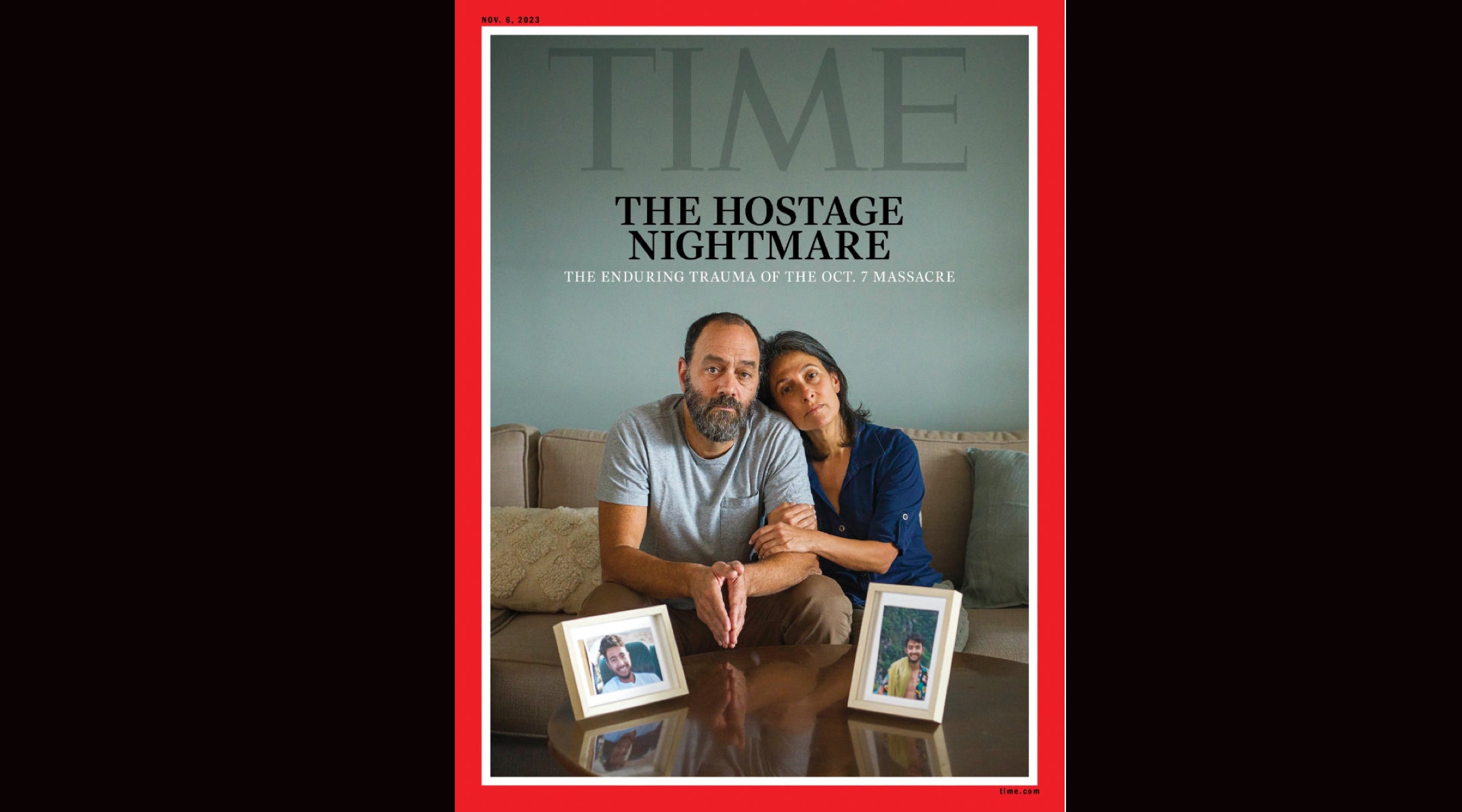
Rachel Goldberg-Polin and Jon Polin posed with pictures of their son Hersh on the cover of Time Magazine in November 2023. (Screenshot)
She is effusive, though, when crediting those who helped ease her pain, such as the American students who transformed the masking tape from a private ritual into a communal effort. In one moving revelation, Goldberg-Polin describes being summoned to meet Or Levy after he was released from Gaza in February 2025. She had never met him before, but he had spent time with Hersh in Gaza, and he wanted to tell Hersh’s mother that he had heard her on the radio, that he knew about her efforts to get him back.
“That will remain one of the highlights of my life for the rest of my life — that meeting with Or Levy in that fluorescently lit hospital room on the evening of [day] 496,” she recalled.
But Goldberg-Polin is not writing for those who want the inside details of a national trauma. The story of Oct. 7, including the massacre at the Nova music festival Hersh attended, takes up only a few pages, just enough to orient the reader. Instead, she envisioned the book as a reflection on the enduringly universal.
“This book is about the human experience of suffering and pain and mourning and grief and loss. And I think the backdrop doesn’t really matter,” she said.
Anyone who has been laid low by grief will recognize Goldberg-Polin’s discomfort at being hugged, difficulty remembering to eat and sleep, or need to retreat into private when publicly sympathies become overwhelming.
But as a longtime Jewish educator who taught courses on Jewish death and mourning practices prior to Oct. 7, Goldberg-Polin offers particular insights from Jewish tradition. (She was just Rachel Goldberg then, before adopting her children’s hyphenated surname to bring the family closer together during Hersh’s captivity.)
In the moments after learning that Hersh had been killed by his captors, just hours after her visit to the Gaza border, she writes that everything she had ever known had evaporated. A rabbi taught her to rend her clothes, a symbolic act that Jews traditionally undertake when learning of the death of a parent, child, spouse or sibling. She got through the funeral and seven-day shiva period almost on autopilot, then embarked upon 11 months of reciting the Mourner’s Kaddish daily for her son. When it came time to Judaism’s official mourning period, she was distressed.
“I am not sure how to put together words to explain how much I did not want to do this. Any of it. But time is unrelenting, even obnoxious,” she writes. She says the milestone was made easier because she marked it without fanfare with her husband and two daughters, Hersh’s younger sisters, in a small synagogue on Cape Cod, alongside members of the Diaspora that had been so supportive throughout the family’s ordeal.
Nine months after that point, Jewish ritual retains both comfort and cruelty for Goldberg-Polin. The Yizkor memorial prayer recited four times a year in synagogues, she said, made her feel resentful: “Every single second of my life is active Yizkor.” At the same time, she also looks forward to thanking God each morning for breathing life into Hersh, reciting a prayer to that effect both in Hebrew and in English, the language in which she is most comfortable.
“I say: The soul you gave Hersh, you created it, you formed it, you breathed into it, you guarded it while it was within him, and one day you did take it from him,” she recounted. “But I’m so thankful that it is here. I know it’s here. It’s just different.”
In the near future, Goldberg-Polin indicated that the family could seek to transform its trauma into action, though she declined to offer details beyond rejecting the idea that she might enter politics in Israel. “Stay tuned,” she said, “because there are things marinating.”
A few things she does know for sure: She’ll keep writing, the words pouring out as she traverses the uneven, treacherous terrain of a lifetime of grief. And she won’t read “When We See You Again” a second time.
“I read it once under duress, as fast as I could, and then I had to record it for the audio version, which was horrific. And that’s it,” she said, adding that when an early copy arrived at her home, she didn’t even open it.
What Goldberg-Polin will do is talk about it, sharing the pain that spills from its pages with national television audiences — her story was recently featured on “60 Minutes” and “Good Morning America” — and sold-out crowds in synagogues across the United States.
“I have no idea if this is going to be the worst mistake ever, or if it’s going to somehow bring some sort of alleviation of the buckling of the weight of my soul that I was suffering from,” she said of her decision to write this book. “I really just felt like I couldn’t shoulder that weight alone anymore.”
Passover may be over, but your chance to support independent Jewish journalism isn’t. Help (JR) keep reporting the stories that define our era.