
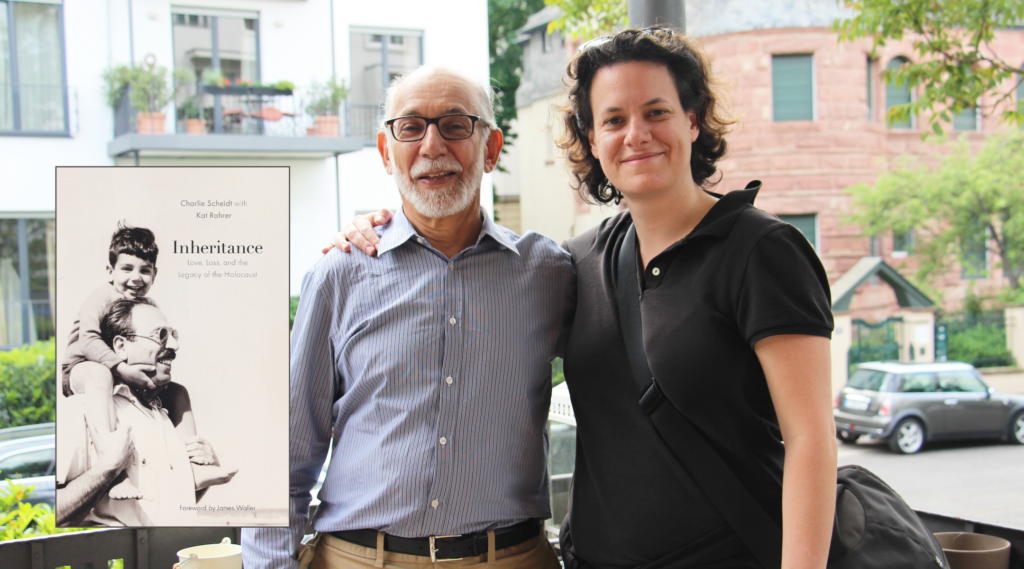
Charlie Scheidt and Kat Rohrer met from opposite sides of the 20th-century moral universe: Scheidt is the only child of German Jewish refugees, raised in New York in a family haunted by what came “before”; she is the granddaughter of a committed Nazi soldier, raised in Austria amid an atmosphere of denial, silence and only partial reckoning.
And yet together, they have written a book about Scheidt’s family’s harrowing escape during the Holocaust.
“Inheritance: Love, Loss and the Legacy of the Holocaust” is based on family letters, archival research and visits to sites in Europe where Scheidt’s family lived and from which they fled. Although Rohrer’s family’s story is only touched upon in the book, the two spoke about their collaboration during a Zoom event earlier this month hosted by the Olga Lengyel Institute for Holocaust Studies and Human Rights in partnership with the Jewish Telegraphic Agency.
“I grew up in a German Jewish world where the history was unspoken,” Scheidt said during the event. “My first language was German. But we didn’t talk about what happened.”
Rohrer, an Austrian filmmaker whose maternal grandfather volunteered for the Wehrmacht and died fighting in Yugoslavia before her mother was born, describes a parallel silence.
“I grew up knowing he was a convinced Nazi,” she said. “But I never met him. There was distance. And with distance comes questions that others in my family didn’t always want to ask.”
Scheidt took years to begin asking such questions. When his mother died in 1988, she left behind an armoire. Expecting to find drawers stuffed with “junk,” he discovered a buried universe.
Inside were nearly 1,000 documents — letters, fragile airmail pages, official papers written in German, French and Dutch. For years, he couldn’t bring himself to fully enter them. They belonged to another time and another world, and he wasn’t ready to unravel the story of family loss and hardship they might reveal.
“I had a life to lead,” said Scheidt, 82, the chairman emeritus of Roland Foods, an importer of specialty foods. “I had a family to raise. I had a business to run.”
Charlie Schedit’s cousin Ellien, second from left, is seen at a friend’s birthday party c. 1941. Ellien and her mother Lilo fled from Germany to Amsterdam, before being sent to Bergen-Belsen and Ravensbruck. (Courtesy of Betsy van der Meer)
In 2009, Scheidt met Rohrer, 46, whose films include the award-winning documentary “Back to the Fatherland,” about Israelis living in Germany. By that time Scheidt had begun slowly to piece together the correspondence between his father, Bruno, who had fled Frankfurt in 1933 and arrived in New York in 1939, and his family still left behind. Rohrer was drawn to historical narratives of displacement and identity.
Scheidt eventually asked Rohrer for help sorting through the overwhelming archive.
“She was interested,” he said. “That was my good fortune.”
Rohrer, for her part, saw something familiar in Scheidt’s hesitation. In the Austria of her youth, she said, the war’s legacy was present but often muted, its meanings buried in silence and national mythmaking.
“I recognized avoidance,” she said. “Not wanting to look too deeply. I saw it in him, and I saw it in myself.”
That mutual recognition became the foundation of their work.
Scheidt’s family were members of the German-Jewish bourgeoisie (a distant cousin, Albert Ballin, was general director of what became the world’s largest steamship line). The family documents describe comfortable lives and prosperous businesses blown apart by the war and the mounting Nazi menace. Bruno’s brother, Max, makes it to France, where he and his wife Erna were safe to restart their lives — until they weren’t. On his mother’s side, his aunt Lilo and her daughter Ellien are chased across Europe, imprisoned in Bergen-Belsen and Ravensbruck, surviving only to face more tragedy.
Among the most painful letters are those between Scheidt’s father and his brother, who would also spend time in internment camps. Max demands his brother’s help and is bitter when it doesn’t arrive quickly enough; Bruno, by then living in New York, insists he is doing all he can.
“They were very intimate letters,” Rohrer said. “Not meant for public consumption. And certainly not meant for us.”
Scheidt said that publishing them required a kind of moral recalibration.
“There are things in there that are critical of my father,” he said. “But that speaks to the reality of what they were living through.”
The book resists tidy moral conclusions. Figures once remembered as heroes reveal blind spots; others previously cast as peripheral or difficult emerge with new complexity. The book is painfully honest about the strained relationship between Lilo, who survived the camps, and her sisters, who made it to America under less dire circumstances. “Lilo was fragile and wounded: Why weren’t they kinder and more tolerant?” Scheidt asks in his book. He suspects a combination of survivors’ guilt and old family grievances not healed by time and tragedy.
Rohrer has other questions about the war, but knows this is Scheidt’s book. What she offered was “inquisitiveness across distance.” She pushed for travel — first across Germany, then France, Austria, and the Netherlands — insisting that documents alone were not enough.
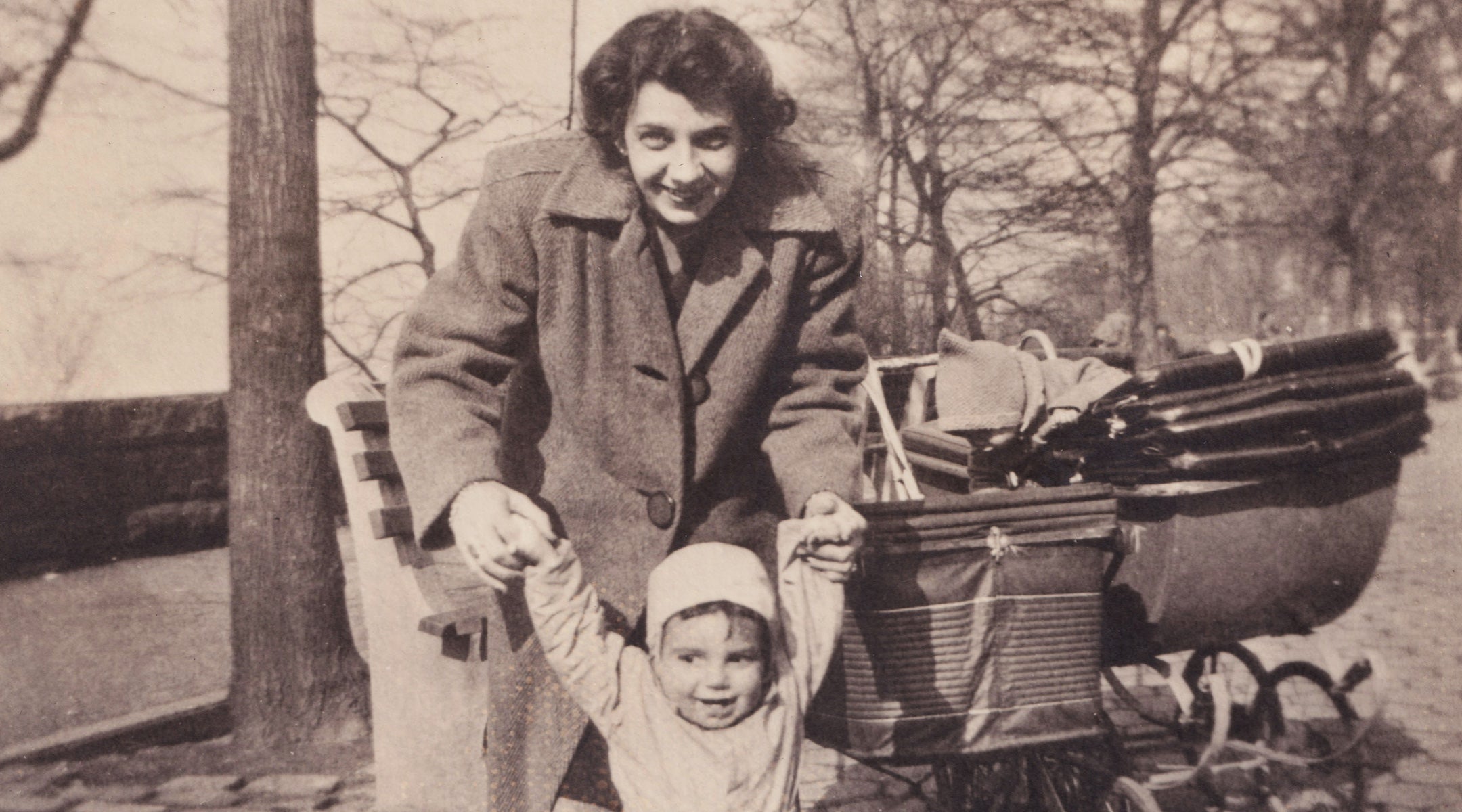
Charlie and his mother Suse in Manhattan’s Riverside Park, Feb. 25, 1944. She and his father Bruno arrived in New York in 1939. (Courtesy Charlie Scheidt)
“I thought I could do this from home,” Scheidt said. “Maybe an archive in the U.S., maybe Europe. But Kat convinced me otherwise.”
Those trips yielded unexpected breakthroughs: from local historians safeguarding forgotten cemeteries, and from strangers who still carried fragments of Scheidt’s family story.
One moment stands out for Rohrer: At an unannounced visit to a school in Amsterdam, a teacher produced a book he researched documenting the Jewish students expelled under Nazi occupation. Inside it, they found a schoolgirl’s note written by Scheidt’s cousin Ellien.
“It was one of those moments where you realize the past is not gone,” Rohrer said. “It is just waiting in different rooms.”
While most of Scheidt’s immediate family members were able to make it out of Europe for new lives in New York and California, he also includes a chapter on relatives who were trapped and his family’s desperate, ultimately futile efforts to save them.
The process changed their understanding of the Holocaust in different but overlapping ways. Scheidt learned more than he had ever known about internment camps in Vichy France and the cruel bureaucratic machinery that blocked escape routes.
For Rohrer, the book intensified longstanding questions about responsibility across generations.
“For many years I felt guilt,” she said. “Shame. Even though I didn’t make those choices.”
Having spent more than a decade on the project, Scheidt has given a lot of thought to why such stories matter, not just to the survivors’ and victims’ progeny but to the world at large.
He has found part of the answer in his work supporting refugees (his family foundation supports the Bruno and Suzanne Scheidt Refugee Protection Program, named for his parents and housed at the Auschwitz Institute for the Prevention of Genocide and Mass Atrocities).
“I couldn’t just let this history disappear with me. It needed to be recorded also for a wider public, because it is a story of refugees, and there are millions and millions of refugees who are being stigmatized and have terrible problems all over the world, including in our country,” said Scheidt. “I grew up with refugees, and I want to tell their story and what they endured and the difficulties of leaving one’s home after centuries in one country, and starting and being chased.
“Some survive, some don’t,” he added. “And I felt it was very important to tell that story.”
Passover may be over, but your chance to support independent Jewish journalism isn’t. Help (JR) keep reporting the stories that define our era.