
This article was produced as part of (JEWISH REVIEW)’s Teen Journalism Fellowship, a program that works with Jewish teens around the world to report on issues that affect their lives.
A Jewish religious school class gathers in a classroom at a private school.
An aliyah — a blessing over the Torah — is read in the First United Methodist Church of Pasadena
A challah is passed from hand to hand at a local university.
In the 15 months since the Eaton Fire destroyed the Pasadena Jewish Temple and Center, a devastating loss to a congregation whose synagogue had stood for more than 80 years, the community continues to practice their faith, even in spaces that aren’t theirs.
In a matter of days, hundreds of Jews across the greater Los Angeles area were stripped not only of their place of worship but also of their religious school, their gathering space, and a place they called home.
In the weeks following the loss, various locations opened their doors and grounds to the 430 congregant families. Students finished out the rest of the religious school year at a local Catholic high school, which welcomed the school to conduct weekly learning on its campus.
Now, they meet two days a week at Frostig School in Pasadena — a K-12 school less than a mile away from the original site. As for other events, the congregation rents out the First United Methodist Church of Pasadena, where they organize b’nai mitzvahs and prayer services and assemble for other gatherings.
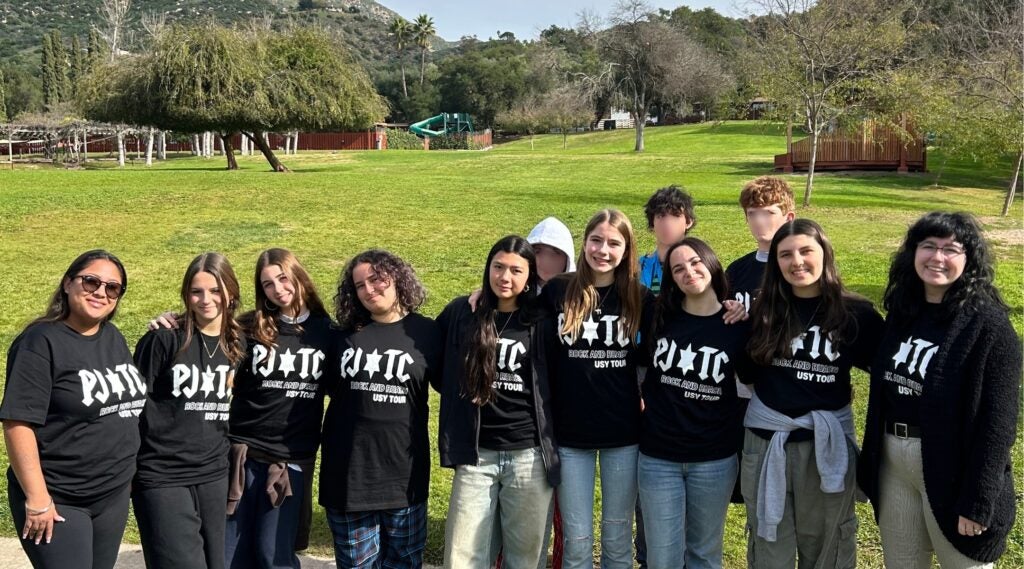
PJTC’s United Synagogue Youth group, for 8th-12th graders, continues to plan and hold events while having to work around disruptions to the program. Student board members must tackle the issue of not having a designated space while gathering for meetings and activities.
“It feels almost like we’re visitors sometimes, and well, because we are visitors,” said Sofia Manacker.
Manacker, 17, a teacher’s assistant at the religious school and the president of her USY group at PJTC, said that because of the displacement, it feels like her community doesn’t have a home.
“I grew up in the temple, and I still miss being able to go to that little alcove where we could just hide out,” she said. Manacker said that in their temporary spaces, attendees have to be more cautious with how they treat their surroundings and feel more guarded with their feelings.
Juliet Levine, 15, who serves as a board member for the PJTC USY, said her discomfort is more prevalent during moments of prayer.
“When I go to services, it is weird because it’s not at PJTC, which was a lot more homey and comfortable to be in, whereas the church is completely different,” Levine said. She added that it doesn’t feel natural to pray as a Jew in a church.
The synagogue is mindful of the community’s comfort level and is selective in how they use borrowed facilities.
“We have purposely not used a Christian or Catholic space for the High Holidays, because some people feel like Shabbat is one thing, but High Holidays is something different,” said Rabbi Jill Gold Wright, PJTC’s director of education. She found that while most congregants accept the displacement and feel that “a house of God is a house of God,” some congregants do not feel comfortable going to shul in a church.
The remains of the Pasadena Jewish Temple and Center following the Eaton Fire in Jan. 2025. (Josh Edelson/AFP via Getty Images)
Last fall, during the first High Holidays following the fire, members of the Pasadena Jewish community met at the California Institute of Technology auditorium to observe Rosh Hashanah and Yom Kippur, led by the PJTC clergy.
Joining the youth group’s executive teen board was once a popular activity for involved students at the temple, whose USY chapter drew dozens of members. “Sushi in the Sukkah” and “Friendsgiving” were regular events that members of the USY board programmed even before the fire. But what was once an engaged teen community that met monthly in the synagogue youth lounge for pizza, planning events with high attendance, is now a group faced with challenges in membership retention, event hosting, and simply community building.
“There’s not a lot of connection that I feel to the temple anymore,” said Charlie Bernstein, 17, a USY member and former religious school teacher’s assistant. “Now is my time to become a leader in the synagogue, but there isn’t really much to lead anymore.”
Levine and others said that in their temporary spaces, they lack permission to do a lot of their traditional activities.
“For example, we can’t do a sleepover before the Purim Carnival, the way that we normally do,” at their temporary location at the Frostig School, said Emily Catalano, the assistant director of youth engagement and education. “We’re not sure that we’ll be able to do one at all,”
PJTC previously had a youth lounge where USY could gather for meetings and events.
“The youth lounge was the USY’s space to do with as they pleased and run their own programs,” Emily Catalano said.
“We don’t have a dedicated space that is ours; we’re constantly wrestling with other groups and between all of the different spaces. And so I think that it’s trickier in general to make programs happen, and it’s also trickier to get that buy-in and engagement from the teens.” Catalano said.
PJTC will return to their original location, and is currently in the “design and permitting” phase of their rebuilding process. Currently, the staff is working to maintain city approval and receive architectural insight. They hope to gather in 2028 for Rosh Hashanah at their new synagogue.
However, even with numerous changes, the PJTC community remains resilient and connected. The changes have even forced synagogue students out of their comfort zone.
“I’ve been talking to more people, and it’s just because I realize how important community is after this,” said Manacker. “It feels like a restart, almost.”
Meanwhile, for Catalano, it is clear that the teens are “still excited and engaged and show their strength and resilience in such an incredible way.”
“People kind of had to reimagine what the synagogue and what their Jewish life meant to them,” Rabbi Jill said, adding that, “people kind of stopped taking for granted the fact that it was always there, and they realized how important their Jewish community was to them.”
Passover may be over, but your chance to support independent Jewish journalism isn’t. Help (JEWISH REVIEW) keep reporting the stories that define our era.