
In the almost three years since the Oct. 7, 2023, Hamas invasion of Israel, Great Britain has seen “a relentless focus on everything to do with the Jewish community in the public domain, and it’s about antisemitism or Israel,” said Adam Ma’anit, the communications manager for the Board of Deputies of British Jews.
Over the past four weeks, a flurry of performances, lectures and art exhibits has been an opportunity to move past that.
The Board of Deputies, which represents a community of diverse and often competing views under its umbrella, created Jewish Culture Month, a first-of-its-kind series held under the banner of “Less Oy, More Joy.” The month was designed to bolster Jewish communal confidence and to introduce wider audiences to aspects of Jewish life that rarely make headlines.
The month, which wrapped up Tuesday, sought to make clear that British Jewish identity is, and always has been, about far more than conflict. “We’re not defined as a community by pain,” Ma’anit told the Jewish Telegraphic Agency. “We’ve got great architects, writers, and musicians as well.”
Those artists were featured in more than 150 events over four weeks across the country at major museums and galleries , including London’s British Museum, Oxford’s Bodlein Library, Bath’s Little Theatre Cinema, Nottinghamshire’s National Holocaust Museum and local synagogues and private homes nationwide.
Among them was The Klezmer Village Band, which introduced Jewish culture to primary schools in Plymouth. “We wanted to bring Jewish culture back into the community,” Plymouth Jewish Community Director Louise Clements said. “This is the first time in many years that something like this has happened here.”
One of the band’s musicians, Ilana Cravitz, also noted after the event that “music is a wordless language. People respond from inside — they stop thinking, they feel. And we really saw that today.”
Notables featured throughout the celebrations included British broadcaster and television personality Vanessa Feltz, who spoke at the opening at London’s Freud Museum; comedian Bennett Arron, who performed stand-up routines in Hampstead, London; and acclaimed British artist and vocal Israel critic Anish Kapoor, whose exhibit opening on Tuesday closed out the month.
“Part of Jewish Culture Month is about us celebrating our own culture and being proud, British Jews, and asserting ourselves in an environment where it has been the most challenging to be that very British Jew,” said Ma’anit.
The Holocaust Memorial Day Trust noted another aspect of the festival soon after it kicked off on May 16. “At a time when division and prejudice continue to affect communities across the country, initiatives like Jewish Culture Month can help build understanding and strengthen social cohesion,” it posted social media.
However, some thought it difficult to focus on social cohesion when discussing contemporary British Jewish identity without discussing how that identity dovetails with British Jews’ relationship with Israel.
It’s something that Jewish Renaissance, the online magazine of Jewish culture, raised ahead of the opening. Freelance writer and former Jewish Quarterly editor Matthew Reisz wrote that while there was definitely diversity in the program, “We seem unlikely to hear much about the deep divisions within the community, not least in relation to Israel/Palestine, or the crucial, though often tense dialogue with other minority communities on both shared and contentious issues.”
The JW3 Jewish community center in London hosted “L’Chaim/L’Chaos – 50 Years of Jewish Punk,” as part of Britain’s Jewish Culture Month, June 7, 2026. (Denise Lester/Courtesy Jewish Culture Month)
Ma’anit insisted that the choice was a deliberate one. “It’s not a rejection of Zionism or distancing ourselves from Israel,” he said. “Quite the opposite. The board’s leadership remains openly supportive of Israel and many of the figures involved in the project have deep personal and family ties to the country.”
Israeli-born Ma’anit is one of those figures. He is the cousin of the Idan family of Nachal Oz, a kibbutz close by the border with Gaza. Eighteen-year-old Maayan Idan was shot and killed by Hamas terrorists on Oct. 7 while trying to help her father, Tsachi, hold their safe room door closed. The entire event was livestreamed by the terrorists. Tsachi was abducted into Gaza, where it was believed he was still alive as the war on Gaza raged. It was discovered only later that he had been murdered, with his body finally returned in the hostage deal in February 2025.
Ma’anit, who spent those years lobbying for the hostages’ return, appearing on news programs and organizing hostage vigils in his hometown of Brighton, has been forced to meld the personal with the professional when it comes to the post-Oct. 7 era.
It’s why, he said, Jewish Culture Month is about creating space for aspects of Jewish identity that have been overshadowed post Oct. 7. “The argument is not that Israel is unimportant,” he said, “it’s that Jewish life cannot be reduced to Israel alone.”
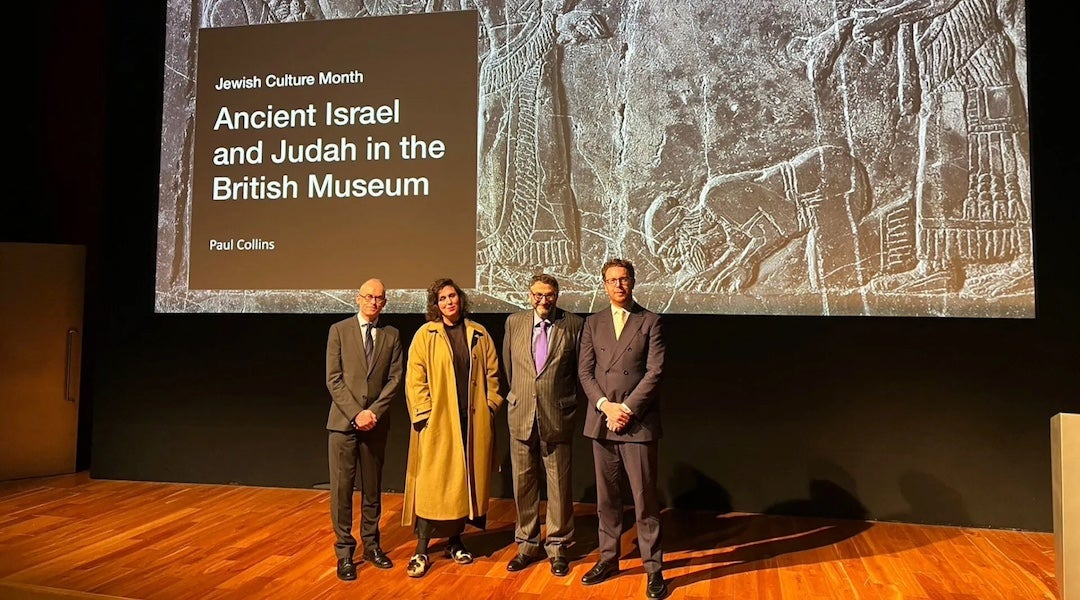
Yet even without a focus on Israel and Zionism, the month did not pass without the conflict in the Middle East affecting the program. In May, a culture month lecture titled “Ancient Israel and Judah” at the British Museum had to be postponed, the museum said, because of “security concerns” over potential “disruptions” by protesters who had obtained tickets. The rescheduled event, held June 11, was the best-attended of the entire series, with around 4,000 people joining in person and online.
Ma’anit called the incident “overblown. It was just procedural,” he said. “People fill in the blanks and then it gets out of control.”
However, the speed with which the controversy escalated and elicited angry reactions from many in the community only served to highlight how questions about Jewish visibility and any event with “Israel” in the name — even a reference to thousands of years ago — have become highly charged in the last three years.
“It just shows how on edge the community is,” Ma’anit said.
That has intensified the need for something like Jewish Culture Month in the eyes of many British Jews. Steph Thwaites, head of a group dedicated to helping Jewish publishing professionals navigate an increasingly hostile publishing industry, said after a Jewish Culture Month event on the topic that the professionals felt “a sense of community and a source of comfort,” as well as a space to “combat anti-Jewish racism in publishing and to support Jewish creatives.”
Ultimately, as UK Communities Secretary Steve Reed put it in his speech at the launch of the festivities, Jewish Culture Month “is a time to celebrate Britain’s Jewish community and its contribution to our shared story. It’s a time for coming together. It’s a time for friendship. Jewish experience cannot just be about defending against fear; it also has to be an expression of hope and joy and freedom.”
Reporting the stories that define our era. When history unfolds in real-time, the Jewish world turns to JR. Your support ensures we can document the complexities of war and the resilience of Jewish communities with integrity.