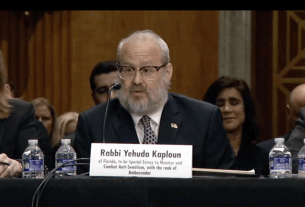

Nearly two dozen Jewish Democrats in Congress signed a letter opposing plans to fold the State Department’s standalone Holocaust envoy office into the office of Rabbi Yehuda Kaploun, the Trump administration’s special envoy to monitor and combat antisemitism.
Kaploun has been pushing for the merger for months, and his efforts have divided Jewish leaders over the future of Holocaust diplomacy. Supporters of the move claimed that it would improve efficiency, while critics said it would flatten the attention given to Holocaust-specific issues, and criticized it as a power grab by Kaploun.
Opposition to the plan escalated Wednesday when 19 members of Congress, in a letter shared exclusively with the Jewish Telegraphic Agency, called for Secretary of State Marco Rubio to preserve the Holocaust envoy as “a distinct, permanent office led by a dedicated career State Department official.”
The officials, who are all members of the Congressional Jewish Caucus, wrote that the two offices “are complementary, but they are not interchangeable.” Kaploun’s office is “responsible for confronting contemporary antisemitism around the world,” the letter reads, while the Holocaust envoy’s office “focuses on Holocaust-era restitution, historical justice, remembrance, and accountability.”
Signatories on the letter include moderate Democrats such as Reps. Jared Moskowitz and Josh Gottheimer, and progressives including Reps. Jamie Raskin and Jan Schakowsky.
New York Rep. Jerry Nadler, who co-led the letter with Illinois Rep. Brad Schneider, said back in June that the potential move was “abominable” and a “vain attempt to consolidate power by Yehuda Kaploun.”
“If supporting Holocaust victims and their families was a priority to this Administration, they would seek further opportunities to support SEHI, not to eliminate it,” said Nadler, the House’s longest-serving Jewish member, using the acronym for the Holocaust envoy office.
Wednesday’s letter called for Rubio to not only preserve the role, which is currently vacant, but also to “immediately appoint a new Special Envoy for Holocaust Issues.” Rubio has not named a successor to Ellen Germain, whose term ended on July 31 after she took over in August 2021.
Germain notably emphasized the need for European nations to sustain remembrance of the Holocaust and their roles in its perpetration; top Trump administration figures, including Vice President JD Vance, have said that the current intensity of Holocaust commemoration in Europe is counterproductive.
A group of Jewish organizations, including the Anti-Defamation League, American Jewish Committee and B’nai Brith International, had called on Rubio to fill the impending vacancy back in April. Doing so, the groups wrote, would “demonstrate the prioritization that the United States ascribes to preserving the uniqueness of the Holocaust through this special office,” and “ensure that its critical work continues.”
A separate host of Jewish groups, including the Combat Antisemitism Movement, the Union of Orthodox Jewish Congregations of America, the World Jewish Congress and Chabad-Lubavitch World Headquarters, had called for Rubio to go ahead with the merger in June to increase efficiency and avoid “duplicative efforts” by the two offices.
The Jewish Democrats’ letter this week refuted that argument.
“Combining them would not streamline efficiency or eliminate any meaningful duplication; it would risk diminishing the focus, experience, and institutional capacity necessary for each,” the letter reads.
As the Year Turns, Support the Journalism You Trust. (JEWISH REVIEW) covers the stories shaping Jewish life around the world — with the depth this moment calls for. As you reflect on the year ahead, consider a gift that keeps independent Jewish journalism strong.