

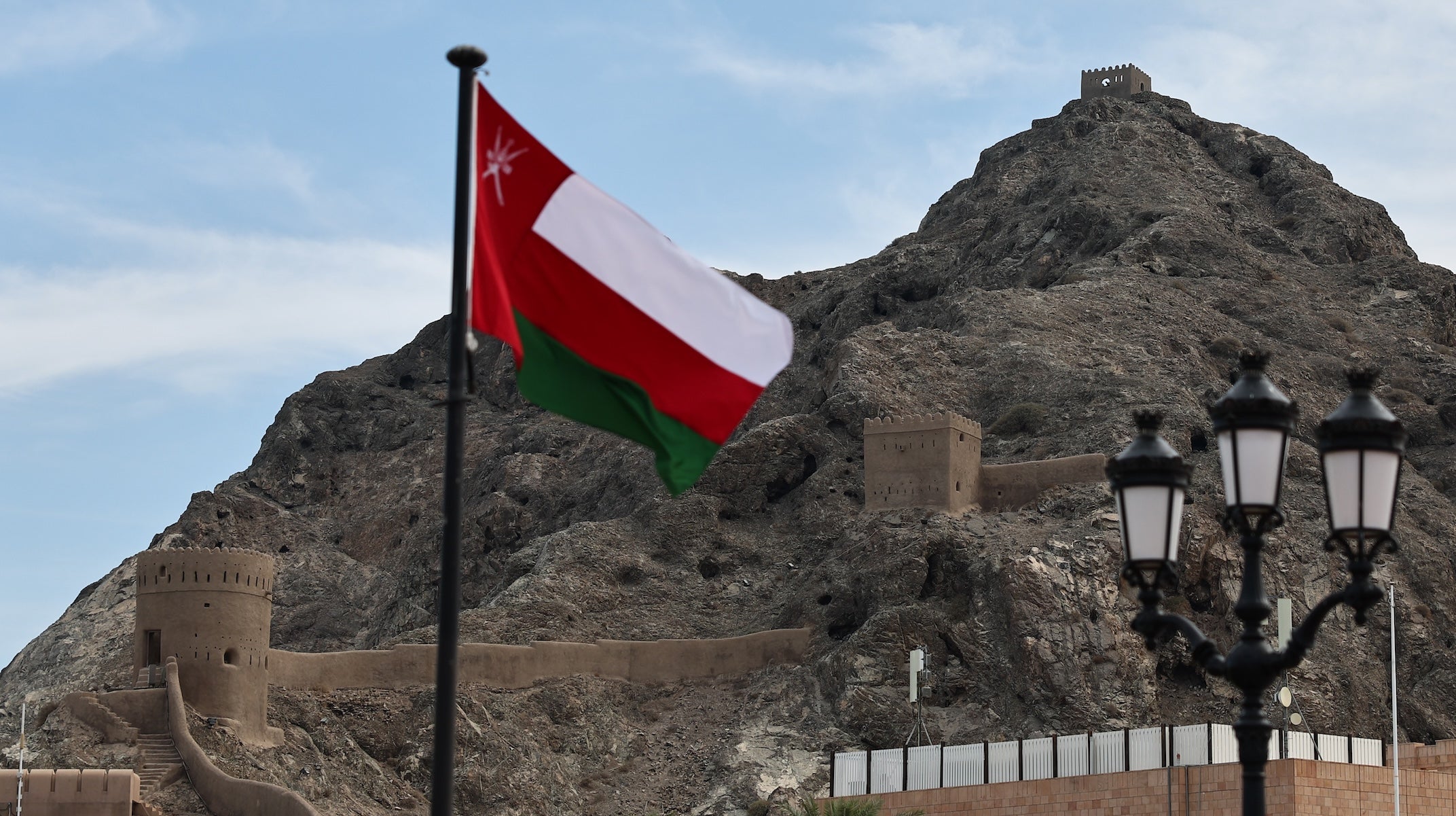
TEL AVIV – The Omani pilot who allegedly tried to hijack and crash a flydubai flight bound for Tel Aviv has drawn new attention to his native country. Oman, which has sometimes been dubbed the “Switzerland of the Middle East,” has long sought to balance its relations with the West and Iran. Its strategic location, combined with its distinctive diplomatic approach, has made it an unusual player in the Middle East.
Oman is located on the southeastern corner of the Arabian Peninsula, bordering Saudi Arabia, the United Arab Emirates and Yemen. It sits alongside the Strait of Hormuz, the strategically important maritime passage through which roughly one-fifth of the world’s oil supply passes.
Until recently, Oman wasn’t a Middle Eastern country used to finding itself in international headlines. But it has emerged as a key player in recent months after long serving as a central mediator between Washington and Tehran. Its neutral posture, along with its close ties to both the United States and Iran, placed it in an important position during the talks between the two sides before the outbreak of the U.S.-Iran war earlier this year.
When Omani mediation failed to prevent the conflict, Oman condemned the joint U.S.-Israeli military campaign launched in February, saying it had “deep regrets at the military operations launched by Israel and the United States of America against the Islamic Republic of Iran” and that it “considers this action to be in contravention of the rules of international law.”
Even after Iran itself attacked Oman, which hosts three U.S. military bases, as part of Tehran’s campaign to pressure countries in the region and deter President Donald Trump, Muscat did not abandon its neutral stance. The targets Iran struck in Oman included a port and oil infrastructure, although the attacks were limited compared with those on other countries in the region.
Relations between Washington and Muscat have become further strained as the war has continued. In an opinion article published in The Economist, Oman’s foreign minister described the war as “unlawful” and said the United States “has lost control of its foreign policy.”
Trump, meanwhile, threatened to bomb Oman, telling reporters in August, “I don’t think they behaved very well, but we’d handle them very easily just like we do others.” The Wall Street Journal reported that senior U.S. officials had privately accused Oman of being “a duplicitous actor” that largely sides with Iran rather than seeking the best possible deal between Washington and Tehran.
While the Gulf state maintains significant ties with Washington, it does not have formal diplomatic relations with Israel. The two countries once maintained commercial relations, but those ties were cut in 2000 amid a deterioration in the Israeli-Palestinian conflict. Contacts between the countries later continued quietly, and Netanyahu visited Oman in 2018 in a rare public meeting between an Israeli prime minister and an Omani sultan.
The two countries have held discussions about establishing formal relations, but those efforts have not come to fruition to date. Oman’s position has remained broadly similar to that of Saudi Arabia, which talked openly about the possibility of normalization with Israel but has conditioned that recognition on a clear, irreversible path toward a Palestinian state. Oman has also expressed support for the Abraham Accords, which normalized relations between Israel, the United Arab Emirates and Bahrain in 2020 and have since been signed by a handful of other Muslim countries.
Oman’s rhetoric toward Israel has grown harsher since Oct. 7, 2023, and relations between the countries have cooled. Omani officials have strongly criticized Israel’s conduct in Gaza and have been particularly critical of Israel’s war against Iran.
Ahmed bin Hamad al-Khalili, Oman’s grand mufti, described Israel’s attack on Iran as “treacherous American-Zionist aggression against Iran.”
A strategic Gulf state
Much of Oman’s geographic importance comes from its position along bodies of water through which large quantities of oil transit. Its land, in contrast, is covered by desert alongside a coastal plain that is home to a significant share of the country’s population of roughly 5.5 million.
That population is distinctive in the Muslim world: A significant portion of its citizens belong to the Ibadi branch of Islam, a tradition separate from both Sunni and Shiite Islam. The country is also home to a large expatriate population made up of people from different religious backgrounds.
Oman is a sultanate, meaning the sultan holds extensive powers. The current ruler, Sultan Haitham bin Tarik Al Said, took office in January 2020 following the death of his cousin, Sultan Qaboos, who had ruled the country for nearly 50 years.
A significant part of Oman’s economy is based on oil, although the country has sought to diversify its economy. Its strategic location and extensive coastline have also made it a gateway for international trade between Europe and Asia.
Oman has so far not issued an official response to the incident or publicly confirmed the identity or nationality of the pilot who allegedly carried out the flydubai attack. But Israeli Prime Minister Benjamin Netanyahu and international media outlets have described the pilot as Omani.
In a statement, Netanyahu said that “the perpetrator underwent Islamist radicalization. He came to crash the plane. We are now investigating whether he was sent, and whoever sent him will pay a very heavy price.”
As the Year Turns, Support the Journalism You Trust. JR covers the stories shaping Jewish life around the world — with the depth this moment calls for. As you reflect on the year ahead, consider a gift that keeps independent Jewish journalism strong.