
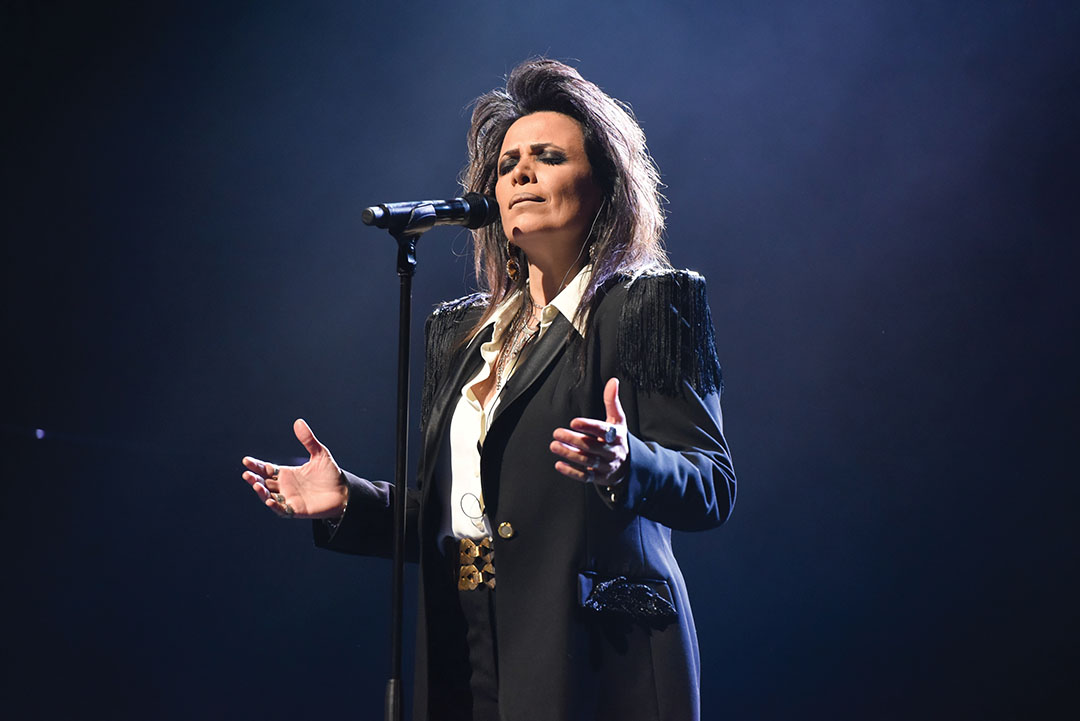
Yasmin Levy inherited one of the Jewish world’s oldest musical traditions and built a career by refusing to leave it untouched. The Israeli singer returns the Saban Theater in Beverly Hills on Oct. 11 with “One More Night,” bringing the mix of Ladino, flamenco and Middle Eastern music that has defined much of her work.
Ladino, or Judeo-Spanish, developed among Sephardic Jews after their expulsion from Spain. Levy was born in Jerusalem in 1975 to a family of Turkish Sephardic heritage. Her father, Yitzhak Levy, was a composer, hazzan and researcher of Ladino music and culture who died when Yasmin was one year old.
Levy’s catalog includes “Adio Kerida,” “La Alegría,” “Me Voy,” “Nací en Álamo,” “Irme Kero” and “Una Pastora.” “Me Voy” won the USA Songwriting Award for Best World Music Song in 2008, according to Levy’s website.
“For me, it’s like Fado, Argentinian tango, flamenco, songs that came from pain and from streets, from life and lives of people,” Levy told the Journal. “And actually those songs like Fado, it helped people to survive difficulties. And there are many funny songs because they had a huge humor. When you’re sad, you use humor.”
One of Levy’s career turns came about 23 years ago during a concert in London. At the time, audiences expected traditional material from her. When the crowd asked for an encore and Levy had nothing left prepared, she asked her manager if she could sing an unreleased song she had written.
“It was the first time that I performed my song,” Levy said. “He said, ‘Yes, of course.’ And this was the theme of my life. It’s changed everything.”
The song was “Me Voy.” The experience pushed Levy toward more of her own writing and away from the musical categories she felt had been assigned to her.
“I broke every frame, every possible frame. Also, my fears,” Levy said.
Levy said promoters could treat Ladino or world music as a slot to fill on a festival bill. She began to feel it did not matter who the singer was as long as somebody occupied that category.
Then she began changing the old songs.
Levy added elements including Turkish music and flamenco. Some Sephardic listeners, Levy said, viewed songs inherited from parents and grandparents as material that should remain in the form they remembered.
“Because I came to something very fragile,” Levy said. “I took songs from their fathers and mothers that sang for them for a baby and very gentle and you can’t do anything. It’s like from a museum. And I said, ‘No, I’m wild when I’m singing.’”
She said it wasn’t received well at all.
.“When I did that, the Jewish community Sephardic in Israel totally boycott me for seven years,” Levy said.
That willingness to reject a framework also appears in the way Levy talks about religion.
Levy said she chose to become religious and lived that way for 21 years. She came to believe that her interpretation of faith had become built around fear, punishment and reward.
“My problem is that I don’t have a middle. I don’t have gray. It’s either white or black. Also, my singing,” Levy said. “People can’t sit and drink wine with my music. It’s either you hate it or you really love it. And what I did with religious was also like this.”
Levy said fear began shaping the way she viewed good and bad actions. “My religion, sorry, my faith was based on fear,” Levy said. “Even the good I did was not to do good to get reward because I’m scared that now I did bad thing and I will get punished.”
Her relationship with criticism changed too. She said reviews could devastate her when she was young. Her newest album came after her divorce, during a period when she no longer wanted critics determining the value of what she made. She told her manager she did not want the record sent to journalists and described it as a private gift to herself.
“That’s why this one is different. But to get to this point that you don’t care about critics, it’s 25 years of really eating s—.”
At another point in her career, Levy stopped recording for seven years.
Producer Ben Mandelson had told her an album should represent what an artist has to say during that part of life. Levy took the idea at face value.
Asked why she went seven years without making another record, Levy gave a short answer.
“If I sing something, I only sing something that I personally live,” Levy said. “And when I sing something, I commit a suicide on a song. This is everything for me. Nevermind, I sang it 20 times, 30. My whole being is singing. All my body. I can’t sing, for example, about the sunshine, flowers.”
Levy has less affection for recording than performing.
“I really hated the studio because I need to bring all my emotions into some computer,” Levy said. “I need to compress. This drives me crazy. My freedom is only on stage. I’m so free, you can’t imagine.”
When asked what audiences should expect from her concerts, Levy stopped during the answer and reconsidered what happens between performer and listener.
“Listen, yes. No one asked me this, but I realize now something,” Levy said. “I bring my journey of life, my sadness, my pain, my happiness. I bring everything on stage.”
Levy said she sees the stage as a place where listeners can confront feelings they may have trouble expressing.
“And now my answer for you is that I bring their pain, that they’re not capable or scared to express,” Levy said. “I was not ashamed to think about all my problems. And people like, ‘Okay, she also suffers. He also, not only me. Okay, let’s deal with this.’”
Music filled Levy’s family life long before it became her career. Levy is the youngest of four children, and the siblings grew up playing piano. Her own children, now 15 and 12, have developed tastes of their own.
“They definitely don’t like my music,” Levy said.
One of Levy’s children had begun listening to Sade, which delighted Levy. Levy said she was glad her children grew up around happier music than the sad songs that surrounded her childhood.
She also believes musical taste can reveal something about relationships.
“I want to prove. I know this. I don’t know how to prove that music tells about you and you can tell if you match or not. I swear to God,” Levy said.
For all the changes Levy has made to the music she inherited, one part of that inheritance has remained constant. Asked which parts of her father’s work she still finds herself returning to, Levy rejected the premise of the question.
“No, because I never left,” Levy said.
Yasmin Levy appears at The Saban Theater, Sunday Oct. 11, at 8 p.m. Tickets: https://wheremusicmeetsthesoul.com/events/yasmin-levy-one-more-night-tour-saban-theatre/