

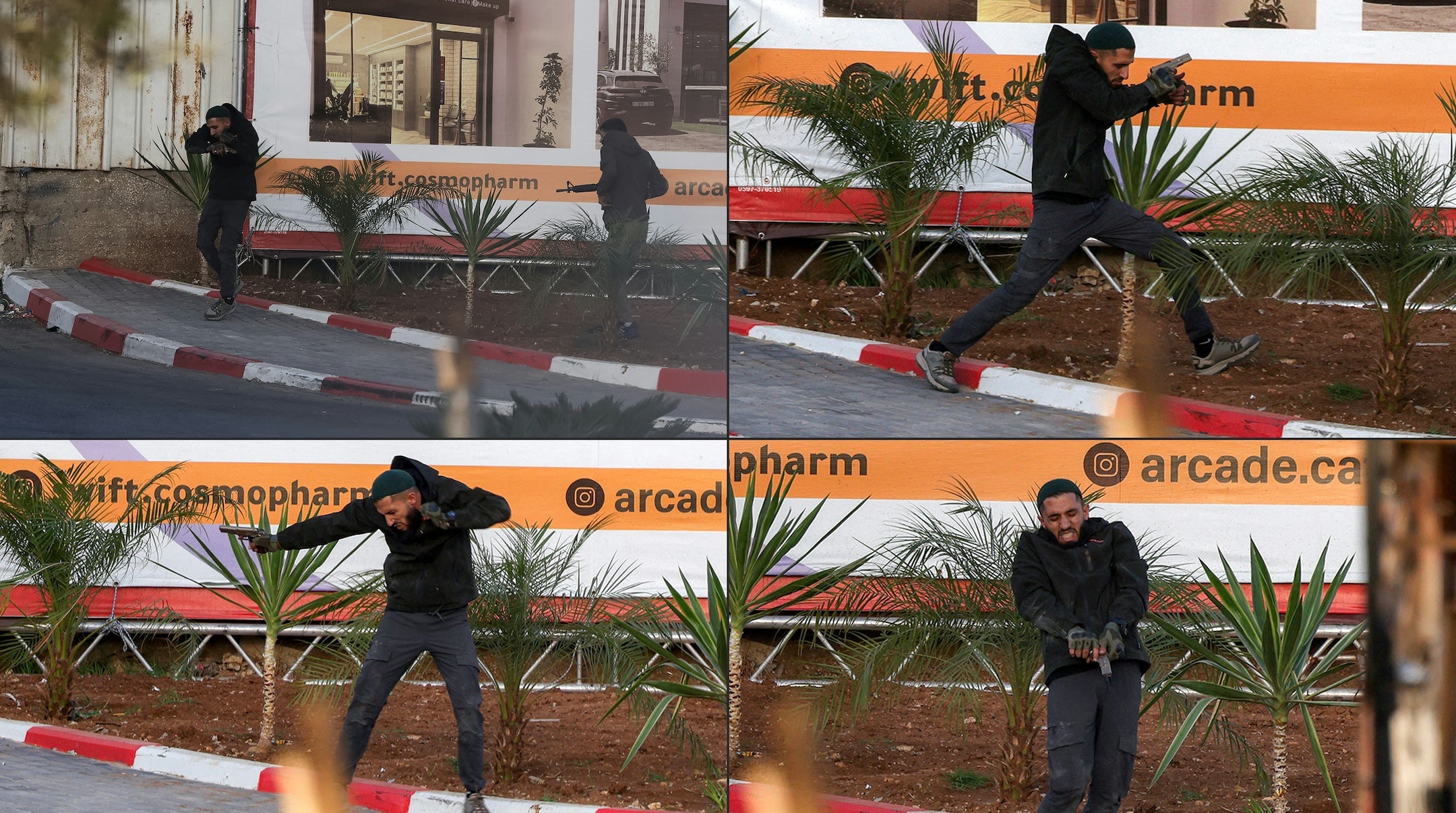
The Israeli army is planning a large-scale military operation against Palestinian terrorists in the West Bank, Prime Minister Benjamin Netanyahu said after Palestinian gunmen killed two soldiers and wounded three others outside of Hebron on Friday morning.
Netanyahu visited the site of the attack along with Defense Minister Israel Katz, pledging that the IDF would destroy the Palestinian neighborhood of Hebron where the two attackers lived.
“We will evacuate the residents, go house-to-house, we will remove the weapons and all the terror infrastructure will be dealt with and destroyed,” Netanyahu said.
The IDF, he added, is preparing for a large-scale military operation against Palestinian terrorism in the West Bank, the likes of which has not been seen since the 1967 Six-Day War.
“We will also guarantee something else,” Netanyahu said, explaining that he and Katz had drawn up plans for “a very broad IDF operation in Judea and Samaria [the West Bank], the likes of which have not been done since the Six-Day War. The IDF is ready to carry it out and we will determine the timing, but it is on its way.”
The attack which claimed the lives of Staff Sergeant Ron Yonatan Roytman, 23, from Ashkelon and Sergeant Yuval Shai Svilem, 20, from Hod Hasharon, occurred as the IDF was already on high alert due to next Tuesday’s Israeli elections.
IDF Chief of Staff Lt. Gen. Eyal Zamir called the incident a “serious attack” and said the actions of Israeli troops at the scene had prevented an even more serious one.
Footage of the incident published on social media and in Israeli media shows the two Palestinian assailants leaving their car and engaging an IDF force stationed at a checkpoint on a road used by Palestinian vehicles off of Route 35 next to Hebron.
According to the military, the assailants were carrying an assault rifle, a handgun and a large quantity of ammunition.
The exchange of fire lasted more than 20 minutes, until an IDF force stormed the scene and killed both assailants, according to the military briefing. A large quantity of ammunition was found in the assailants’ vehicle, and the IDF assessed that they had been on their way to carry out a major attack against Israeli civilians.
One of the first responders to the scene, MDA emergency medical technician Tzuriel Edri, told reporters, “We arrived at a difficult scene while gunfire was still ongoing in the area.
“We entered with MDA’s bulletproof ambulance and immediately began helping evacuate the wounded. We loaded a young man in his 20s, who was unconscious with gunshot wounds and in very serious condition, into the ambulance and provided him with medical treatment.
“We evacuated additional wounded people to MDA ambulances that had arrived at the scene and immediately began transporting them to hospitals. Another patient in very serious condition was treated by IDF medical personnel in a mobile intensive care unit.”
Netanyahu held a security assessment with senior defense officials and announced he had instructed the IDF to immediately impose a siege on Hebron and “prepare for a full shutdown of all of Judea and Samaria starting today.”
Netanyahu added that Israel would “pursue Hamas terrorists and those who send them, everywhere and at all times. You have nowhere to hide.”
The IDF briefed reporters that Hebron, a Palestinian city of over 200,000, was under a full siege, with no one permitted to enter or leave the city. Elsewhere in the West Bank, IDF forces were conducting extensive checks of Palestinian vehicles arriving at major roads.
With four days to go until the elections, politicians condemned the attack with rhetoric that hammered home the essential security messages of their campaigns.
Israeli right-wing leaders Benjamin Netanyahu, Itamar Ben-Gvir and Bezalel Smotrich quickly called for tough measures in the West Bank following the attack.
Though Netanyahu announced a sweeping military operation, Ben-Gvir moved to outflank him from the right, saying the attack “once again illustrates what I have been saying in the cabinet for four years. We need to dismantle this thing called the Palestinian Authority.”
Finance Minister Smotrich also quickly posted a video of himself at the scene wearing a military vest, announcing that he had instructed authorities to demolish illegal Palestinian structures.
“We are sending our enemies an unequivocal message: If you mess with Jews, you will pay a very heavy price,” Smotrich said, adding that “there is no alternative to a full-scale military campaign in Judea and Samaria,” similar to the ones Israel conducted in Gaza and Lebanon.
By contrast, Gadi Eisenkot, leader of Yashar, the largest party in the anti-Netanyahu bloc according to polls, said in an interview with Channel 12 News that he “would not be surprised” if Netanyahu blamed his political rivals for the attack.
In the interview, Eisenkot said that the IDF should be allowed to “focus on counterterrorism and security.” Instead, he said, soldiers are “forced to carry out law enforcement and public order activities” — an apparent reference to the military’s role in addressing violence by extremist settlers in the West Bank.
But opposition leaders refrained from directly criticizing the government following the attack, instead posting messages of condolence to the families of the soldiers and expressing support for the security forces. Naftali Bennett, leader of the Together party, wrote on X that the loss of the soldiers was “heartbreaking” and that Israel had lost “two heroes.”
Yair Golan, leader of the left-wing Democrats party, wrote in a separate post that “the fight against terrorism requires determination, responsibility and a firm hand. We will fight terrorism without compromise, wherever it rears its head. We will protect Israeli citizens and restore security.”
This is a developing story.
A Season of Big Decisions. From the Knesset campaign to American midterms, Jewish communities are weighing what comes next. Help (JEWISH REVIEW) keep delivering the deeper context.


