

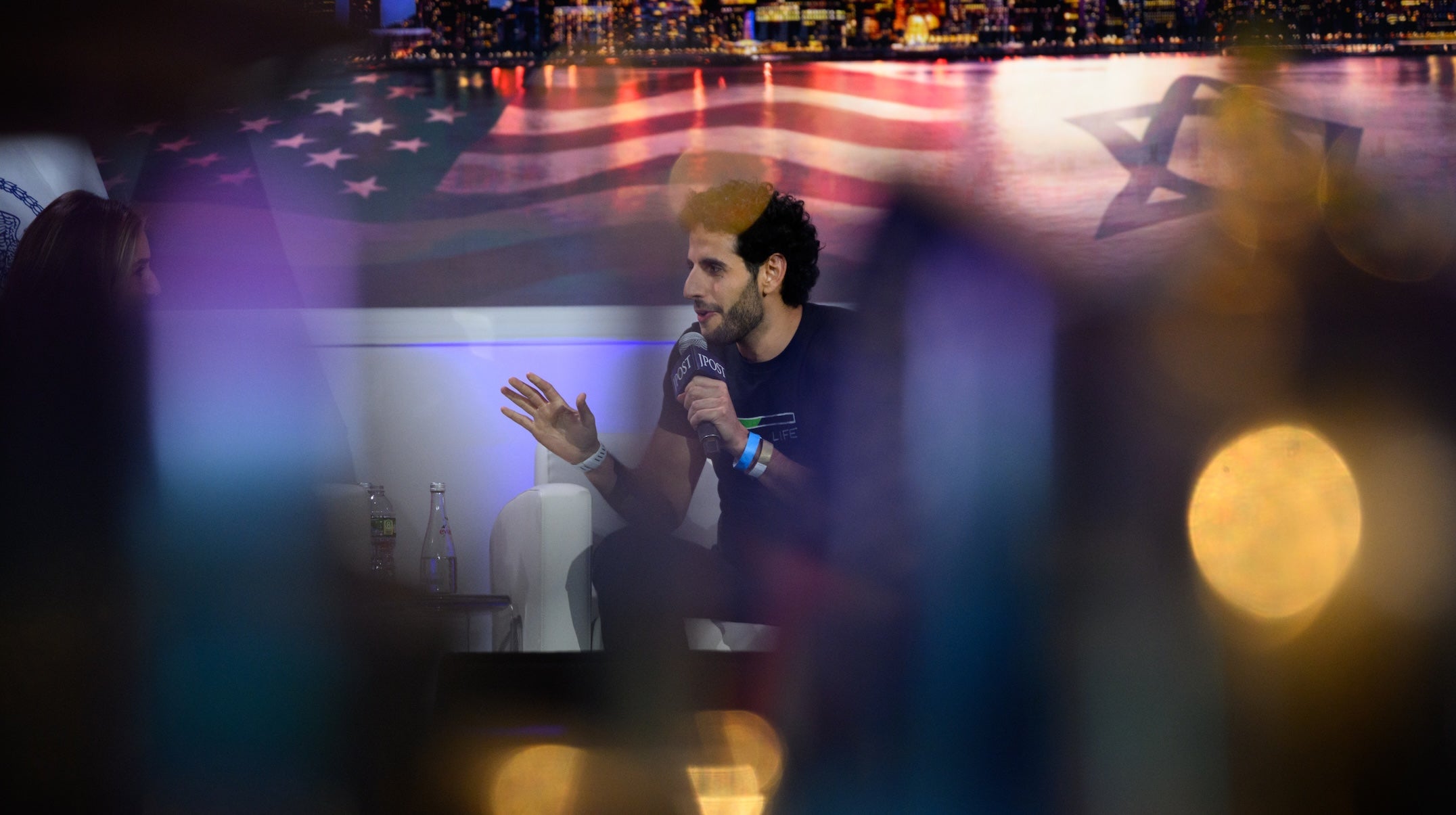
DENVER – Israeli-Arab social media entrepreneur Nuseir Yassin, of the viral vlog “Nas Daily,” said he believes “anti-Zionism is a form of antisemitism” and stressed his commitment to overturning “misguided hate” against Jews, at a conference devoted to the subject this week.
Yassin, 34, was speaking with the Jewish Telegraphic Agency on the sidelines of the conference, hosted by the David Merage Foundation for Confronting Antisemitism. A self-described “village boy” from the Lower Galilee town of Arraba in Israel, he achieved massive success through viral short-form videos that attracted viewers from all over the world. Today he boasts more than 68 million followers across numerous social networks.
Yassin is a Muslim of Palestinian origin, although he said he is not religious. Asked why it was important for a non-Jewish person to participate in a conference about combatting antisemitism, Yassin equated this battle to fighting for his family, noting that “the success of Israel and the Jewish people is also my success as an Israeli citizen.”
“I’m not a fan of the Israeli government, and I’m not here to defend it, just like I’m not a fan of many governments,” Yassin noted, but he asserted that the reaction to the government “is absolutely fueled by antisemitism.”
“I do believe anti-Zionism is a form of antisemitism,” he added.
He said he views Zionism as “the most vanilla thing in the world – a group of people wanting a place to live,” and has therefore concluded that Israel’s detractors “just really don’t like Jews.”
Yassin, who first broke through in 2016, has become increasingly outspoken in recent years about his combined Israeli and Palestinian identity. During the conference, he recalled that he grew up labeling himself Arab-Israeli. After the Hamas attacks of Oct. 7, 2023, he started listing Israeli first and Palestinian second.
“I could not relate to the extremism that I saw, and I wanted to distance myself from it without erasing my identity connected to it,” Yassin said. “I’m not just Israeli because I think it removes a little bit of spice, but I’m also not just Palestinian anymore.”
“A lot of Israeli culture is inside me,” he continued. “I never agree with people. I’m always disagreeable. That’s Israeli. I speak up.”
Yassin noted that he was “the first guy to go study in the United States out of my entire lineage,” graduating from Harvard University in 2014 with a degree in economics and a minor in computer science. Despite having grown up in Israel, Yassin said that Harvard was the place where he made his first Jewish friend.
After working as a software developer for Venmo in New York, Yassin left his job in 2016 to travel and document his journeys. Ultimately, he launched a Facebook page called Nas Daily – using the word for “people” in Arabic – where he posted one-minute videos for 1,000 days, telling the stories of communities around the world.
What was once a personal brand has since expanded into the parent Nas Company, which offers platforms for solo entrepreneurs to build and monetize their online businesses.
Yassin earned an honorary degree from Ben-Gurion University of the Negev in 2025 in recognition of his advocacy work for Israeli and Palestinian coexistence. This past August, he also joined the advisory board for the Genesis Prize Foundation, which each year celebrates inspiring Jewish individuals for their achievements.
“I do not relate to hundreds of men on the street shouting ‘Allahu Akbar,’” Yassin told (JR), adding that there needed to be more women and fewer religious fanatics participating in the Israeli-Palestinian conversation.
Yassin argued that he’s “not a weird Arab for saying this” and that “the entire country of the UAE says the same thing,” referring to one of the Gulf countries that signed onto the Abraham Accords normalizing relations with Israel. He also challenged “Free Palestine” activists to envision a concrete future for Palestinians rather than fixating on Israel’s transgressions.
“We should all be ‘Free Palestine’ – but from what?” Yassin asked. “We disagree on the solution, not on the problem. We don’t want suffering. Nobody wants suffering.”
“I’m a free-Palestine-from-Hamas guy,” he continued. “Just free Palestine,” he said, ”is not an answer. I’m free-Palestine-from-extremism.”
Yassin affirmed that there is room for criticism of Israel’s government, noting, for example, that he would like to see an Israeli-Arab presence in the government.
But he marveled at the notion that an alien visiting Earth would likely guess that the most hated country in the United Nations is North Korea, when in fact “It’s not – It’s Israel.”
That struck him as absurd because “the Israel-Palestine conflict is not a big deal when you compare it to everything else that’s happening on planet Earth. The only thing that makes it a big deal is that we, as Palestinians, have the perfect enemy.”
That enemy, he continued, is “the most hated type of enemy, which is the Jews.”
As part of his appearance at the conference, Yassin presented a recap of a fellowship he launched this past spring in partnership with the David Merage Foundation to help 50 content creators – 25 Jewish and 25 Muslim – produce meaningful material.
Participants received $1,000 and spent a month learning from the Nas Daily team about viral and impactful storytelling during the fellowship, named for Yassin’s first Jewish friend, Zaki Djemal, who recently died of a sudden heart attack.
To Laura Merage, the Iranian-born Jewish co-founder of the foundation, Yassin was a natural partner for this bridge-building effort. Given his social media following and “infectious personality,” Merage said she felt “that’s what we need more of in the world.”
At the conference on Tuesday, Yassin announced two winners of the fellowship’s influencer competition: recent McGill University graduate Raihaana Adira, a Canadian Muslim, and Grace, a Jewish-American digital content creator who preferred to use only her first name for privacy reasons. Grace tells stories about unique public figures, such as the first Arab “Miss Israel.” Adira, meanwhile, began posting about antisemitism and Muslim-Jewish relations after witnessing anti-Zionist protests at McGill.
“When I see a Jewish person being attacked on campus or online, it feels like I’m watching someone from my own community hurt,” Adira told (JR), noting that she started posting because no one believed her when she talked about incidents on campus.
“I wanted the protests and the graffiti on the walls that said ‘Death to the IDF’ to be seen,” she continued. “I am a Canadian, I am a Muslim, and when people at school on the streets say, ‘Death to Canada, We are Hamas, Hamas is heroic’ – that is not me.”
Adira said she received many death threats when she first started posting. While acknowledging how difficult that was, she also emphasized an influx of support that has helped “drown out the hate.”
Yassin offered a similar perspective, noting that at the beginning of his career, he “used to amplify the blowback and talk a lot about it,” referring to the criticisms he’d receive for promoting coexistence and calling out antisemitism. But after realizing that this deterred others from speaking out, he deemed the threats insignificant, calling them “the smallest price to pay for the largest outcome you can possibly imagine.”
During his travels around the world, Yassin said he has witnessed how flawed people’s perceptions of Jews can be and that he feels “a responsibility to set the record straight.” He also noted that he is dating a Jewish woman, author and influencer Aija Mayrock, whom he is marrying next year and with whom he expects to have children.
“They’re going to be Jewish, so that’s my family – literally, my family,” Yassin said.
A Season of Big Decisions. From the Knesset campaign to American midterms, Jewish communities are weighing what comes next. Help (JR) keep delivering the deeper context.


