

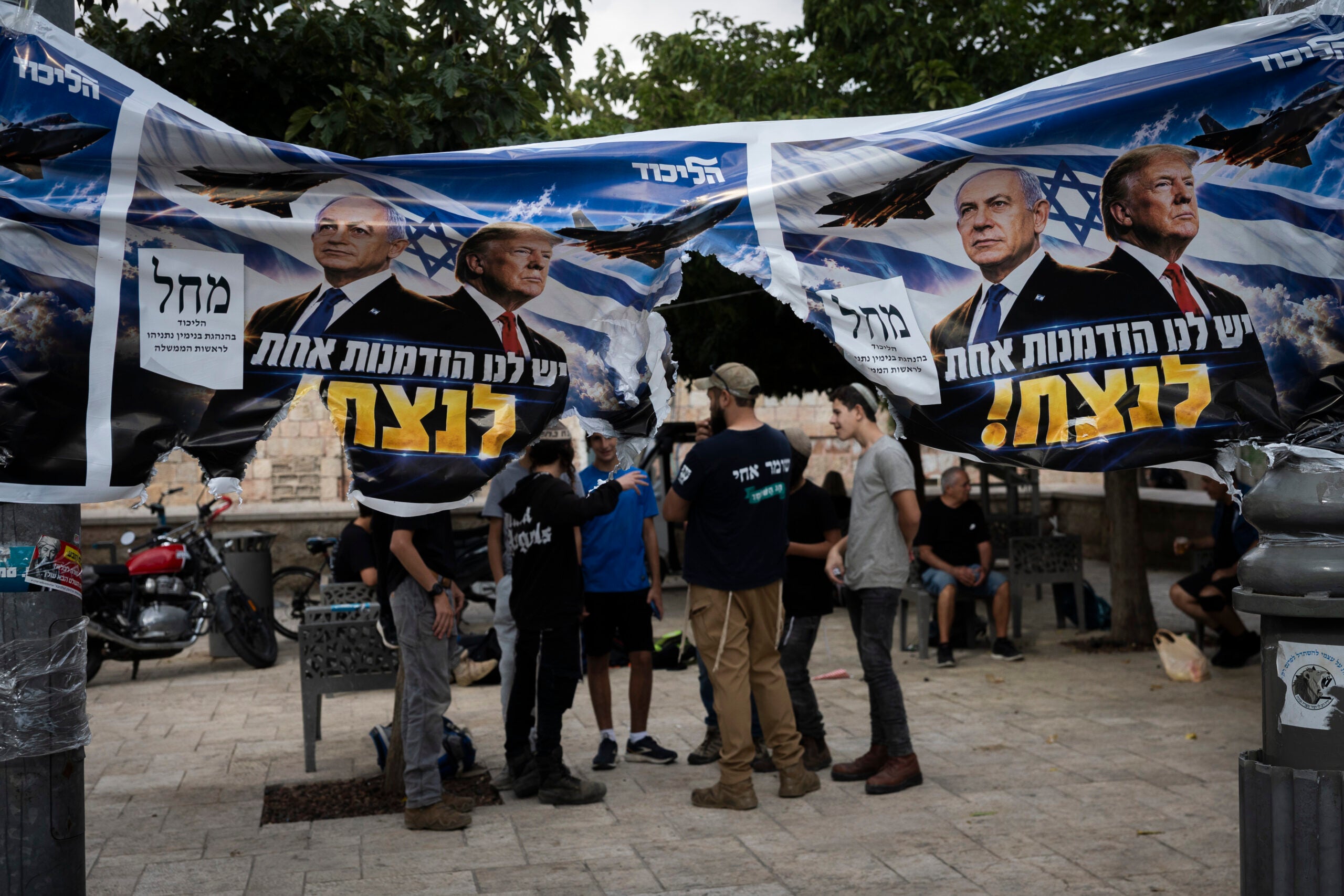
Israeli election officials are batting down charges by Prime Minister Benjamin Netanyahu that Qatari election interference significantly boosted the Arab vote, as the Likud leader sought to invalidate their ballots and the opposition accused him of trying to undermine the results.
Netanyahu claims that the election was “stolen” because, he alleges, Qatar secretly funded efforts to boost Arab voter turnout. The rate of Arab voter participation nearly doubled from the previous election, as did their representation in the parliament, the Knesset. Their unprecedented number of Knesset seats potentially gives them a decisive role in efforts to unseat Netanyahu.
Israeli authorities have opened an investigation into the allegations. But election officials were at pains to say that, even if they were substantiated, they did not indicate widespread fraud and would not invalidate the election.
On Friday, Acting Central Elections Committee Director-General Dean Livne recorded a statement saying that, while an investigation had been opened, “It does not affect the final results that will be submitted to the President, nor does it concern any particular sector of the population.”
In his statement, which was coordinated with the Shin Bet, Israel’s internal security apparatus, and Supreme Court Justice Noam Sohlberg, chairman of the Central Elections Committee, Livne disclosed that on Thursday, “the head of the Israel Security Agency presented classified intelligence to the Chairman of the Committee, which led to the opening of the investigation.” He noted that the information had also been shared with Prime Minister Benjamin Netanyahu, Opposition Leader Yair Lapid and Yashar party chairman Gadi Eisenkot.
“I wish to emphasize that the circle of individuals with access to this intelligence is extremely limited due to its highly classified nature. No further details can be disclosed,” he said. “However, reports published throughout the day are entirely unfounded.”
In a statement on Thursday, Livne stressed that “The elections to the Knesset were conducted lawfully,” and that “to the best of our knowledge there is no basis for claims of systematic harm to the integrity of the elections.”
The Shin Bet on Thursday cautioned against jumping to conclusions. “The Shin Bet has not yet completed its investigation, and any statements concerning the substance or nature of the suspicions under investigation do not reflect the agency’s position,” the statement said. “Such statements should have been avoided.”
The Shin Bet noted that the intelligence originated from its own operations and “did not come from any political party or political entity on either side of the political spectrum.”
The agency stressed that the investigation was narrowly focused and “does not cast suspicion on, or accuse, an entire sector of society that went out to vote democratically and legally.”
But Netanyahu’s Likud party is arguing that the allegations are significant. “The Ra’amgate affair is an earthquake,” the Likud said in a statement posted on the prime minister’s X account, referring to Ra’am, one of two Arab lists running in the election. “They stole the elections in Israel.”
Opposition leaders and leaders of Arab parties welcomed the investigation in order to dispel the allegations and accused Netanyahu of fearmongering, noting that figures in his office have themselves been under investigation for months for alleged ties to Qatar.
“I welcome the fact that Netanyahu is finally condemning Qatari involvement in the State of Israel,” said Gadi Eisenkot, whose Yashar Party is the largest in the opposition bloc coming out of Tuesday’s vote. “It is serious when it happens in the Prime Minister’s Office and it is serious if it happens in the election system.”
Eisenkot accused Netanyahu of trying to undermine the vote after losing it.
“What is already clear is that Likud and Netanyahu have embarked on an orchestrated and organized campaign to delegitimize the election results,” he said.
In theory, if the allegations were substantiated and found to have affected the results, a court could invalidate the election in whole or in part and order a new vote – though overturning an entire election is unprecedented in Israeli history.
With counting complete, Netanyahu’s bloc has 53 seats and the opposition bloc led by Eisenkot has 48, leaving neither with the 61 seats needed for a majority. The Arab parties got a combined 19 seats. One potential path for Eisenkot is to form a government with Arab parties or a minority government with their support from outside the coalition.
In a letter to Shin Bet chief David Zini earlier in the week, Supreme Court Justice Noam Sohlberg had called for an investigation into suspected foreign interference.
“Serious suspicions have been brought to my attention regarding improper influence on the elections through foreign funding by outside actors operating against Israeli interests,” Sohlberg wrote.
“I cannot attest to the nature of these suspicions,” he added, but said that because they involved foreign entities, “there is an obligation to investigate them thoroughly.”
Sohlberg instructed Zini to “uncover evidence to substantiate or refute the suspicions,” requesting findings within a week, ahead of the deadline for filing election appeals.
The letter did not identify Qatar or any Arab political party.
Likud alleged that foreign actors had sought to bring about an “Islamization of Israel” and overthrow the right-wing government. It urged other Zionist parties not to cooperate with Ra’am or the Joint List to replace the Knesset speaker or form a government reliant on Arab lawmakers.
Ra’am chairman Mansour Abbas denied any connection between his party and the suspected financing.
“Ra’am has no connection whatsoever to the affair in question or to any other such affairs,” Abbas said in a statement, pledging full cooperation with law enforcement.
He mocked Netanyahu, referring to him by the nickname Abu Yair (father of Yair), by invoking the allegations that Netanyahu’s office has been infiltrated by Qatari agents and also by linking him to his son Yair, a provocateur who has been caught up in separate controversies.
“To Abu Yair, who employs Qatari agents in his office, we have one message in response to the campaign of incitement and delegitimization he is waging against Arab citizens: There will be nothing, because there is nothing,” he said.
Knesset Speaker Amir Ohana of the Likud party called the allegations the most serious in Israeli democratic history, while far-right Netanyahu ally National Security Minister Itamar Ben-Gvir urged the arrest of Arab party leaders suspected of involvement.
Qatar rejected the allegations, calling them “ridiculous and dangerous.”
“We categorically deny allegations that Qatar has interfered in Israeli elections or funded any activities intended to influence their outcome,” Foreign Ministry spokesman Majed Al Ansari said in a statement.
Al Ansari accused Israeli politicians of attempting to use Qatar as a scapegoat for their electoral setbacks, pointing to what he described as contradictory accusations that Doha had bought Netanyahu’s loyalty, financed Israel’s left and now manipulated Arab voters.
Experts on Israel’s Arabs said the massive turnout was organic.
Rami Zeedan, a professor of Israel studies and author of a book on Arab political participation in Israel, said he observed extensive grassroots mobilization during three months of fieldwork in Israel this summer. Many Arab voters viewed Netanyahu’s government as particularly hostile to their community and were determined to replace it, believing that almost any alternative would treat them more equitably as Israeli citizens, he said.
“The exceptional turnout was therefore not inexplicable,” Zeedan told the Jewish Telegraphic Agency. “It reflected a genuine and highly visible effort to remove Netanyahu and his government.”
Zeedan said Likud and the Israeli right have long sought to delegitimize Arab political participation. He warned that the allegations could be used to cast doubt on the entire Arab vote or justify calls for a new election.
“The danger is that an investigation into specific financial or criminal allegations will be transformed into a sweeping claim that the Arab vote itself was fraudulent,” he said.
Joint List leader Yousef Jabareen accused Netanyahu of attempting to delegitimize Arab voters and prevent the new Knesset from being sworn in on schedule.
“Netanyahu was defeated at the ballot box. No incitement campaign will change the voters’ decision,” Jabareen wrote on X.
Knesset member Ahmad Tibi, also from the Joint List, fired back after the prime minister questioned why he had visited Qatar four days before the election.
“I told Al Jazeera in Doha that we very much want to bring you down,” Tibi wrote on X, quoting Netanyahu’s post.
“Meanwhile, according to Israeli police, the only ones who received Qatari money are those in your own office. Lots of money,” he added, referring to the investigation into allegations that Netanyahu’s aides received payments to promote the Gulf state’s interests.
Anwar Mhajne, a political scientist originally from the Arab city of Umm al-Fahm, said she was not surprised by the Arab voter turnout, saying she witnessed “sophisticated social media mobilization by journalists, influencers, activists,” who made a compelling case for voting.
Mhajne argued that Netanyahu was using the allegations to discourage opposition parties from partnering with Ra’am and the Joint List.
“The allegations risk achieving Netanyahu’s objective before the investigation concludes: making cooperation with Arab representatives appear illegitimate and closing off a possible route to replacing his government,” she said in an email to (JEWISH REVIEW).
President Isaac Herzog, who decides which political leader will get the first shot at forming a coalition, called for the allegations to be thoroughly investigated but warned against casting suspicion on Arab voters collectively.
“Even at a moment like this, we must not tarnish an entire community that sought to exercise its right to vote and take an active part in democracy,” Herzog said Thursday.
A Season of Big Decisions. From the Knesset campaign to American midterms, Jewish communities are weighing what comes next. Help (JEWISH REVIEW) keep delivering the deeper context.