

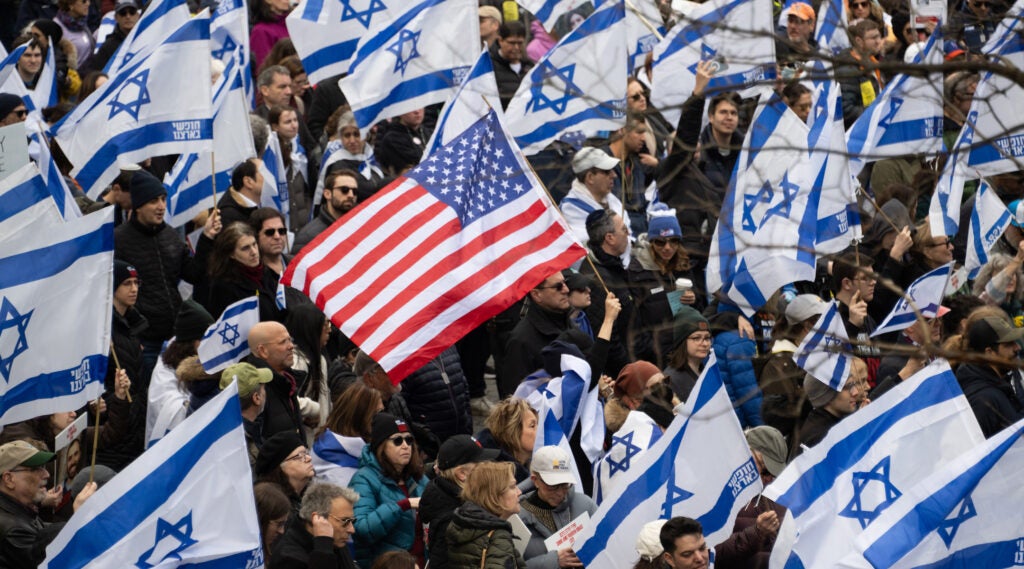
Over the last few years, as tragedy, war and rising global antisemitism afflicted Jewish communities in both the U.S. and Israel, our communities experienced an unexpected rise in their shared sense of peoplehood. Despite very different lived experiences, Israeli and American Jews feel closer today than just a few years ago. Yet there are also real differences of opinion within our global Jewish people. We set out to understand the nature of our differences by conducting parallel studies of U.S. and Israeli Jews and asking questions about key issues of importance to all of us – and about the nature of our relationship.
As we showed in our previous (JEWISH REVIEW) Ideas piece, “U.S. and Israeli Jews are drawing closer together,” our connection has grown. The share of American Jews calling Israelis extended family or community has climbed from 46% to 62% since 2021, and the share of Israelis saying the same about American Jews has risen from 45% to 53%. Seventy-nine percent of Israelis and 56% of Americans affirm that Jews around the world share a common fate and must act accordingly.
This deep, connected relationship makes it even more important for us to understand our differences. We entered this research assuming these gaps were largely shaped by our distinct life experiences, and we do, in fact, live in very different realities. But what we found instead were people with similar viewpoints within each Jewish community who shared a political or religious ideology.
It became clear that it’s mostly ideology, not geography, that drives the differences among Jews in both countries. And what differs between the two countries isn’t the views themselves. It’s the proportions. A majority of American Jews lean left, while a majority of Israeli Jews lean right.
Political ideology and religious affiliation are closely linked in both countries. In both the U.S. and Israel, those who identify with more traditional forms of Judaism lean further right, while those who are secular or identify with more progressive forms lean further left. Among American Jews, those with no denominational affiliation or a Reform affiliation lean furthest left, while those who are Orthodox or Haredi lean furthest right. Among Israeli Jews, secular Israelis are the most ideologically mixed, while religious Zionist and Haredi Israelis lean overwhelmingly right.
Consider three questions about Israeli security and the path to peace. Asked whether Israel can remain a democracy while maintaining control over the West Bank/Judea and Samaria, the right agrees that it can and the left disagrees. That results in 60% of Israelis holding this view, compared with just 37% of Americans. The same holds for whether Israeli security and Palestinian statehood are fundamentally incompatible goals (55% of Israelis believe they are incompatible, compared with 28% of Americans). On whether a two-state solution is the long-term right path toward peace, the pattern reverses; the left agrees that it is and the right disagrees. That comes to 50% of Americans, compared with just 24% of Israelis.
This matters more than it might seem. Disagreements that feel like a rift between the largest global Jewish communities are more accurately understood as disagreements within our respective communities. We have people who think like us on the other side of the ocean, as well as people who deeply disagree with each other within their own synagogues and neighborhoods. It is critical here to reiterate that, across every ideology, Jews still affirm responsibility for one another. Our disagreements live inside a shared commitment to one another.
A similar pattern held when we asked whether Israeli decision-makers should consider how their actions affect American Jews. Large majorities of both Israeli Jews and American Jews agree that they should. But when we ask about specific issues on which that impact should be considered, the same ideological differences reappear – though these answers are also affected by the level of engagement that exists on the issues.
We divided these questions into two categories, Jewish identity and security. On questions of Jewish identity, such as who is recognized as a Jew and Israeli immigration policy, Israeli Jews are far more likely than American Jews to say that Israeli decision-makers should weigh how actions affect American Jews. Forty-five percent of Israeli Jews say American Jews should be considered when determining who is recognized as a Jew, compared with 37% of American Jews. Forty-two percent of Israeli Jews say the same on making aliya, or the granting of Israeli citizenship to Jews who move to Israel, compared with 21% of American Jews.
On closer examination, two patterns stand out. For Israelis, political ideology predicts these answers on both Jewish identity and security, with secular, left-leaning Israelis most likely to want American input considered. For Americans, ideology matters less than their level of engagement. More engaged American Jews care more about issues of Jewish identity in Israel than those who are less engaged, largely because it takes real engagement in Jewish life to even encounter these issues.
On conflict and security, the pattern reverses. Americans are far more likely than Israelis, 49% versus 21%, to want security decisions regarding the Israeli-Palestinian conflict to take into account consequences for American Jews. Unlike Jewish identity – which requires real engagement in Jewish life to even encounter – nearly all Jews, engaged or not, are aware of the conflict. It is a constant presence in the news and public life. Ideology is also a strong factor here: The left leans far more strongly toward wanting the impact on American Jews considered than the right does.
Across all these questions about whether Israeli decision-makers should consider American Jews, a meaningful minority, roughly a quarter, say it shouldn’t be considered in issues of either Jewish identity or security. Their reasoning was direct: Israel should make the best decisions for its own citizens, and those who want this considered should move there.
Overall, across every issue we asked about, ideology far more than geography explains where and why we disagree.
It is possible to disagree, even deeply, and remain one people, as long as that disagreement happens inside real relationship, not at a distance from it. Our own tradition has a name for this. The rabbis called it “machloket l’shem shamayim,” a dispute for the sake of heaven. The House of Hillel and the House of Shammai disagreed about nearly everything, yet the Talmud records that their households continued to intermarry and eat in each other’s homes throughout. The disagreement itself wasn’t what made it holy. Staying in relationship while disagreeing was.
That’s the invitation here. Our research shows that we care for each other and are committed to our people. That doesn’t erase our disagreements. It means that there’s value to us being in conversation with each other within our own communities and across the ocean. Travel, Israeli emissaries, and other forms of personal contact can all help us turn abstract disagreement with others into healthy disagreement in the space of a relationship. Now, more than ever, is the time to build relationship across our differences.
A Season of Big Decisions. From the Knesset campaign to American midterms, Jewish communities are weighing what comes next. Help (JEWISH REVIEW) keep delivering the deeper context.
is senior vice president for Israel and Overseas and director general of Jewish Federations of North America’s Israel Office.

is chief impact officer for Jewish Federations of North America.
The views and opinions expressed in this article are those of the author and do not necessarily reflect the views of (JEWISH REVIEW) or its parent company, 70 Faces Media.