

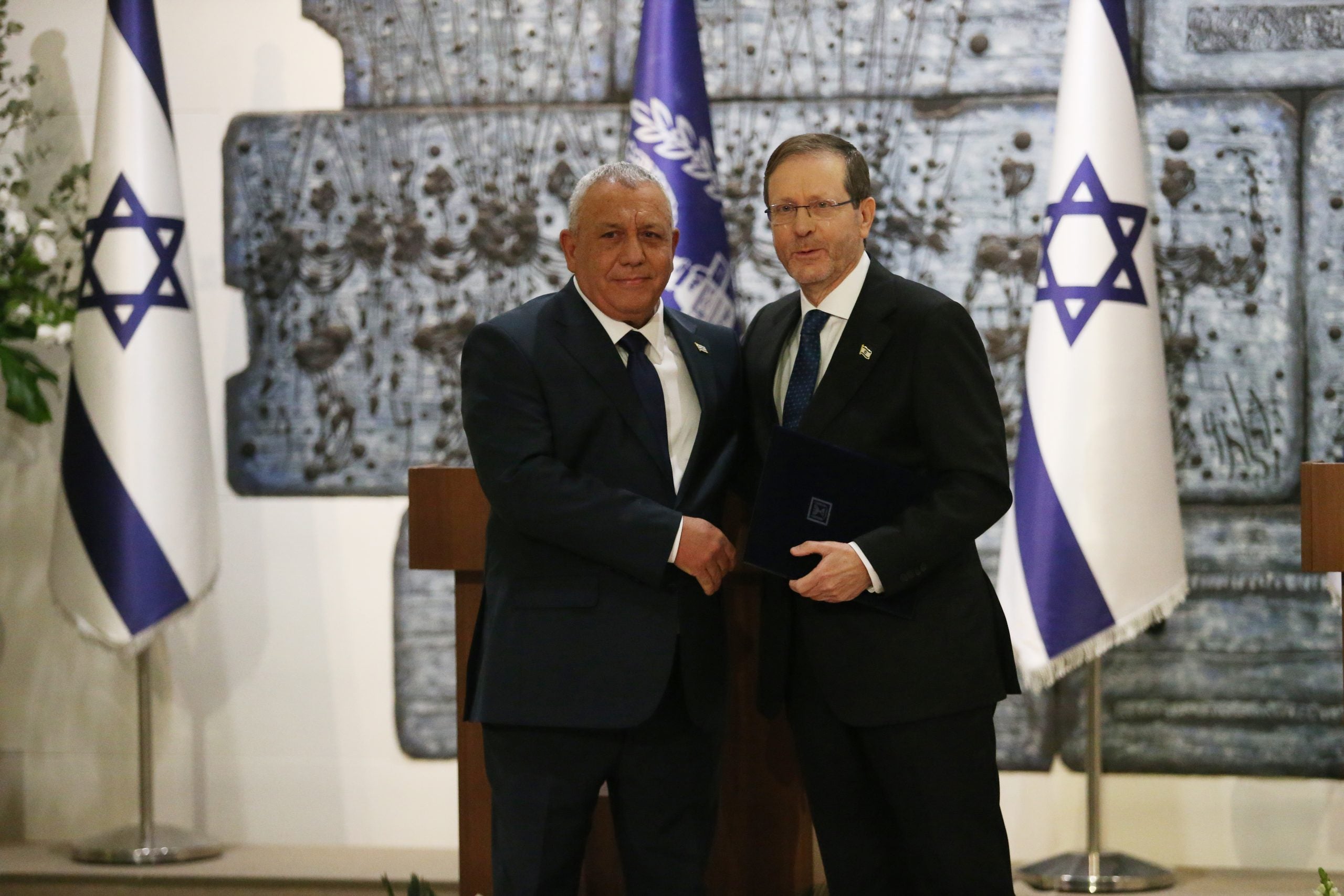
JERUSALEM – Israeli President Isaac Herzog on Sunday formally tasked Gadi Eisenkot with forming the next government, nearly two weeks after the country held a national election and days after a majority of parliamentary factions said they would recommend Eisenkot as the next prime minister.
“Yashar Leader Gadi Eisenkot, I expect you to do everything in your power to establish a government that will serve the entire people, those who supported it and those who did not, and that will be a responsible and decent address for all sectors, faiths, ways of life, and worldviews,” Herzog said in a televised ceremony held at his residence in Jerusalem.
Eisenkot has up to six weeks to assemble a coalition, a step that typically includes at least 61 seats out of 120 in Israel’s parliament, the Knesset. If he fails to do so within that time, then the president can give another Knesset member the opportunity to form a government.
In his speech on Sunday, Eisenkot said that Israeli democracy was “at one of its most vulnerable moments.”
“The campaign to undermine the legitimacy of our democracy, together with the growing distrust in state institutions, fueled daily, has brought us to an extremely dangerous point,” he said, adding that continuing on this path Israel would reach the “point of no return.”
“The formal consultations held here, at the President’s Residence, have revealed a clear picture: an absolute majority of Knesset members, representing the Israeli public, support change and support me as prime minister,” he said.
Some 67 members of the Knesset recommended Eisenkot, a former IDF chief of staff, for prime minister during those consultations. Meanwhile, 46 members of Knesset recommended incumbent Prime Minister and Likud Leader, Benjamin Netanyahu. One faction, United Torah Judaism, with seven members of Knesset, refrained from recommending any candidate.
The consultations, Herzog said, “brought to the surface the disputes, the painful points, and of course, the multitude of voices within Israeli society and politics.”
He added that the differences “reminded us all that every citizen of Israel has an equal voice, from every side, every view, every way of life, and every faith.”
Eisenkot said he would work to bridge those divisions and attempt to form a national emergency government, even if it required “creative and unconventional political initiatives.”
“Israel cannot afford delay or yet another cycle of endless elections,” he said, inviting elected parties and individual members of Knesset to join him in setting up the next government.
A Season of Big Decisions. From the Knesset campaign to American midterms, Jewish communities are weighing what comes next. Help (JEWISH REVIEW) keep delivering the deeper context.


