

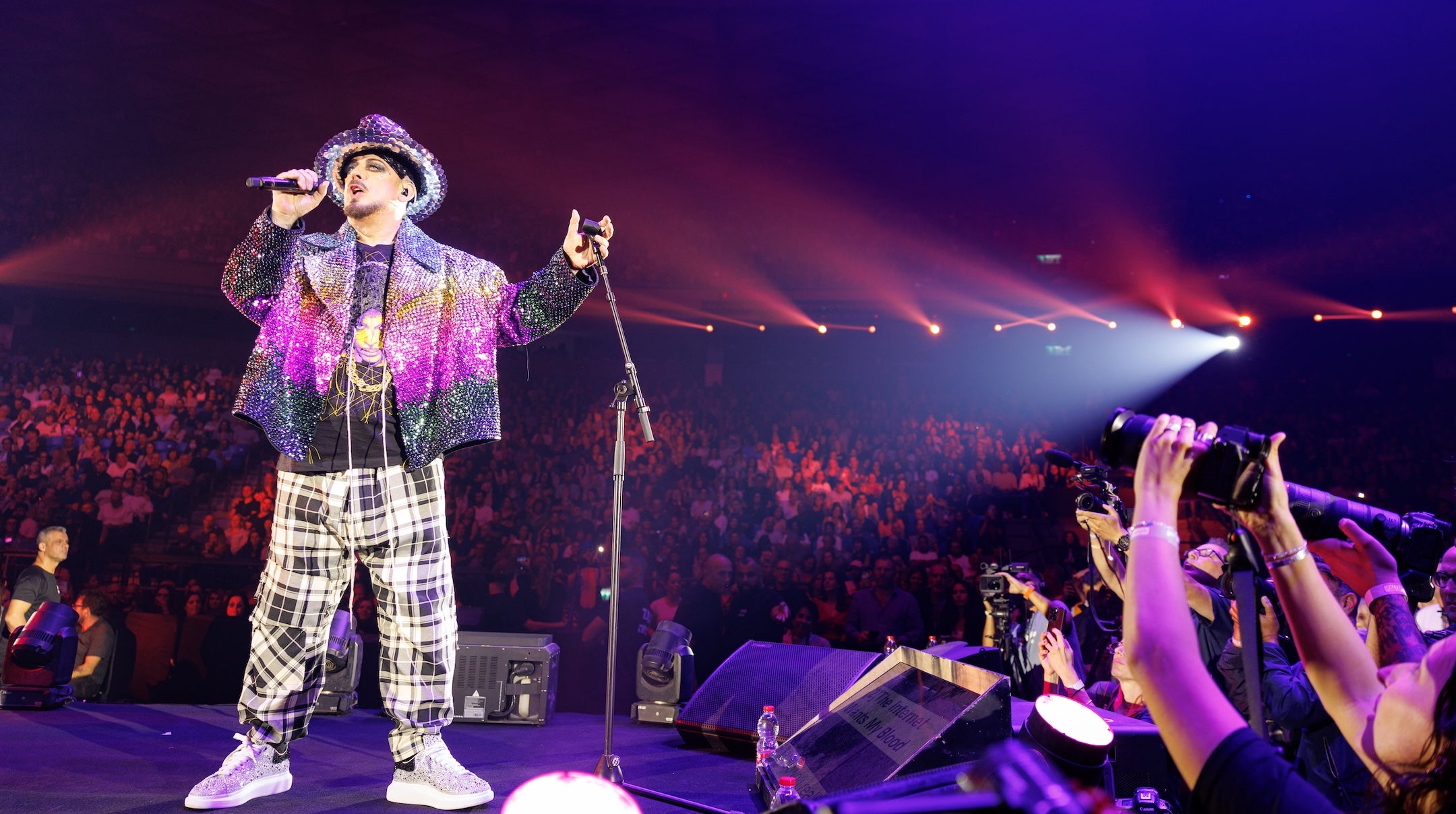
TEL AVIV — Sound problems, guitar trouble and an admission of forgotten lyrics punctuated Boy George’s second Tel Aviv show Saturday night. But the British pop star, irreverent, occasionally exasperated and frequently hilarious, could hardly have asked for a more forgiving audience.
At 65, the Culture Club frontman is no longer the chart-topping phenomenon of the 1980s. Although plenty of those who filled Menora Mivtachim Arena were old enough to remember his heyday firsthand, his appeal went well beyond nostalgia.
At a time when international stars have largely stayed away from Israel, George has become one of the country’s most outspoken supporters, enduring considerable backlash from within the music industry for his refusal to remain silent over the Oct. 7 Hamas attack.
“Silence is not a f—ing option,” he said to thunderous applause.
Saturday’s concert, the second of two nearly sold-out performances following Wednesday’s show at the same venue, was dedicated to survivors of the Nova music festival massacre and bereaved families, with 1,500 tickets donated to members of the community. Israeli DJ and producer Ofer Nissim joined George onstage in the second half, bringing a dance-club element to an evening that mixed Culture Club classics, covers and newer material.
His habit of mocking himself and mimicking others repeatedly drove the crowd to laughter, turning interruptions that might have derailed a slicker performance into part of the entertainment.
The banter ranged from wisecracks about technical glitches to personal reflections on the hostility he has encountered over his support for Israel. When a guitar failed to produce any sound, he appeared mildly irritated, telling the crew, “You have to plug things in, you know.”
“This is a weird moment,” he added, before smiling and continuing, “but this whole night has been a weird moment.”
Introducing his cover of Bob Dylan’s “It Ain’t Me, Babe,” he explained that he had attempted it on Wednesday but forgotten the lyrics. “Luckily, this time I have autocue,” he said, breaking into his trademark laugh.
As for his detractors around the world, he made clear that he had little interest in winning them over.
“I’m 65. It’s too late to hate me, I don’t give a s–t,” he told the audience.
The one person’s opinion that mattered to him, he said, was his late mother’s. Recalling an Irishman who had suggested that his Irish mother would be ashamed of his support for Israel, given Ireland’s strong sympathy for the Palestinian cause, George was defiant.
“I can tell you categorically my mother will be more proud of me than she’s ever been,” he said.
In another characteristically unpredictable diversion, George dedicated his solo release “Clouds” to Philip Sallon, a longtime Jewish friend and influential figure in London’s club scene who helped introduce him to Jewish traditions when he was young.
The two have since fallen out. “He hates my guts right now,” George said, asking anyone who knew Sallon to tell him that he had sung the song for him in Israel as an act of forgiveness, “as a mitzvah.”
But the evening’s most emotional moments belonged to “We Will Dance Again,” the song George released in July about the Nova attack. Its lyrics explicitly reference the atrocities committed on Oct. 7, criticize fellow musicians for their silence and challenge accusations of genocide against Israel.
George’s eight-day visit included a meeting with President Isaac Herzog and a trip to the Nova massacre site near Kibbutz Re’im, where Hamas terrorists murdered more than 360 festivalgoers on Oct. 7, 2023.
Having visited Israel many times before, he told the audience that this trip had affected him differently. He also appeared uneasy about the gratitude being lavished on him.
“It’s awkward for me as an outsider to be in the midst of this amazing recovery and sadness,” he said.
Survivors of the Nova massacre and relatives of those murdered joined George onstage carrying Israeli flags for “We Will Dance Again.”
George, having changed into a colorful, geometric-print suit and rhinestone-studded black hat, performed the reggae-inflected song about one of the most traumatic events in Israeli history while embracing the survivors and bereaved relatives beside him.
At one point, he seemed close to tears. “I’m going to cry,” he said.
But even the solemnity didn’t last long. When George invited one of the bereaved women to address the crowd, she demurred because she didn’t speak English.
“I’ve never met a Jewish person who doesn’t have anything to say,” he joked, drawing laughter and applause from the crowd.
In the audience, people swayed to lyrics that included an explicit reference to girls raped against trees. Kay, a singer from Tel Aviv, remained seated, tears in her eyes.
“I can’t dance to that,” she said.
Yet she was deeply moved by George and the atmosphere surrounding the performance, and was untroubled by its hiccups.
“It doesn’t have to be perfect. It just has to be human, and that’s what connects us,” she said.
Tammy, a 60-year-old dance instructor who regularly plays Culture Club songs in her classes, hadn’t initially intended to attend. But after seeing footage of George’s Wednesday performance, she changed her mind.
“I saw the clips on social media and was jealous of people who went,” she said.
Lavie, a 24-year-old Israeli-born performer who divides his time between New York and Los Angeles, had never heard of Boy George before the singer began making headlines in Israel. He started studying his music ahead of the concert, hoping to learn from the veteran entertainer’s stagecraft.
“I learned a lot,” he said toward the end of the performance. “What impressed me most was how he handled all the glitches with grace and humor.”
Not everyone was quite so impressed.
Daniel, a Jaffa resident originally from Los Angeles, was scathing about the musical performance and even more critical of the audience’s reaction.
“Everyone was off-key, and it was just awful,” he said. “But what bothered me most was the crowd’s desperate need for approval.”
“We need a national therapy session to counter our neediness,” he added.
George saved “Karma Chameleon,” the 1983 hit that made him a household name around the world, for the finale. By then, the show had stretched to roughly two and a half hours, but thousands of people were still on their feet.
George contrasted the atmosphere in Israel with London, which he described as “full of anxiety and tension.”
“It feels so relaxed here,” he said. “I don’t want to go home.”
A Season of Big Decisions. From the Knesset campaign to American midterms, Jewish communities are weighing what comes next. Help (JR) keep delivering the deeper context.


