

The parsha begins with a direct statement: “This is the story of Isaac, son of Abraham.”
And we do, indeed, learn quite a bit about the second patriarch in these chapters.
We learn, for instance, that when God speaks to him, he listens — as when God tells him to stay in Canaan during a famine and not to go to Egypt, always first choice of famine-sufferers.
We learn that he has great knack for finding water wells. Wherever he goes, he finds them in places no one ever thought of looking.
We learn that he prefers compromise to confrontation as when he avoids a fight with the Philistines after they demand he abandon wells that rightly belong to him — perhaps the first example of antisemitism in recorded history.
The source of the hatred is, of course, envy. The Philistines don’t want to glean from Isaac how to find wells or improve their digging methods, they simply want to confiscate his property.
Most of all we learn that Isaac is a man who wants peace — outside his home and certainly within it.
We also learn a lot about Isaac’s wife, Rebecca. Perhaps the most impressive woman in the entire Torah, she’s the brains of the outfit. She, more so than Isaac, has a handle on the direction the tribe must go. Isaac seems to recognize this, and for that we should give him credit.
He doesn’t fight her. He works with her — always. Maybe that’s why they have the only monogamous relationship among the patriarchs.
But for all we learn about Isaac and Rebecca, we best remember this parsha for their sons, Jacob and Esau.
Rebecca, like Sarah, has infertility issues. Isaac pleads with God on her behalf and his prayer is answered. Rebecca becomes pregnant with twins.
Even in the womb, the infants battle.
In the midst of her agony, Rebecca asks God why she is suffering so. He answers her that not only is she carrying twins, but two nations.
No wonder things feel a bit crowded.
Esau emerges first; Jacob, hanging onto his heel, follows.
From day one, the two boys couldn’t be more different. Esau is an athlete; Jacob is a thinker. Esau is a hunter; Jacob is a chef. Esau has a rough manner. Jacob’s manner is mild. Esau is hairy; Jacob is smooth-skinned.
Their father, never much of a sportsman himself, favors the son who is so unlike him; Rebecca favors Jacob. Esau wins on brawn; Jacob wins on brains. Which one the Torah values more is made clear in the following story.
Esau comes home one day from a hunt. Exhausted, he enters the house to find Jacob stirring up a tasty stew. He asks his brother for a serving. Jacob is willing to oblige, but only if Esau forks over his birthright.
Why that thought came into Jacob’s head at that moment, we will never know, but Esau, who lamely protests that he’s literally dying of hunger, agrees.
So, what did Esau sell? His privileges as the first born? The responsibility to carry on the covenant of his father and his grandfather? The text is not clear except on one crucial point — whatever it is, it isn’t as important to twin number one as it is to twin number two.
Time passes. Famines come and go. Turf wars, mostly over water, flare up and flare out. Now an old man, Isaac has little to complain about.
Yeah, Esau married out of the tribe to a Hittite woman, but Isaac seems to have gotten over that. God has been good to him. He’s rich in livestock and grazing land. He even has his teeth — as witnessed by his zesty appetite for meat.
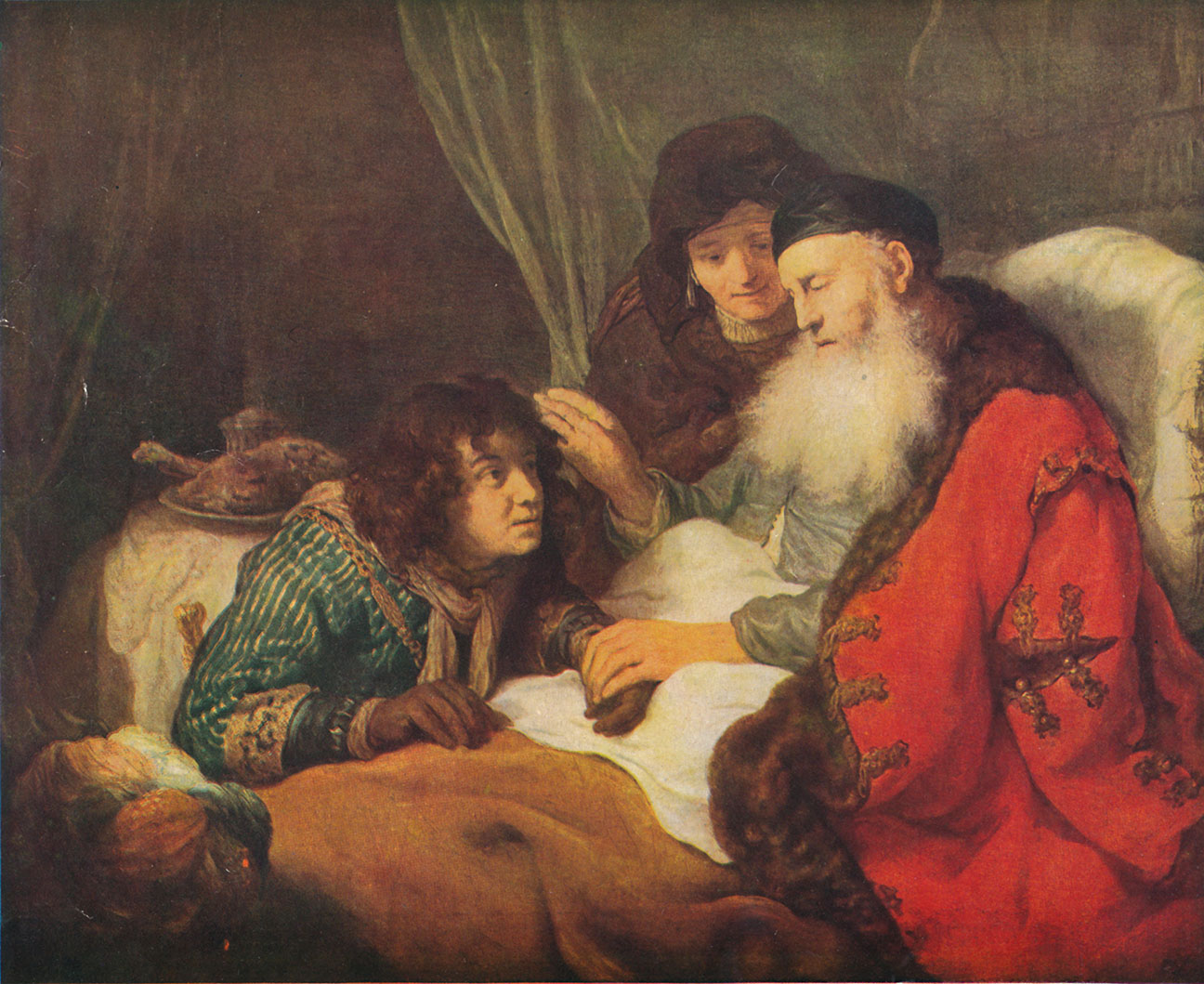
Still, his failing vision tells him that the end is approaching. Critical business must be attended to before his final rest. Most importantly, he must give a testimonial blessing to his eldest and favorite son.
To that end, he summons Esau and commands him to kill some game in preparation for a meal. When he returns with the food, he, Isaac, his father, will bless him. Esau grabs his bow and arrow and races out of the house.
Rebecca, however, has overheard the exchange.
She’s not a matriarch for nothing. She has already decided who is to carry the sacred covenant into the next generation.
And it’s not going to be a slow-witted, sun-worshipping, Hittite-marrying hunter, even if he is her first-out-of-the-womb son.
She tells Jacob to slip sheepskin over his hands and neck while she cooks the meal her husband requested. When Jacob presents the food, his blind-as-a-bat father will think it’s Esau.
That’s the plan, anyway.
Jacob wants no part of it. “Mom, it’s crazy. I’m going to look ridiculous. It’s not going to work.” Rebecca waves him off: “I don’t care what you think,” she tells him. “Just do it.”
The ruse, as crude as it is, comes off pretty much without a hitch. It’s true that Isaac is confused: “The voice is the voice of Jacob,” he says, “yet the hands are the hands of Esau,” but, ultimately, he’s convinced by the masquerade and blesses Jacob, thinking he’s Esau.
The key line is this: “Cursed be they who curse you. Blessed be they who bless you.”
A short time later, Esau enters, his meal prepared. When he hears that Jacob, through trickery, has received the blessing promised to him, he flies into a rage. He vows to kill his brother as soon as his father dies.
But the wily Rebecca thwarts this plan, too.
With her husband’s knowledge, she sends Jacob to her brother Laban with strict orders for him to find a wife among her brother’s daughters, to marry within the tribe and not, like Esau, outside of it.
It is not by an accident of birth order, or by parental favoritism that the family of Abraham and Isaac and the Jewish people will continue.
As the third patriarch soon discovers, it will take much more.
And that is a brief summary of Torah portion Toldot.
Allen Estrin is the Executive Director and Co-Founder of PragerU.