

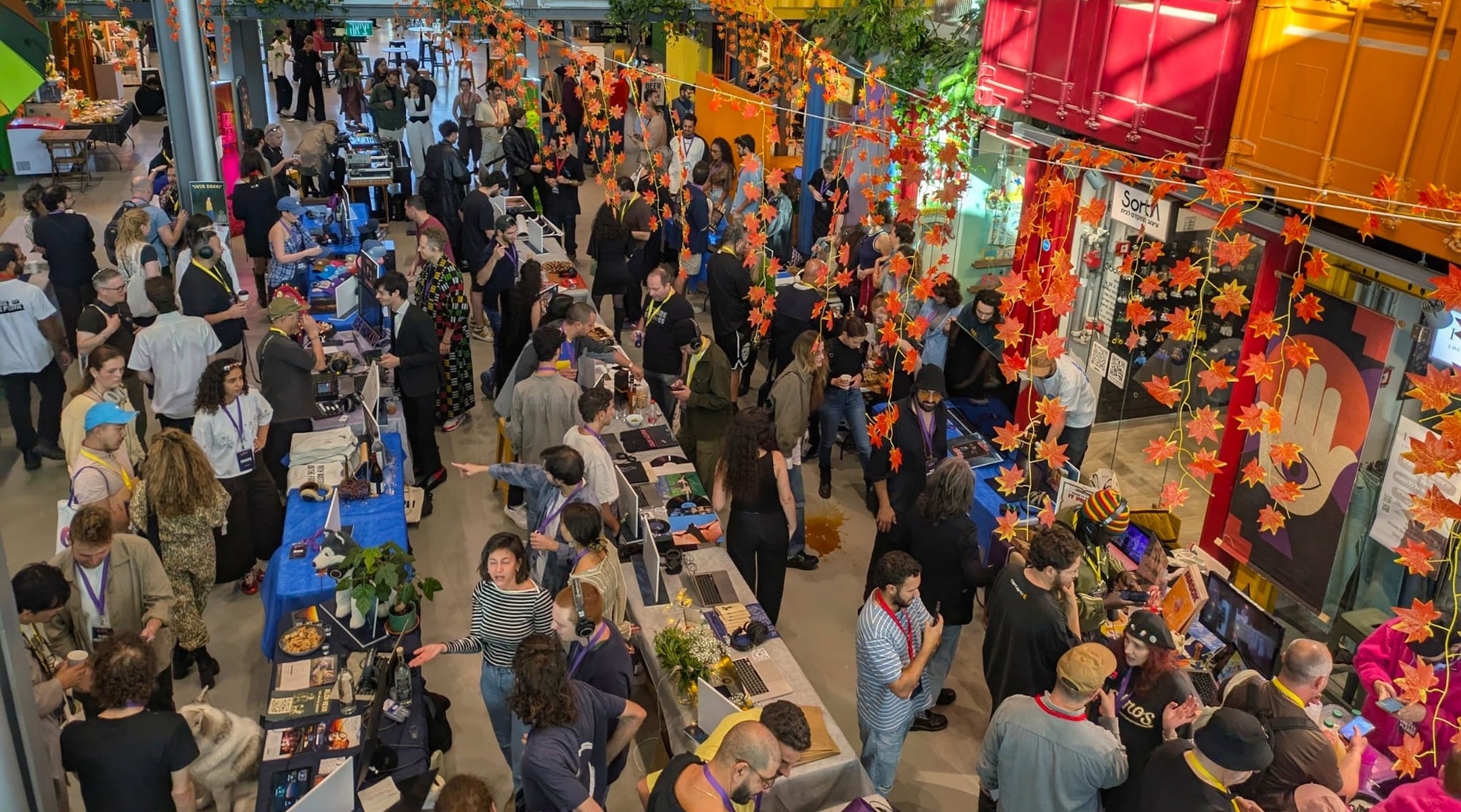
TEL AVIV – The Israeli music industry had its own take on speed dating this week at a venue built from repurposed shipping containers in the Jaffa Port.
International booking agents and record label executives moved from table to table, slipping on headphones and chatting with Israeli musicians at Beit Hamecholot.
The musicians had come armed with vinyl records, snacks, bottles of alcohol and, in some cases, furry costumes — anything that might entice a prospective booker to stop and listen. A few minutes of conversation could determine whether their music would be heard in Berlin, Tokyo or New York.
But getting the people who could make that happen to come from abroad to Israel’s Music Showcase Festival in the first place has become increasingly difficult due to cultural boycotts of Israel.
Of the at least 200 music industry professionals invited this year, 32 attended, down from 55 last year. In previous years, the festival would typically send out between 400 and 500 invitations, but the festival’s artistic director, Hadas Vanunu, said organizers had become more selective about whom they’d approached since the war in Gaza began three years ago.
Vanunu said the way prospective delegates responded was more troubling than the drop in numbers.
In 2024, when just 22 international guests came, many cited security concerns and pressure from their families. By 2025, objections were increasingly political, although Vanunu said Israel still elicited a measure of sympathy abroad because of the hostages held in Gaza.
This year, many of those approached simply didn’t respond.
“We were practically begging people to tell us why they wouldn’t come, even if it meant getting angry messages saying, ‘We’re not coming because Israel is doing this or that.’ This year, we didn’t even get that,” Vanunu told the Jewish Telegraphic Agency.
“What was a trend of hating Israel a year or two ago has now become the norm. Israel is a pariah state. You can really feel it in your blood, just how hated you are,” she said.
Founded in 2009, the festival has helped propel Israeli acts including Noga Erez, Lola Marsh and Garden City Movement onto the international music scene. This year’s six-day event featured some 50 performances across Jerusalem and Tel Aviv, spanning jazz, hip-hop, rock, electronic and Middle Eastern music.
Produced by Jerusalem’s Yellow Submarine music center in partnership with the Foreign Ministry’s cultural diplomacy division, the festival has suffered from budget cuts and been a target of the Boycott, Divestment and Sanctions movement. In 2022, Palestinian boycott campaigners explicitly called on international guests to shun the event, citing its government sponsorship.
Since the outbreak of the Gaza war following the Hamas-led attack on Oct. 7, 2023, even people who attended the festival years earlier have grown wary of being publicly associated with Israel.
“We’ve even had Jews from the diaspora and former Israelis who attended the festival ask us to erase every digital trace of their visits,” Vanunu said.
Where once the festival prominently publicized the identities of its international guests as a measure of its prestige, this year organizers supplied (JR) with a list of delegates on the strict condition that neither their names nor their job titles be published.
Among the organizations represented were those affiliated with Warner Records, Germany’s Asphalt Festival, Britain’s National Jazz Archive, South Korea’s Jarasum Jazz Festival and the music publications Rolling Stone and Billboard. Delegates came from countries including the United States, Germany, Britain, Poland, China, Japan, Vietnam, Singapore, Ghana, Zimbabwe and the United Arab Emirates.
Some prospective delegates, Vanunu said, wanted the festival’s organizers to clarify their position on the Israeli government’s actions before they would even consider engaging with them.
“There is absolutely no longer any distinction between an Israeli individual and their country,” she said.
The musicians in Jaffa, however, were also grappling with other consequences of the war.
Magi Hikri, who performs as MAGI, was left to fend for herself at the showcase after her manager was called up at the last minute for reserve duty. “What can you do? That’s the reality we live in here,” she said.
With long, tousled blond hair, Middle Eastern roots and pounding dance beats, Hikri has echoes of the international star Shakira in her persona, including a soccer connection: The singer, of Iraqi and Yemeni Jewish descent, has a track, “Jilala,” on the soundtrack of the wildly popular EA Sports FC 26, the soccer video game from the series formerly known as FIFA.
Despite the setbacks, Hikri saw the foreign delegation as “proof that music prevails and will always have a place.”
Several delegates were willing to speak publicly about their decision to attend. Maciej Nestor, who runs the independent Polish record label V Records, said that having toured western Ukraine during the war, he understood how vital music and culture were to people living through conflict. Yet even some of his Jewish musician friends questioned his decision to come to Israel.
“I don’t justify violence or take political sides,” he said, but added that neither artists nor audiences should be “isolated by political conflicts.”
Nestor pointed to what he had seen both on the streets and onstage: Jews and Arabs “going about their lives” and Israeli and Palestinian musicians performing together at the Jaffa gathering as part of the FeelBeit Ensemble, led by jazz trumpeter Avishai Cohen.
“Culture must remain a space for dialogue and human connection,” he said.
Isaac Green, a New York-based executive at Warner Records, by contrast, said he had encountered no pushback over his decision to attend. Green, who is Jewish, pointed to the considerable Jewish presence in the American music industry.
He was struck by the breadth of musical innovation in Israel, he said, and by the “energy of audiences,” even at jazz concerts.
Green described a set by Ethiopian Israeli rapper Eden Derso, who fuses Hebrew hip-hop with soulful R&B vocals, as “phenomenal.”
Derso said hearing praise from someone who did not understand her lyrics was particularly gratifying. “They don’t understand the words but still love it, that’s crazy to me,” she said. “People are just drawn to it.”
She recalled her first performance in Berlin after the outbreak of the Gaza war, when some audience members visibly recoiled upon hearing she was from Tel Aviv.
Asked if such reactions might make her conceal her nationality abroad, Derso scoffed, invoking her Beta Israel heritage. “My father waited long enough to come to this country,” she said. Hiding her Israeli identity, she said, was “like hiding my Blackness.”
The war has changed the repertoire of Boogie Balagan, a Paris-based Israeli duo whose music draws heavily on Arabic influences. Gabri, one half of the duo, said that since Oct. 7, he now improvises a different lyric rather than sing the word “Palestine” in one of their songs. The word had become difficult to sing, he said, after so many of his friends lost loved ones that day.
In the aftermath of the attack, the duo recorded “Mashiah,” singing entirely in Hebrew for the first time in 20 years together. Muslim audiences had responded positively to the song, Gabri’s musical partner, Azri, said, adding that it was younger people on the French far left who were “particularly obstinate” in their hostility toward the duo as Israelis.
Huy Tuan Bui, a prominent Vietnamese music producer and founder of several major music festivals, acknowledged having “moments of doubt” before coming to the expo in Israel, but he said he was deeply moved by the organizers’ refusal to give up on the festival through years of war.
He described his week in Israel as “unforgettable,” praising the caliber of Israeli musicians and the warmth of the people.
“What I witnessed completely changed my perception of this land,” Bui said, pledging to become a “voluntary ambassador promoting the beauty and kindness of Israel and its people.”
According to Vanunu, the willingness of foreign guests to travel to Israel should not be mistaken for an act of charity toward Israeli musicians.
“They don’t want to help Israeli artists simply out of the goodness of their hearts. They want to help because the artists are insanely talented and the music is incredible,” she said.
Cuts to the Foreign Ministry’s cultural diplomacy budget have also threatened the festival’s future. Last year, the ministry froze an estimated 5 million shekels in funding for international cultural collaborations.
“We’re either fighting what the world thinks of us or fighting over whether our own country even believes in investing in culture at all,” she said.
Vanunu said the music industry needed to collectively resist the pressure to boycott artists.
“We’re here to make art, and art has a role that isn’t political,” she said. “The day will come when everyone understands that, and when everyone does, we’ll still be here, doing what we do.”
Count yourself in. Independent Jewish journalism runs on thousands of readers. Join them with a year-end gift. We can’t do it without you.