

Noam Ash didn’t expect his own life to become the inspiration for his first feature film. But that’s what happened when the then-27-year-old was living with his grandparents in 2018.
The screenwriter’s conversations with his manager about another script he was working on kept turning to how he had moved in with his Holocaust survivor grandfather after breaking up with his boyfriend.
“My manager was like, ‘I think you should actually write about that,’” Ash recalled in an interview.
Nearly a decade later, Ash’s film “Bookends,” which is loosely inspired by his own experience, is the first movie incubated by the Jewish Writers Institute Screenwriters Lab to make it to production. It stars F. Murray Abraham, Caroline Aaron and Charlie Barnett alongside Ash, who portrays a character loosely based on himself.
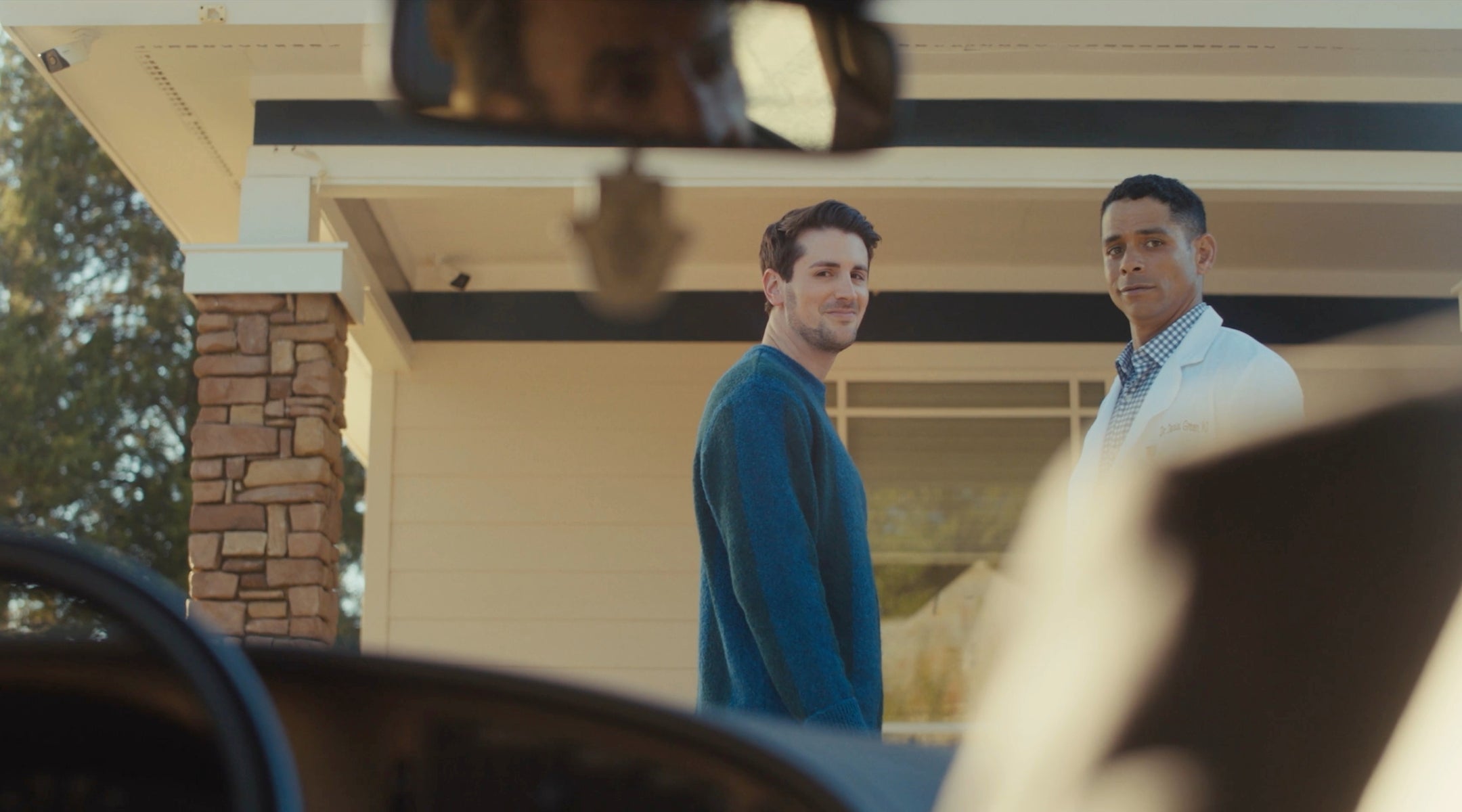
The film follows a young gay man who moves in with his grandmother and grandfather — a Holocaust survivor — after a bad breakup, and soon confronts end-of-life issues while navigating a new romance with his grandparents’ doctor.
“Bookends,” directed by Mike Doyle, recently premiered at the Santa Barbara Film Festival, where it received the 2026 Stand Up Award sponsored by the Anti-Defamation League, and has since drawn offers of distribution.
“Bookends is a work of art that explores the richness, diversity, and complexity of a Jewish family and community,” ADL California regional director Joshua Burt said in a statement. “It is just the sort of storytelling that will help the Jewish community seem familiar to the non-Jewish world, helping everyone embrace one another as part of the wider community.”
For Ash, the film is a testament not only to his own story but to the nurturing that came from the Jewish Writers Institute throughout the process, which overlapped with an increasingly fraught time for Jewish creatives.
“Over the past couple of years, there has been a lot of fear in Hollywood, there’s a lot of people not knowing if they should include certain subject matter in their work.” Ash said. “I think fear thrives in isolation and love blossoms in community, and [JWI] really created the space where they were saying, ‘there are people out here who want your stories, and there are people out here who believe in them.’”
One of multiple initiatives supporting Jewish creatives, the Screenwriters Lab provides financial and networking support for Jewish filmmakers and writers seeking to create Jewish films and television programs.
“If we don’t tell our stories, there’s lots of people who are telling alternate versions, so it’ll be swallowed up,” said Ari Pinchot, a film producer and co-director of the Screenwriters Lab.
Pinchot said he was drawn to supporting Jewish screenwriters after premiering his 2012 documentary “Follow Me: The Yoni Netanyahu Story,” about the brother of the current Israeli prime minister who was killed while rescuing hostages during Israel’s raid in Entebbe in 1977.
“I realized how much the audience was starving for this kind of Jewish content,” Pinchot said.
Pinchot ultimately secured support from the Maimonides Fund, a private foundation, to launch the Screenwriters Lab in conjunction with Crystal City Entertainment, his feature film finance and production company. (Maimonides also supports 70 Faces Media, (JR)’s parent company.)
To participate in the Screenwriters Lab, applicants must submit a detailed pitch of their script. Cohort members receive a $10,000 stipend and spend three days in New York, three days in Los Angeles, and eight days in Israel. They receive one-on-one mentorship, attend master classes and lectures, and meet with producers, writers, directors, studio heads, distributors, and financiers.
Other projects supported by the lab include a script for nonfiction writer Sarah Wildman’s memoir “Paper Love”; a reimagining of “Pride and Prejudice” that takes place at a Jewish summer camp; and “We Canceled Mikvah Night,” a miniseries inspired by the 2024 sex strike in Borough Park that became part of a campaign to help an Orthodox woman obtain her religious divorce. But Ash’s is the first to be completed and seen by the public.
Pinchot said “Bookends” exemplifies the Screenwriters Lab’s value proposition.
“We love to find stories that aren’t the typical Jewish story,” Pinchot said of Ash’s film. “And so his approach and his story was really atypical but shine a light on a wonderful aspect of the Jewish community, which is acceptance and multi-generational interactions and people who are trying to find their place within a very tight-knit community.”
Noam Ash’s grandparents both died before the film was finished. His grandmother Miriam Friederman Cohen died in 2021 and his grandfather Saul B. Cohen died in 2022. They were both 96 years old at the time of their deaths.
But Ash said they both lived long enough to know that he was working on the film.
“The film is really a love letter to my grandparents, and the greatest generation,” Ash said. “I do consider my relationship with my grandparents to be one of the greatest blessings of my life.”