

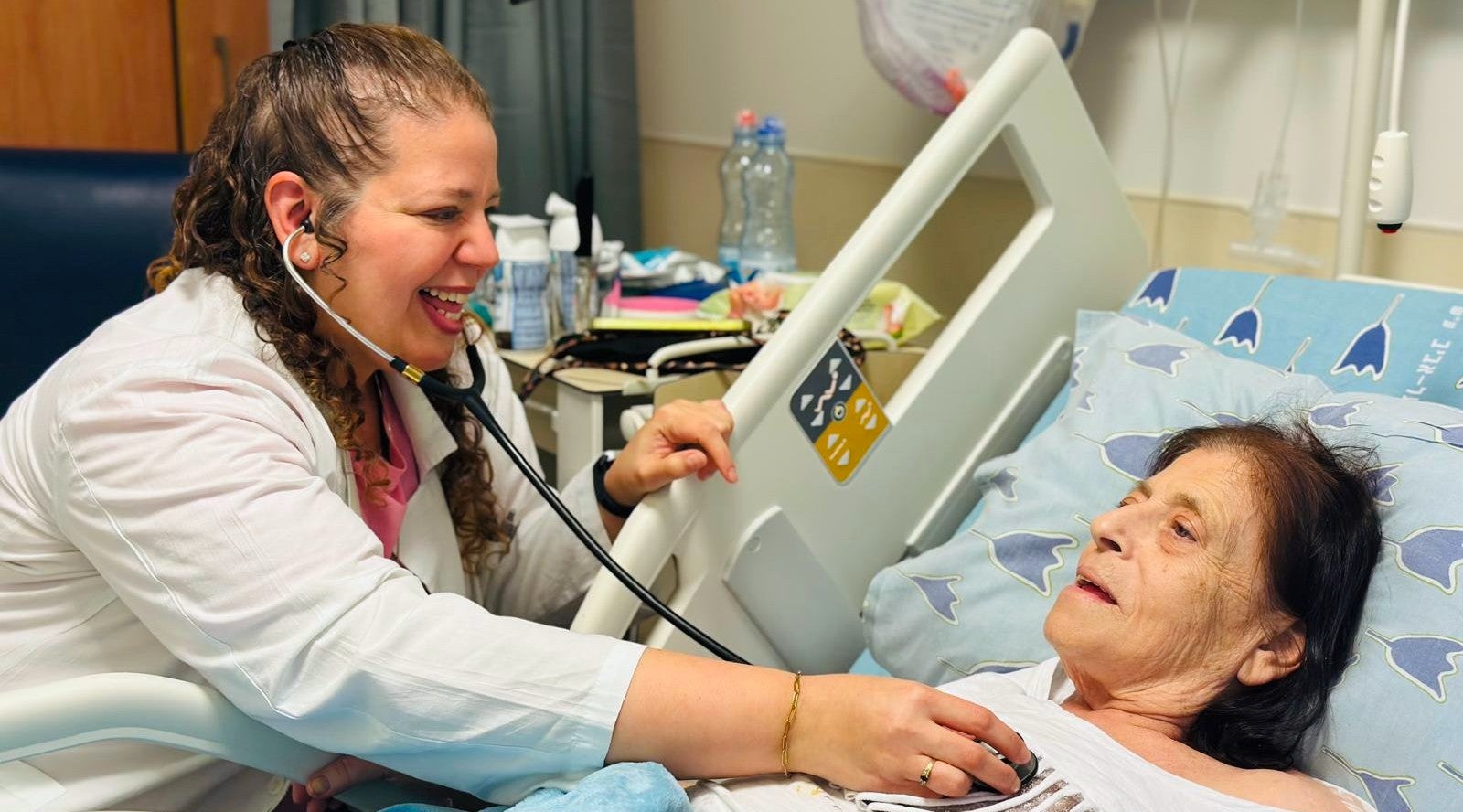
TEL AVIV — Dr. Olivia Keller-Baruch had long dreamed of working as a doctor in Israel.
Originally from Montreal, she knew making the move would require some adjustments. Her Hebrew skills needed work, she was aware physician salaries in Israel differ from those in North America and she assumed navigating Israeli bureaucracy would take time.
But when Keller-Baruch, 29, immigrated recently after finishing her residency at the University of Missouri, she received assistance that smoothed the path to getting credentialed in Israel and quickly finding a job in the Emergency Department at Ichilov Tel Aviv Sourasky Medical Center.
She’s also had some amazing experiences she never could have imagined in her native Canada. In mid-October last year, Keller-Baruch’s ER team was part of the welcoming committee that received many of the 20 Israeli hostages upon their release after two years in Hamas captivity in Gaza.
“It was very emotional for all of us,” she recalled. “Our job in the ER unit was to receive and stabilize them before sending them to their private rooms in the ICU. Even though it was brief, it was such an honor to be part of this moment we had all been holding our breath for.”
Keller-Baruch is among more than 1,000 doctors who have immigrated to Israel since the launch, in 2024, of the International Medical Aliyah Program (IMAP) — a joint effort headed by Nefesh B’Nefesh in partnership with Israel’s Ministry of Health, the Ministry of Aliyah and Integration, the Ministry of the Negev, Galilee and National Resilience, and the Jewish Agency for Israel.
The program aims to bring 2,000 doctors to Israel by 2029 to help relieve the country’s increasingly dire physician shortage, with support from the Marcus Foundation, the Gottesman Fund, Jewish Federations of North America, the Azrieli Foundation and the Arison Foundation.
Israel’s physician scarcity is due to a number of factors: the retirement of Russian doctors who immigrated to Israel en masse in the 1990s after the fall of the Soviet Union, a decision by the Israeli medical establishment to stop accepting medical degrees from various institutions in Eastern Europe as well as the limited number of seats in Israeli medical schools, according to Tony Gelbart, co-founder and chairman of Nefesh B’Nefesh.
“Israel never fully adjusted for this, resulting in a bottleneck in residency and internship positions,” said Tony Gelbart, whose organization facilitates Aliyah from North America. “The convergence of these factors is creating an impending crisis.”
Nefesh B’Nefesh Co-Founders Rabbi Yehoshua Fass and Tony Gelbart at MedEx France, part of the International Medical Aliyah Program. (Shahar Azran)
The International Medical Aliyah Program is bringing accredited physicians to Israel by helping speed their credentialing process and easing their immigration with concierge-style services.
For many physicians, the process begins in their home countries at MedEx fairs, where they can get answers to all their questions about accreditation and immigration, meet with prospective Israeli healthcare employers and get an expedited path through the paperwork.
“Physicians interested in aliyah arrive with their diplomas and certifications in hand, some still in frames, and are licensed on the spot,” Gelbart said. “Rather than landing in Israel and waiting nine months for paperwork and processing, physicians complete the licensing process prior to aliyah. Upon arrival, they receive citizenship and, within a week, are able to practice.”
The International Medical Aliyah Program also aims to help doctors find jobs and homes in Israel’s periphery, where the physician shortage is even more severe.
Dr. Vladimir Belkin from Yekaterinburg, a city in Russia’s Ural region, came to Israel with his wife, Anastasia, also a doctor, in August 2023. Despite having a doctorate in neurology, he chose to do a four-year residency in physical rehabilitation medicine at Beersheva’s Soroka Hospital.
The timing was propitious, as the need for rehabilitation services in Israel skyrocketed in the wake of the Oct. 7 war. In June, the war arrived at Belkin’s own hospital, when his building sustained a direct hit from an Iranian ballistic missile.
“Our department was on the first floor, and most injuries were on higher floors,” Belkin said. “It was a miracle none of our patients were hurt.”
Despite the tumult, Belkin, 34, says he is thankful to be in Israel.
“I think it was the right decision because it led to changes that were good for me and my family,” he said.
Keller-Baruch echoed that sentiment.
“Israel has always felt like a home away from home,” she said. “I’m extremely grateful for being able to do the job that I love in a country known not just for innovation but also compassion.”
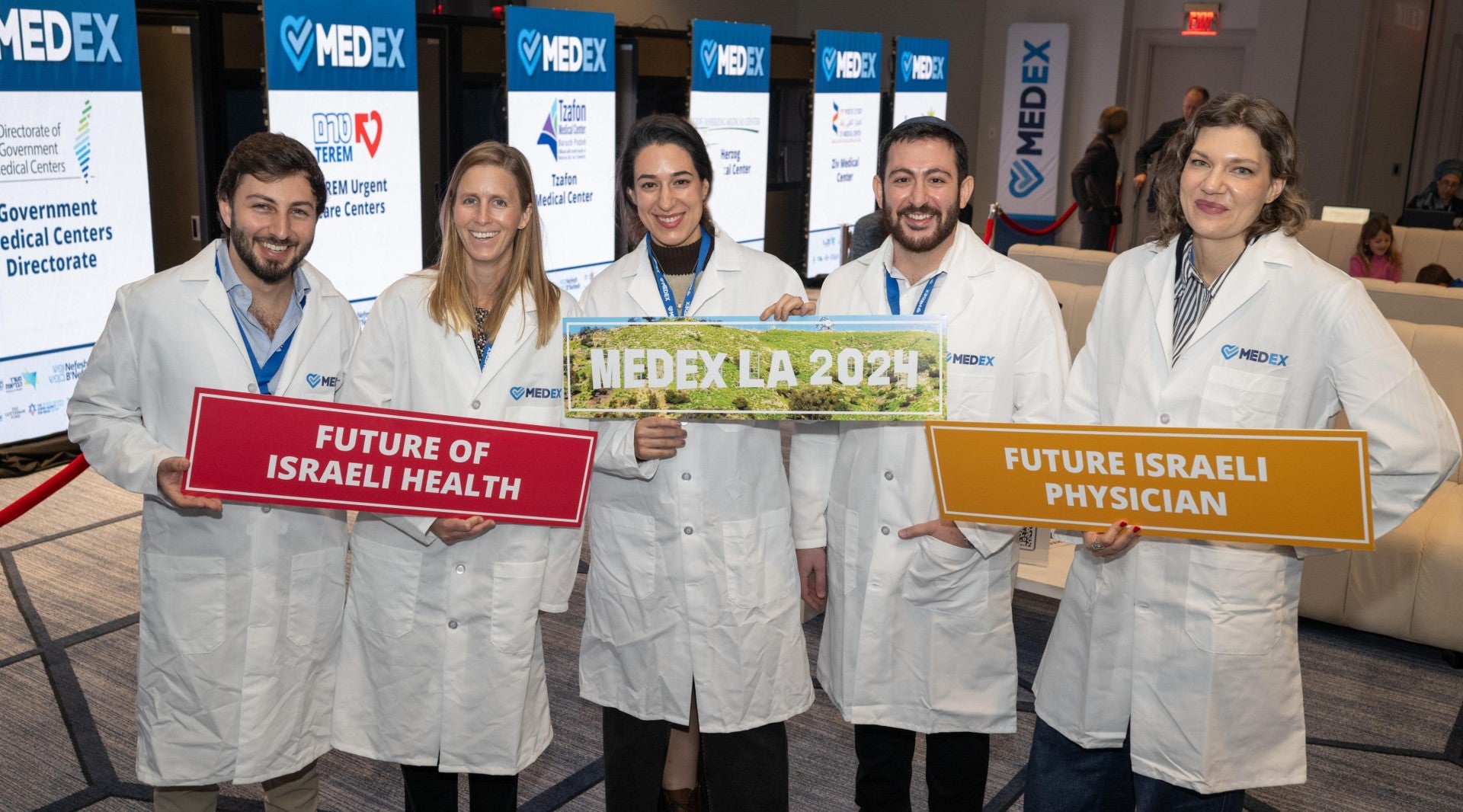
Attendees at MedEx Los Angeles explore the Aliyah process and next steps to becoming licensed medical professionals in Israel through the International Medical Aliyah Program. (Shahar Azra)
Fellow Canadian doctor Osnat Steiman moved to Israel in January 2024. A geriatrician, she works at Ichilov’s rehabilitation center, helping mostly elderly patients recover from falls, brain bleeds and other traumatic injuries.
Steiman, 42, said that moving to Israel had been a lifelong goal.
“I had a strong Zionist upbringing. My mother’s Israeli, and it was always part of the plan to come back to Israel,” Steiman said. “Of course, there are always some frustrations, but that’s everywhere. In spite of everything going on here, I wouldn’t want to be anywhere else.”
Although Nefesh B’Nefesh generally focuses exclusively on immigrants from North America, its work for the International Medical Aliyah Program is global. In recent months, the organization has held MedEx events in New Jersey, Los Angeles, Paris, London, Buenos Aires, Sydney and Melbourne. In November last year, MedEx launched in Canada, with more than 500 attendees in Toronto and Montreal.
At such events, doctors often sit for interviews with representatives of major Israeli hospitals, including Ichilov, Hadassah, Rambam, Kaplan and Galilee Medical Center, as well as Israel’s four health maintenance organizations.
Anesthesiologist Eugene Rappaport, 59, moved to Israel in June 2024 from Manhattan Beach, California, where he worked with patients undergoing heart and lung surgery. Now he works for Assuta, Israel’s leading private hospital network. He earns less than he did in California, but Rappaport says it’s worth it.
“My aliyah was not driven by money, but purely my desire to be a part of Israel and the joy I take in caring for our people,” Rappaport said.
Steiman said that doctors who move to Israel should speak serviceable Hebrew, be prepared financially and find a strong support system. The International Medical Aliyah Program can help with all those elements, and ease the daunting administrative side of things.
“There’s a lot of bureaucracy, but the second I made my application through Nefesh B’Nefesh, they reached out to me,” Steiman said. “It was a very smooth landing. Overall, it’s been positive.”
Asked if she has any advice for physicians considering aliyah, Keller-Baruch said, “Don’t be afraid to make the jump. Despite all the hardships we’ve experienced, these terrible things will only help us grow back stronger.”