
The class does not begin with a lecture. Instead, Neta Elkayam stands at the front of the room and sings. Usually in the Moroccan Arabic of her ancestors, rather than her native Hebrew.
The students — most of them Black, most of them American, many of them encountering Jewish culture for the first time — do not ask what the lyrics mean. They listen. They feel something, and it’s the feeling that eventually leads to learning.
“Seeing me perform live reveals a common ground, the desire we all share to understand our origins, a search for the lost voices of our ancestors,” Elkayamm said in an interview. “The fact that I am singing not in English but in an African language resonates with the students and helps propel them on their own quest.”
The scene has become familiar at Xavier University of Louisiana, the nation’s only Catholic historically Black university, where Elkayam and her partner in life and art, Amit Hai Cohen, have spent the past two years as visiting artists and instructors. Their course, an immersive, multidisciplinary exploration of music, memory, diaspora and interfaith exchange, grew out of an initiative to increase understanding between the Black and Jewish communities. It is now one of the most sought-after electives on campus, recommended by students by word of mouth.
It is an unlikely setting for two Israeli artists whose work has been shaped by Morocco, Jerusalem, Marseille and Paris, and whose creative lives have long resisted fixed categories. Yet Xavier has become a place where their music, pedagogy and personal histories suddenly make sense together.
It is also the place where they now face a crossroads.
After two years of teaching, performing and building cultural bridges in New Orleans, the private funding that brought them to Xavier has ended. The university wants them to stay. But whether they can remains uncertain, a predicament reflecting a wider strain on the institution itself.
Xavier University is facing significant financial uncertainty, underscored by recent layoffs even as it received a major gift from philanthropist MacKenzie Scott that offered partial relief. At the same time, moves by the Trump administration to cut or reshape federal higher-education programs have disrupted key funding streams the university relies on, adding to the instability.
For Elkayam and Cohen, who have spent their careers moving along what they call the “Jerusalem-Morocco axis,” the question is no longer how to live between places, but whether that in-between can become a home.
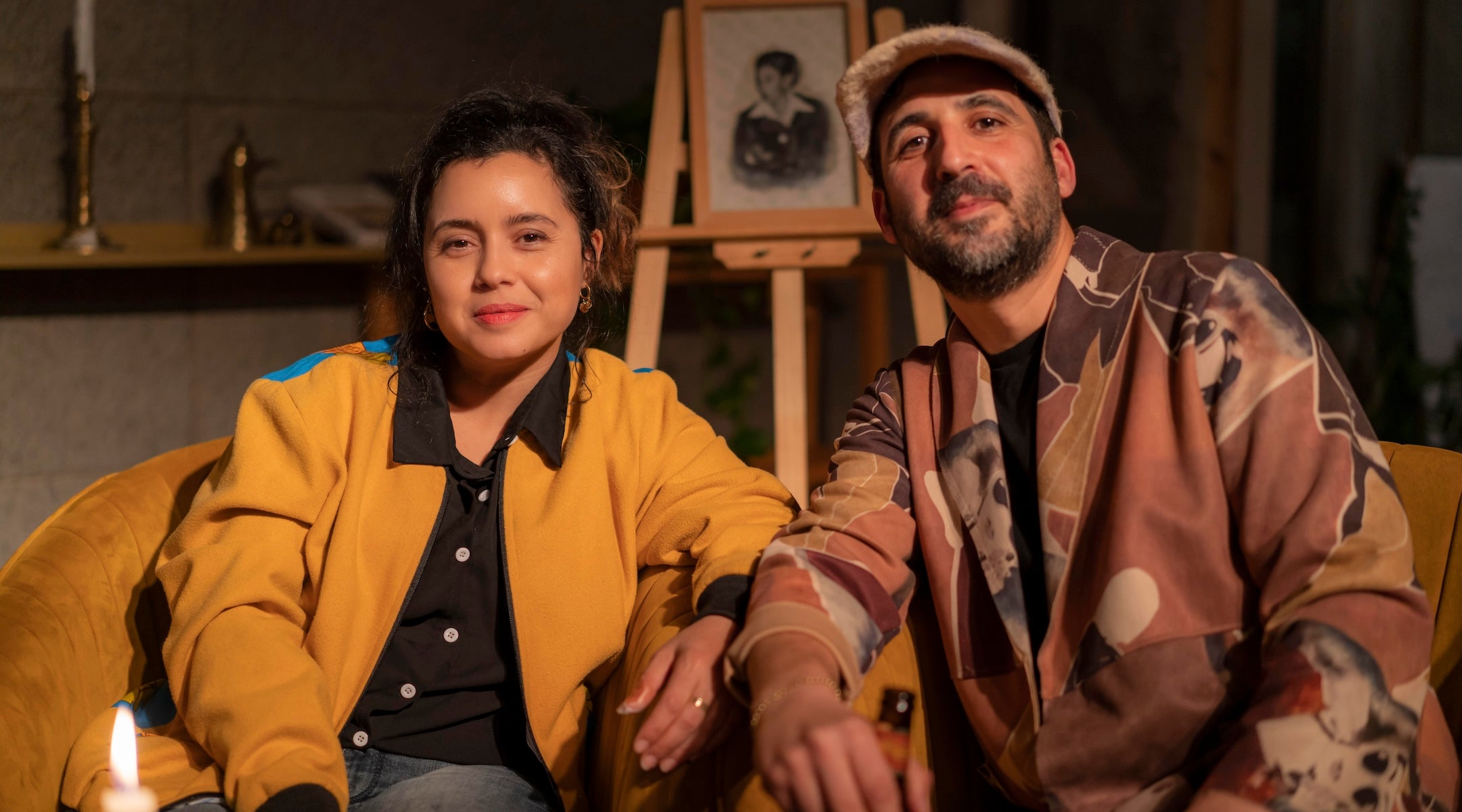
The couple often perform together, with Elkayam singing and Cohen at the keyboard. (Shmulik Balmas)
Long before New Orleans entered the picture, Elkayam and Cohen were already artists of transit and connection.
Elkayam, 45, rose to prominence in Israel, Europe and Morocco for her reinterpretations of North African Jewish music, not as preservation, but as reinvention. Born in Netivot, on Israel’s geographic and social periphery, she grew up acutely aware of the ruptures many Mizrahi Jews feel: the distance from ancestral languages, sounds and stories. Her work has become a way to address that loss, offering a path back to connection beyond nostalgia.
Drawing on Andalusian, Amazigh (Berber) and Jewish liturgical traditions, she folds in elements of jazz, rock and contemporary performance art. Her sensibility is evident in projects like “Hilula,” a multidisciplinary opera blending drag, Torah study and live music, and “Arénas,” a collaboration built around archival recordings of women from Morocco’s Atlas Mountains who passed through a transit camp in Marseille on their way to Israel.
Cohen, 43, has worked in music, cinema and visual installation, often in collaboration with artists from Morocco. He recently explored memory and ritual across Judaism, Christianity and Islam through a ceiling installation for the Tower of David Museum in Jerusalem weaving together the elements from all three faiths.
Together, the couple built ambitious, research-driven projects that blurred the line between scholarship and performance. Their collaborators included towering figures of North African Jewish music — among them the Algerian pianist Maurice El Médioni — as well as Moroccan Muslim artists and Gnawa masters.
“We’re not interested in freezing the past,” Cohen said. “We’re interested in what happens when you improvise inside it.”

A still from a music video featuring Elkayam and Gnawa musician Moktar Gania.
That ethos drew the attention of scholars such as Chris Silver, a professor at McGill University who studies North African music and Jewish-Muslim history. Silver describes their approach as not merely performing an inherited repertoire, but actively shaping how the past is understood and carried forward.
“As a scholar focused on the relationship of music to history, I marvel at what sometimes feels like their historiographical approach, in which their music builds on a well-known and lesser-known past, is in dialogue with the contemporary, and is future-oriented, contributing to and shaping the sounds of the possible and what may yet be,” Silver said.
For Flo Low, the founder of Bamah, the nonprofit that brought the couple to Xavier University two years ago, the future Silver describes crystallized in a single moment.
Low, an American Jew who has lived in Israel, first saw Elkayam perform in Jerusalem in 2018, at an outdoor concert beneath the walls of the Old City. She expected virtuosity. What she did not expect, she said, was what happened next.
“Neta started singing in Moroccan Arabic,” Low recalled, “and thousands of people in the audience were singing along with her. Her music is allowing so many people in the Jewish world to reconnect with their Jewish roots through their music.”
For Low, who had been working to build cultural exchange programs between Israeli artists and American institutions, the scene was revelatory.
“I knew at that moment that I wanted to bring Neta and her partner Amit to the United States,” Low said. “If they could inspire me and thousands of others in a single performance, I could only imagine what they might do with a full semester, or even a full academic year, with students.”
Still, it would take several years, and an unexpected chain of events in New Orleans, before the partnership materialized.

Cohen taking a selfie with his students (Courtesy)
The road to Xavier began with Kanye West, the musician who now goes by Ye.
In late 2022, as antisemitic rhetoric surged into mainstream discourse — fueled in part by Ye’s public outbursts — students at Xavier were finding themselves caught in a confusing digital and social crossfire.
“My freshman honors students were hearing a lot of people in their lives say that ‘Kanye has a point,’ and they wanted to know, as students at a historically Black university, ‘What is our response?’” recalled Shearon Roberts, a professor and associate dean at Xavier. “They realized: we don’t actually know Jewish people. Many students had never met a Jew at all.”
Roberts saw an opportunity for a different kind of education. “How about we start there?” she told them.
A small group of Xavier students launched an initiative that set out to address antisemitism and anti-Black racism together, rather than as separate problems.
They partnered with local Jewish organizations and faculty mentors, built relationships with students at nearby Tulane University, known for its high concentrations of Jewish students, and began hosting dialogues that emphasized shared histories of exclusion and violence — alongside the tensions and misunderstandings between the two communities. The students designed workshops, social media campaigns and campus events focused on media literacy and the warning signs of radicalization.
“We wanted to tackle that problem in our community,” Aarinii Parms-Green, one of the Xavier students, who graduated last month. “We saw it rising with Kanye West, Whoopi Goldberg, Kyrie Irving and other figures saying things like, ‘Black people are the real Jews’ or ‘Jews people control the media.’”
Parms-Green said the students were inspired by the history of Jewish-Black solidarity, from the civil rights movement to the Jewish academics fleeing the Nazis in the 1930s who found refuge at HBCUs.
Their project eventually won a national Department of Homeland Security award for innovative anti-extremism programming. (The federal program behind the award was shut down by the Trump administration earlier this year.)
The win led to a trip to Israel for the students and when they returned they wanted to sustain the connection, especially to Israel’s racially and ethnically diverse culture.
“The project started as a way to give back, to bring Black and Jewish students together and counter hate, and it just took off,” Parms-Green said.
After the attacks of Oct. 7, the work felt only more urgent.
“Instead of rushing to blame, people on campus asked questions,” Parms-Green said. “They wanted context. We didn’t see protests — there was more curiosity than anything.”
While it’s true that Xavier has not been a central hotspot of campus unrest around the war in Gaza, the atmosphere has not been entirely tranquil either. In June 2024, administrators canceled a commencement address by United Nations Ambassador Linda Thomas-Greenfield after students organized a petition and raised objections over her role in U.S. policy backing Israel in the Gaza war.
Still, just as the Xavier students were looking for ways to engage with Israelis, Elkayam and Cohen were searching for a way to stay abroad, wary of returning to a country in turmoil.
They had landed in Morocco two days before Oct. 7, planning on little more than a week of concerts and screenings. The documentary they were showing, directed by a local Muslim filmmaker and titled “In Your Eyes I See My Country,” follows the two as they travel through Morocco, searching for traces of the Jewish world their families left behind, a world that once numbered about a quarter million people and has dwindled to only a few thousand.

Elkayam and Cohen, in the front row at far right, attend the Marrakech International Film Festival for the premiere of “In Your Eyes I See My Country” by Kamal Hachka in 2020. (Courtesy)
On Oct. 6, they gathered to celebrate at Hachkar’s home with a mostly Muslim circle of friends where they recited the Jewish blessing over wine that marks the start of the Sabbath, and sang, and shared stories late into the night. The next morning, they woke to the news.
With two young children and a single suitcase, they faced a choice.
“We quickly understood the insanity that was coming to Israel and decided to stay,” Cohen said.
Their outlook proved to be a premonition of how many Israelis would come to feel over the next two years, as more than 69,000 residents left Israel in 2025 alone, contributing to sustained negative migration and one of the largest modern spikes in emigration from the country.
For Elkayam and Cohen, the decision was about preserving relationships and the ability to think, mourn and speak honestly, especially given how unpopular their left-wing views have become in Israel after Oct. 7.
“It might sound weird but we felt safer in a sense in Morocco, to be among our friends and accepted with our complexities, where we can talk about different narratives at once.” Cohen said. “In Israel, inside the family, you can’t always speak freely. I don’t want to fight with my dad about politics. I am not going to let it happen.”
After three months, living in friends’ homes and watching events unfold from a painful distance, Bamah brought the couple to Xavier University.
At Xavier, Elkayam and Cohen were not treated like visiting artists passing through. They were, as Roberts, their host and champion on campus, put it, “part of the university’s extended family.”
“They are a model for what it looks like to have members of the Jewish diaspora — Israeli citizens, artists, educators — serve, teach and mentor at a historically Black university,” she said. “And they’ve always led with their artistry first. When you connect with people through art, through beauty, everything opens up in a different way.”
Roberts continued, “If I brought someone who was like a Jewish studies expert or political or sociology expert, and they’re lecturing to these students about complex issues connected to Jewish identity, African American identity, Jewish or African diasporic identities, it might get lost in translation. But when Neta and Amit say, ‘All right, grab an instrument. Let’s sing, let’s improvise,’ they’re all speaking one language, even though they don’t speak the same language.”
The warm embrace the couple has found at Xavier, including from Muslim faculty, comes at a moment when many Israeli academics report feeling the opposite: isolated, targeted, and professionally vulnerable on American campuses amid the Gaza war.
For Roberts, it’s no surprise that a historically Black university would be different. HBCUs, she says, know how to practice inclusion because they were founded as an answer to racial exclusion. “By nature, we welcome before we turn away,” she said.
At the same time, Elkayam and Cohen’s particular outlook and style have helped them avoid the kinds of conflicts and tensions Israelis have faced at other universities. By their own account and that of supporters like Roberts, their work is deeply political, but because they communicate through their art, it is harder to flatten them into a caricature or cast them as political adversaries.
Their success at navigating an era prone to strife isn’t confined to Xavier or New Orleans.
In August, Elkayam and Cohen traveled to Flint, Michigan, where they appeared on stage with their New Orleans band alongside musicians from the National Arab Orchestra, in a concert co-presented by Bamah and the Flint Jewish Federation.
Titled “Songs of Our Mothers,” the program represented a rare collaboration in a moment when Israeli artists often face boycotts. The evening unfolded quietly, without protest and without political interference.
At Xavier, each semester culminates in a public showcase of student work, where projects ranging from short films to musical performances and research presentations are shared with classmates, faculty and community members.
“One student told me he would have never been able to voice how I feel on an artistic level with the class,” Parms-Green said. “He left that class feeling more confident, his ability to kind of just put himself out there.”
For all their travel, Elkayam and Cohen have begun to lay down something like roots in New Orleans. They built a band with local musicians, adapting their repertoire of Moroccan Jewish songs to the rhythms of the city, letting brass and jazz sensibilities seep into the arrangements. They were struck by how New Orleans’ second-line parades echoed Morocco’s street rituals, where music spills into public space and celebration becomes something the whole neighborhood moves through together.
“It’s like when I went to Morocco for the first time and was totally shocked,” Elkayam said. “You see music inside people’s homes, art inside people’s homes. Suddenly all the hierarchies in your head collapse — what’s ‘folklore,’ what’s ‘high art,’ what’s ‘low.’ We came back from Morocco as different people, it blew our minds. And it’s the same here, discovering America — the non-stereotypical America, the one they don’t market to you.”
Last year, they brought to New Orleans one of the figures who helped unlock their Moroccan heritage: Reuven Abergel, a founder of Israel’s Black Panthers.
The movement, started by Mizrahi Jews in the 1970s, intentionally borrowed its name and tactics from the American Black Panther Party to protest the systemic discrimination and domination of Israeli society by Ashkenazi elites. A longtime mentor and friend to Elkayam and Cogen, Abergel met with the students at Xavier, creating a bridge between two distinct histories of marginalization and resistance. Cohen filmed the visit for an ongoing documentary about Abergel’s life, capturing the moment where the “Jerusalem-Morocco axis” met the American South.
Cohen also helped create a digital exhibition marking 100 years of The Louisiana Weekly, the city’s historic Black newspaper, helping research its archives and design the site. The work pulled him into the civic memory of the place, into conversations about race, migration and culture that felt familiar and new at once.

Elkayam and Cohen are part of a band that performs in New Orleans (Courtesy)
At home, the process has been quieter and more complicated. In our conversation, Elkayam described feeling like an immigrant for the first time, even as her children, almost without noticing, were becoming New Orleanians. They now speak mostly English to their parents. They know the songs, the parades, the small neighborhood rituals. “They’re really from here,” she said. “They grew up inside the parades. For them, this is how you celebrate.”
The couple are also seeing transformation in themselves. The war, the distance, the months in Morocco and now New Orleans have left them feeling untethered from the national identities they had once inhabited. They miss Jerusalem and the community that formed around them there. They also recognize the relief in being in a place where they are not required to perform loyalty, and where it is possible to hold grief and criticism in the same breath.
“We don’t feel Israeli in the rooted sense of the word,” Cohen said. “What matters to us now is not the place, it’s the people.”
They have begun to think of themselves as Jews in the diaspora — not as a temporary condition but as a way of moving through the world.
What happens next is unclear. They are currently in the United States on J-1 visiting scholar visas sponsored by Xavier University, but the university cannot offer enough funding to hire them as full-time instructors. Without outside support to replace the now-expired Bamah grant, they risk losing their visas and their right to stay in the country.
For now, they keep teaching, composing and building relationships, unsure how long New Orleans will remain home.
“I really feel like a Jewish migrant right now, in the most basic sense of the word,” Cohen said.
Elkayam offered a caveat. She has come to see their time abroad as a fragile privilege — a brief chance to heal while others, especially Mizrahim without the means to leave, remain stuck.
Grateful yet uneasy, she misses the heavy responsibility she once carried in Jerusalem: showing up for her community, helping hold its history, telling stories that might otherwise disappear. From New Orleans, she allows herself to rest, even as she knows the future is uncertain.
“Maybe, God willing, we’ll be able to continue here,” she said, “because yeah, I don’t always miss that role.”