
The arson in December at Beth Israel Congregation didn’t just damage the only synagogue in Jackson, Mississippi. It also threw into disarray the operations of a Jewish nonprofit that aims to serve the entire American South.
The Goldring/Woldenberg Institute of Southern Jewish Life is housed at the opposite end of the Beth Israel building from the library where the fire started. Most of its activities take place off site, in the small Jewish communities scattered across the region, and much of its archives had been digitized before the fire.
Still, the arson attack struck an institution that, since its founding in 2000, has linked far-flung congregations across the South and imbued generations of Jewish leaders with an appreciation for Jewish life in a region where community is often small, deeply rooted and hard-won.
“This is sort of the hub of where things happen, so we’re still assessing what is truly lost, what can be repaired, what can’t be,” Michele Schipper, the organization’s CEO, said ahead of the synagogue’s first Shabbat since the attack.
Even as the institute embarks on the long road of repairing its brick-and-mortar headquarters, its core mission of connecting and sustaining Jewish communities across the South remains unchanged.
“It will be important for my communities this winter and spring to be with me, to hear from me about what’s going on,” said Rabbi Salem Pearce, who is officially ISJL’s director of spirituality but unofficially “the traveling rabbi of the South.” She roves from her home in Durham, North Carolina, across 70 congregations throughout a 13-state region that extends from Texas to Florida.
Following the arson attack, Pearce said she believed the communities she serves had taken the attack personally because “they identify strongly, both with the ISJL and with the idea of being vulnerable being a small Jewish community in the South.”
“I always want to ground what I do in Torah and in Jewish tradition, and I think that both of those things have a lot to say about the power of community and resilience and being together and survival,” said Pearce.
For years, the institute also placed early-career Jewish educators in Southern communities through its flagship fellowship program. The program ended in 2022, but the network of dozens of former fellows scattered across the country say their work supporting Jewish life in the South left lasting impressions on their own Jewish identities.
Rabbi Lex Rofeberg, an ISJL fellow from 2013 to 2015, was attending a gathering of clergy from the Jewish Renewal movement in Boulder, Colorado, when he first heard the news of the arson.
“I felt in my body like a deep pain, and I immediately flashed to the incredible experiences I had as part of that synagogue community,” said Rofeberg.
He wasn’t the only one at the conference to feel that way. “I was with people that had a shared connection to the space and who I had met through this incredible community, and I thought all that was helpful,” he said. “So it was heartbreaking, and it was meaningful to see in that space a couple hundred people looking to be supportive of this community.”
Beth Israel Congregation in Jackson, Mississippi, on Jan. 16, 2025. (Jewish Telegraphic Agency)
Molly Levy, ISJL’s director of education, said one of the reasons why the institute shifted away from the fellowship program was that the communities were so strong that they needed more than temporary fellows could provide.
“They’ve all used the curriculum, they’re very familiar with it, and they want to do things that are more experiential, and looking at making their schools fit the students that they have today, as well as having these big conversations around antisemitism, around safety, making sure that their students feel safe,” Levy said.
The communities in the network also bond with each other. For Beth Israel Congregation’s first Shabbat service following the arson attack, the congregation used a Torah borrowed from Temple B’nai Israel, located about 90 miles southeast along Route 49.
“We’re just down the road in Hattiesburg. So people immediately wanted to know, OK, how can we help?” said Rabbi Debra Kassoff of Temple B’nai Israel, who became the ISJL’s first director of rabbinic services in 2003.
During her stint as the ISJL’s resident rabbi, Kassoff traveled across the region to offer rabbinic services to congregations.
“It was an honor, it was fascinating and overwhelming,” said Kassoff. “When I first came here I felt really embraced, people seemed excited to have me, and were glad that I was wanting to be there and be a part of this kind of corner of the American Jewish landscape that is so often overlooked.

The original building of the Museum of the Southern Jewish Experience, which was the precursor to the ISJL, at the Henry S. Jacobs camp in Utica, Mississippi. (Courtesy Bill Aron)
In the wake of the attack, rabbis from several Southern congregations quickly voiced their dismay and solidarity with the institute.
Rabbi Jeremy Simons, a former director of the rabbinic department at the ISJL and incoming rabbi of Congregation Beth Israel in Carmel-by-the-Sea, California, recalled his time in Jackson in a post on Facebook and appealed to his followers to donate to the synagogue’s recovery fund.
“While I have plenty of fond memories in that building and in that library, there are so many who call Beth Israel their spiritual home and are feeling a pain neither you or I will ever know (God willing),” wrote Simmons. “I know you don’t have to have spent time in that building, or even know of its existence, to be shaken by this news. I try to remind myself they can destroy our buildings, but they can never destroy our faith. If anything it will only strengthen it.”
Rabbi Raina Siroty of Temple Beth-El in Knoxville, Tennessee, wrote in a post on Facebook that the ISJL had “connected and strengthened Jewish communities from Texas to the Florida Panhandle,” adding that “Southern Jewish communities are woven deeply into the fabric of their cities. They deserve to worship without fear.”
Rabbi Jason Holtz of Temple Kehillat Chaim in Roswell, Georgia, wrote in another post that he had attended the ISJL’s conference within a few weeks of moving to Georgia.
“I remember leaving with a sense of enthusiasm but also amazement at the wonderful people that provide such resources and leadership for Jewish communities all over the South,” he wrote. “When people think of Jewish life, places like Jackson probably don’t immediately come to mind. But Jews all over the South, my congregation included, have benefited so much from the tireless and dedicated people who call Jackson home.”

Smoke damage inside a classroom in Beth Israel Congregation on Jan. 16, 2025. (Jewish Telegraphic Agency)
Schipper said many past fellows and staff of the ISJL had also shared messages of support.
“There’s such powerful messages that they are sharing and remembrances of their time here in Jackson and at Beth Israel, because for many, this was their first non-parent home synagogue,” she said. “I’m overwhelmed in the best possible way of the outpouring of support from the local community to the Jewish community worldwide. It really makes me proud to be Jewish.”
Rofeberg said his two years at the ISJL, which included hosting a “Purim-gras,” or a Mardi Gras-Purim combo at a Louisiana synagogue, were “pivotal” in setting him on a path to seek rabbinic ordination.
“I think I went down thinking I was doing this grand service as somebody who had learned in college about Judaism,” said Rofeberg. “And I really quickly learned how wrong that was, and how so many of these communities I was visiting and the community I was living in had way more to teach me than I had to teach them.”
Megan Roberts Koller, an ISJL fellow from 2007 to 2009 who grew up in Knoxville, Tennessee, said her time with the institute deepened her own understanding of her identity as a Jew in the South.
“I think being in an environment with lots of different types of people helped me realize how special the Southern Jewish experience was,” she said. “It was interesting to be part of something so new and something so different.”
Roberts Koller recalled the fellows going on trips to the Neshoba County Fair and local blues concerts to experience a “slice of life” of Mississippi.
“Especially over the summers, when we were traveling less and we were onboarding new people, there was quite a push to have us experience that authentic Mississippi summer and help people feel both out of their comfort zone and comfortable in Mississippi,” she said.
While Roberts Koller, who lives in Nashville, Tennessee, no longer works in Jewish communal life, she said her experiences at the ISJL had inspired her to continue pursuing Jewish involvement in her own community.
“The experience of working for the Institute of Southern Jewish life and seeing congregational life all across the South and cities large and small, I think, really made an impact and made it a priority to be part of a congregation here in Nashville,” she said.
In recent years, Levy said the ISJL had created a “catalogue” of lessons about Jewish pride and information on teaching students about antisemitism.

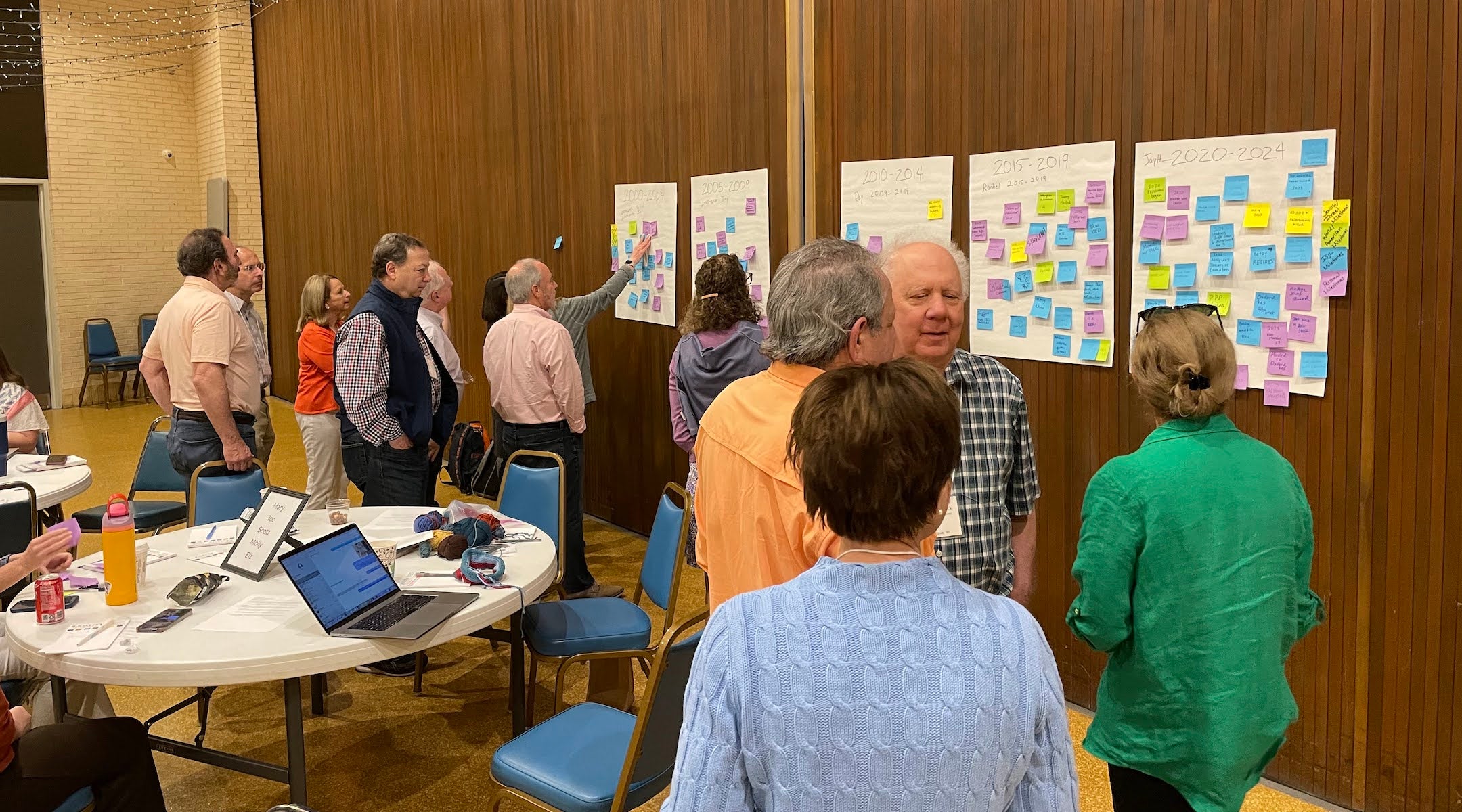
Staff gather during the ISJL’s 2025 retreat. (Courtesy Michele Schipper)
Currently, the ISJL’s antisemitism curriculum begins in the eighth grade, but Levy said she was working on starting antisemitism education in the earlier grades.
“When I go into a community, I usually meet with the teens, and will usually have conversations on being the only Jewish kid in your school or being a small population of Jewish kids in your school,” said Levy. “When I ask, ‘Have you heard something antisemitic, or have you had an incident in your school?’ It’s very rare when someone doesn’t raise their hand.”
Looking ahead, Schipper said the institute’s focus will be on building on a firm foundation, not just in its physical space but in the messages it delivers across the South.
“If you look at our curriculum, it already had information on how to be a proud Jew,” said Schipper. “So I think, can we strengthen that message? Can we let people know a little bit more about what we are doing, so that they’re well aware that this organization is providing support to these communities in so many ways.”
For Levy, the aftermath of the attack has underscored the strength of the organization’s broad spanning community.
“It’s only shown us how incredibly powerful our network and how incredibly important these connections are, just because of all of the outpouring of love and support that’s come from our other ISJL communities and how much they want to support Beth Israel,” she said. “It’s been really hard and really sad and really challenging, and we were incredibly ready to activate our network and activate the support that we needed to give.”
Schipper said she could see an upside to the bleak circumstances that brought national attention to her work this year.
“This is not how I would love more publicity,” she said, referring to the arson. “But if somebody else learns about who we are and what we do and goes, ‘Oh my gosh, my cousin’s in Kentucky, and they could really use your resources,’ then great.”