
SYDNEY — “As a Holocaust survivor, I want my Australia back!”
This was the impassioned plea that garnered rapturous applause from several thousand mourners who converged in the pouring rain at Bondi Beach on Sunday evening to mark shloshim — the 30 days of mourning since the Hanukkah massacre that claimed 15 lives on Dec. 14.
Mark Spigelman, the long-lost cousin of Art Spiegelman, the American cartoonist most famous for his book “Maus,” recalled that he arrived in Sydney as a young refugee. “We were the leaders in the world of multicultural coexistence,” he said. “But on Oct. 7 something happened. Our icon, our Opera House, was taken over by hate. [Then] our wonderful Harbor Bridge was crossed by many well-meaning people but also by hate.
“And I thought: That’s two of the three icons that Sydney is renowned for. Then came Dec. 14.”
The Opera House. The Harbor Bridge. Bondi Beach.
Each one an icon, a totem, a postcard. More than just a place, they imbued the very idea of Australia: a land of optimism, freedom, egalitarianism — the so-called Aussie “fair go.”
Whether the foaming mob of pro-Palestinian protestors chanted “Where’s the Jews?” or “Gas the Jews” on the steps of the Opera House on Oct. 9, 2023, the intent was the same: F–k the Jews.
The “March for Humanity” across the Harbor Bridge in August 2025 ostensibly protested the humanitarian crisis in Gaza. But the bridge – its dazzling fireworks display beamed around the globe every New Year’s Eve — soon became occupied territory for globalizing the intifada.
And now Bondi Beach. The Hannukah massacre of 15 innocent people exactly one month ago was the devastating denouement of an arc of anti-Semitism that has terrorized Australia’s 120,000-strong Jewish community over the last two years.
“This isn’t the Australia I grew up in,” Spigelman added. “If we keep this going our multicultural society will fall apart.”
Australia’s multicultural experiment was birthed in the 1970s. Until then, the nascent nation operated under the White Australia policy — racist laws from 1901 that were designed to prevent non-Europeans, especially Asians, from entering this great southern land.
White Australia was built on the notion of integration and assimilation; immigrants signed up to the “Great Australian Dream” — that owning a home would be the key to success and security; real assimilation meant barracking for an Australian Rules football team because sport is the national religion.
From the 1970s, however, the new multicultural project embraced the diversity of difference; hundreds of cultural and ethnic groups, who now speak more than 300 languages, created a largely peaceful melting pot that became the envy of the world.
Until Dec. 14 at around 6:45 p.m.
And while Australia’s Jews have long championed the fact that we welcomed some 30,000 Holocaust survivors — the largest survivor community per capita outside of Israel – this statistic avoids an inconvenient truth: The Australian government enforced quotas limiting the numbering of Jews allowed to board ships from Europe after the Holocaust. And to add insult to injury, successive Australian governments — Liberal and Labor — turned a blind eye to the thousands of Nazi war criminals and collaborators who slinked into this country and disappeared into our sunburnt suburbs. Despite a belated attempt, none was ever brought to justice.
Many of those Holocaust survivors who fled as far away from Europe as possible began to rekindle their lives here in Bondi. Back then the beachside suburb was a far cry from today’s sun-kissed Instagram posts; drugs, prostitution and organized crime sullied Bondi’s golden sands. Remarkably, until the early 1960s, bikinis were not tolerated; official beach inspectors enforced strict modesty rules in what was dubbed the “bikini wars.”
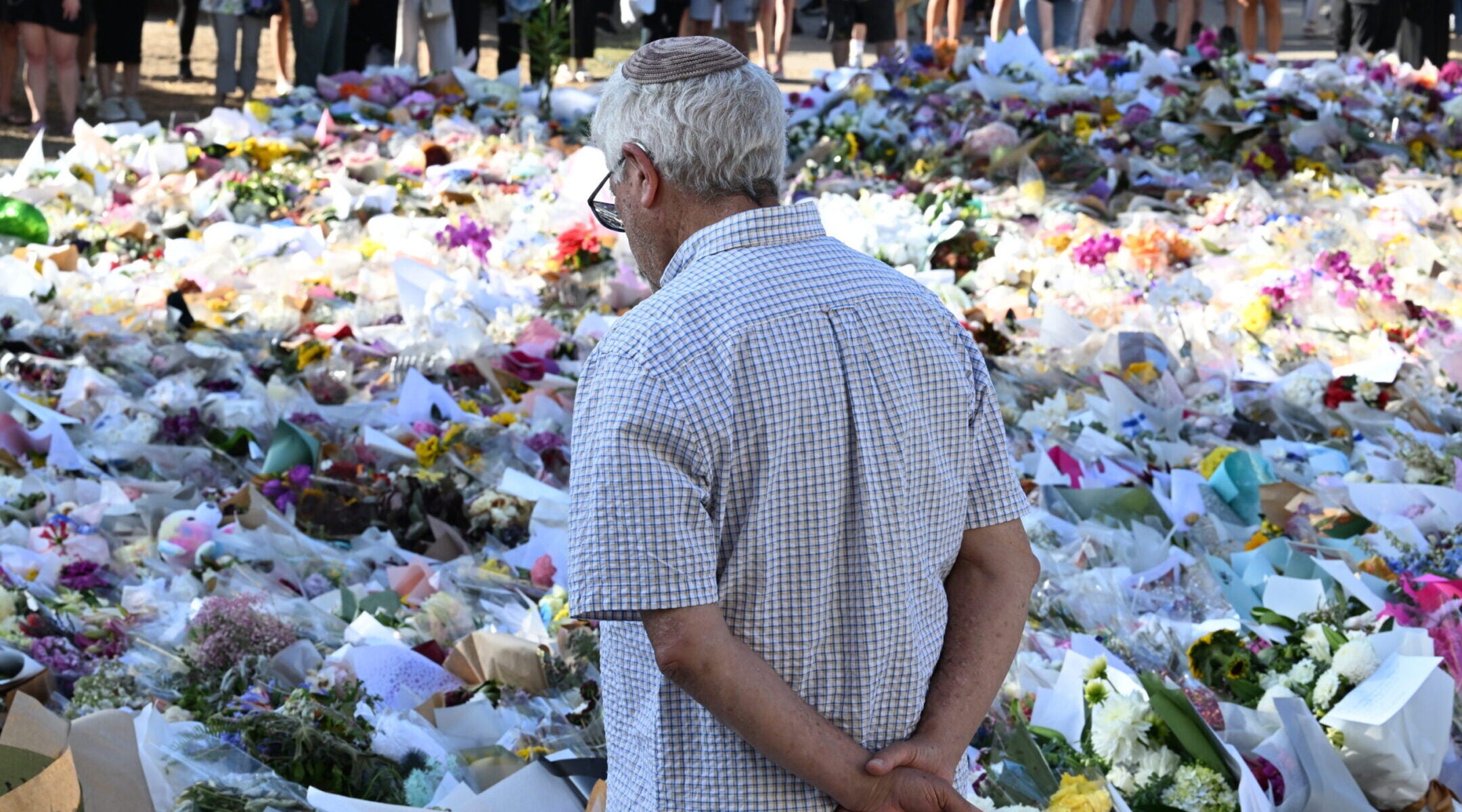
A Jewish man stands in silent contemplation at a flower memorial beside Bondi Pavilion on Dec. 17, 2025 in Sydney, Australia. (James D. Morgan/Getty Images)
But the Swinging Sixties ushered in a newfound freedom, and Bondi was its HQ.
And since the 1970s, three large waves of Jewish emigres – South Africans, Russians and Israelis — have helped ensure Bondi remains the epicenter of Jewish life here. Chabad-Lubavitch established itself in multiple Bondi locations, injecting a vibrant religious dimension to Jewish cultural life that was previously centered around the Hakoah Club — a Jewish community and sporting center that was bombed in 1982, mercifully with no casualties.
Bagels, borscht and boerewors; pita, hummus and falafel — Bondi’s diverse Jewish menu was embraced by our non-Jewish neighbors who travelled from across the city and country to taste the bounty of this beach.
That helps explain the heaving sea of flowers that engulfed the unofficial memorial; the stones laid by the Jews were subsumed by the mass of bouquets left by the non-Jews who now, finally it seemed, understood what many Jews have been saying for the last two years: that the inflammatory sermons of the “hate preachers” the intimidation, cancelling, doxxing, vandalism, assaults, and firebombings would simmer and smolder before erupting like a volcano.
Ignored, disbelieved and gaslit, Australia’s Jews are still seething with rage. And many are still boiling with contempt for Prime Minister Anthony Albanese, albeit slightly tempered after he finally caved into mounting pressure and agreed to call a Royal Commission on Anti-Semitism and Social Cohesion last week. The report of the inquiry is due on the one-year anniversary of the tragedy.
Sifting through the rubble, at least one thing appears clear: Australia’s multicultural project now hangs in the balance. But there is at least one thing keeping it on life support: the man who saved countless lives, the hero who disarmed one of the terrorists before being shot himself was an Arab. Born in Syria. A Muslim. A refugee.
And a new Australian.
Ahmed al-Ahmed — who travelled to America last week in a trip paid for by Chabad — acted on instinct, not ideology, politics or religion. “I’m defending my people,” he told the New York Times in one of his many media interviews in America. “It’s defending innocent people, whatever their religion.”
Boris and Sofia Gurman, realizing Jews were being executed for being Jews, were the first to attempt to stop the gunmen. Tragically, they failed but moments later Ahmed’s act of bravery saved more than just Jewish lives; unwittingly, he may have helped salvage the last heartbeat of Australian multiculturalism.
It may well be a naïve hope. But right now, as we mark the shloshim since the worst terror attack in Australia’s history, which slaughtered 15 lives and shredded our social cohesion, it’s all we’ve got to cling on to.
is a former national editor of the Australian Jewish News. He is also a TV producer and writer for an independent TV production company.
The views and opinions expressed in this article are those of the author and do not necessarily reflect the views of JR or its parent company, 70 Faces Media.