
When writing a review for a play you haven’t seen, you have to wait until the end of the show to start writing your piece.
But when you attend violinist Itzhak Perlman’s 80th birthday klezmer concert — featuring musicians from acclaimed klezmer bands like The Klezmer Conservatory Band and The Klezmatics — your review can anticipate several things:
A. At the end of the show, the audience will give gave Perlman a standing ovation that lasts for several minutes.
B. The audience will join the musicians in singing happy birthday to Itzhak.
And C. During the performance, members of the audience will sing along, clap and even dance to the pieces being played.
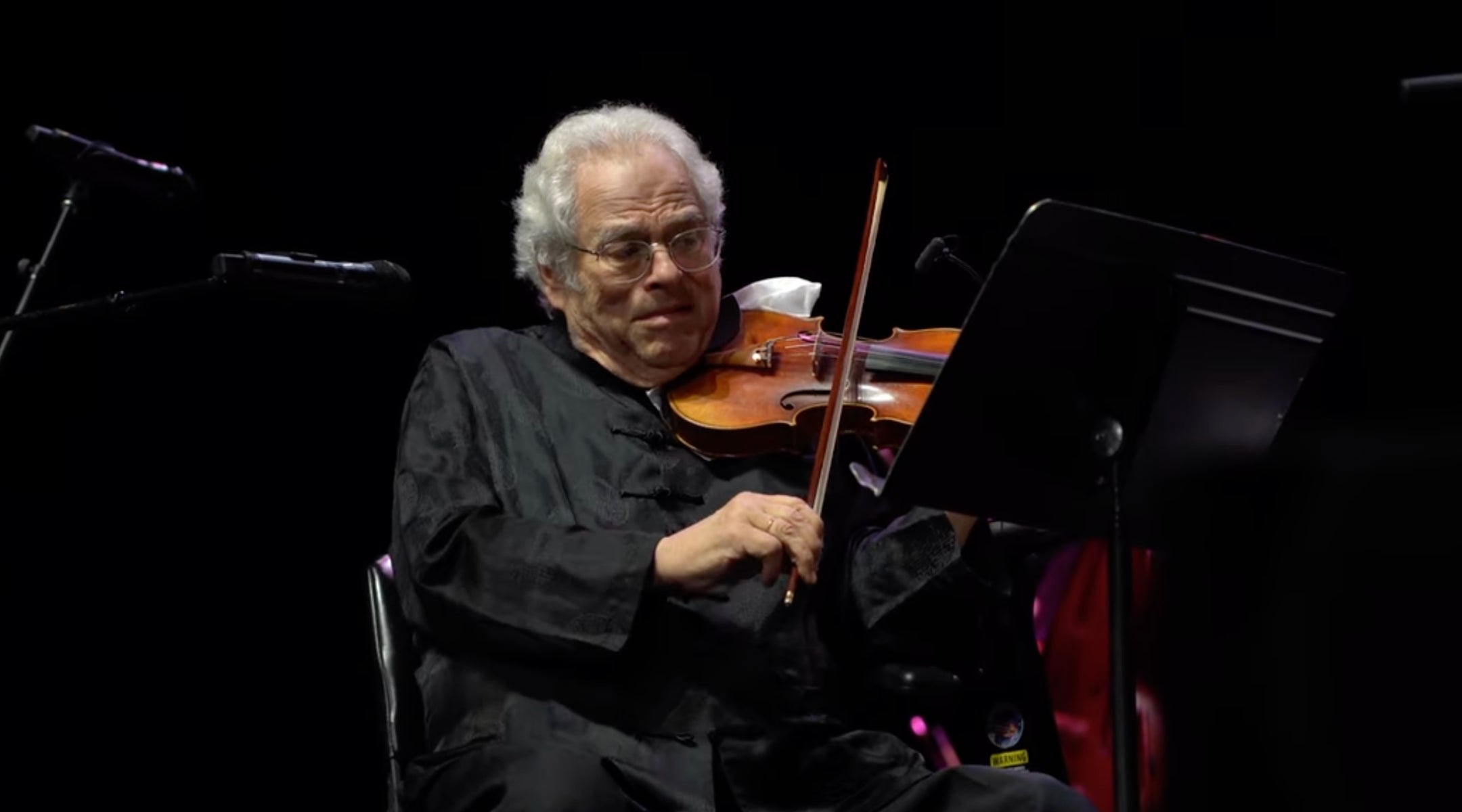
All of these things came to pass at the concert, which occurred at the Upper West Side’s ornate Beacon Theater on Sept. 29, and so much more did, too. For example, after the “Happy Birthday” singalong, a huge cake was rolled out to the center of the stage where Perlman sat. The maestro, with a broad smile, proudly told the audience: “This cake was made by my daughter, Navah.”
And while Perlman and the musicians received a well-deserved standing ovation at the end of the show, the audience also gave such a long standing ovation at the start of the concert that Perlman had to make a sit-down motion with his hands.
Perhaps my personal highlight of the evening came when the show’s Master of Ceremonies, the Klezmer Conservatory Band founder and composer, Hankus Netsky — who was the musical director of this show and had accompanied most of the pieces on either the piano or the saxophone — asked for the house lights to be turned on. “Anyone who wants to dance, go out into the aisles and dance,” he said.
Scores of people were waiting for this moment — including me. Luckily, three seats next to mine were empty, so I was able to stretch my feet and dance most of the time in place. But with Netsky’s invitation to dance in the aisles, I sprung from my seat to join them. For about 15 minutes, we danced in the aisles, forming small groups; at one point, a long chain of dancers snaked its way down the right aisle to the first row of the orchestra.
I had come to this concert almost by accident. A couple of weeks earlier, I randomly ran across an item about Itzhak Perlman on the internet with a mention of him fiddling around with a klezmer band. This intrigued me, because for years I have been an aficionado of klezmer music, as well as a fan of the famed violinist, frequently listening to recordings of both.
The more I looked into “In the Fiddler’s House” — the 1995 Emmy-winning PBS special, and its accompanying album — the more I found the combination exciting. At first, the maestro seems tentative in his attempts to join a klezmer group, to everyone’s joy and amusement. But then, thanks to Perlman’s intuitive musicianship, and his memory of listening to klezmer music when he was a youngster in Tel Aviv, Perlman sounded like a full-fledged member of the klezmer band. Sometimes he repeated phrases that the group had played with klez flair, and then the klezmers joined; sometimes, laughing, Perlman began a melody and the other musicians played harmony and riffs on his tune.
Then, a couple of weeks later, a dear friend notified me about an upcoming concert in New York — an 80th birthday celebration for Itzhak Perlman along with several renowned klezmer bands. How could I resist an event like that? I didn’t — and the result was a memorable, magnificent night of music.
Over the course of the two-hour concert, Perlman stopped fiddling during one Yiddish medley and sang the lyrics into the mike with his engaging baritone. There were moments of musical bliss when trumpeter and Klezmatics co-founder Frank London played a few solos; when when clarinetist Ilene Stahl played and swayed, as if in prayer, with her gorgeous riffs; when vocalist Judy Bressler and violinist Michael Alpert sang in Yiddish. Other highlights included Patrick McGonigle’s masterful mandolin playing, Lorin Sklamberg’s niggun, or wordless melody, and Andy Statman’s soaring clarinet melodies.
At the after-party, held at a restaurant just down the street from The Beacon, I gave Perlman — whom I had met two years earlier at a private charity affair — a copy of one of my Sholom Aleichem translations, “Happy New Year and Other Stories,” which was published in 1991. The cover of the slim volume had a sketch of klezmer musicians, including a violinist, on the cover. I have quite a few other volumes of Sholom Aleichem translations, as well as my translations of books by other giants in Yiddish literature like Chaim Grade and Isaac Bashevis Singer, but they are heavy, hardcover editions and so I thought a slim paperback might be the most efficient way to give Perlman my gift. By his smile and words of thanks, I saw that he had not only appreciated the book but also our short conversation in those two Jewish languages, Yiddish and Hebrew, in which both of us had been nurtured.
During our conversation, I told Perlman in Yiddish that when the band played the Friday night hymn, “Sholom Aleichem” — traditionally sung at home as Jews welcome the angels for the Sabbath — I heard the angels gratefully applauding. (in appreciation). And I couldn’t resist adding, in Hebrew, that instead of saying that the angels “makh’oo kapayim” [clapped their hands], I punned “makh’oo kenafayim” [clapped their wings]. Perlman laughed appreciatively at both of these remarks.
But perhaps the most memorable part of the evening was observing how Perlman pairs his virtuosity with sharing. For a musician of Perlman’s eminence — used to being a soloist and the center of attention — to subsume himself and become a member of a larger group is an act of selflessness and generosity. Watching Perlman play with the other musicians onstage was one of the rare moments in theater when you sensed the electricity in the air and felt the flow of unity between performers and audience.
I’ve tried to analyze why sparks flew during those two-and-a-half enchanting hours.
I think it’s because the Jewish music that Perlman and company made was being played from the heart with enthusiasm and joy, and the audience mirrored this. It would not be an exaggeration to say that this Itzhak Perlman 80th birthday klezmer event was an occasion when the spiritual, musical, religious, and ecstatic sides of Jewish emotions were magically aligned.
The views and opinions expressed in this article are those of the author and do not necessarily reflect the views of NYJW or its parent company, 70 Faces Media.