

In Jewish time, history often has a way of rhyming with the calendar. So when Iran’s supreme leader Ali Khamenei was killed in an Israeli air strike on the Shabbat before Purim — the holiday that commemorates the downfall of Haman, a Persian tyrant who sought to annihilate the Jews — it was perhaps inevitable that rabbis, politicians and social media commentators would reach for the Book of Esther.
Some did so reverently, others triumphantly, and a few with a wink. But as Jews prepared to don costumes and drown out Haman’s name with noisemakers, the ancient story of survival in Persia collided with a very modern war in what is now known as Iran.
The Orthodox Union, the Modern Orthodox umbrella group, put out a statement titled “Purim in Our Time: Standing Up to Iranian Tyranny.” “We will read the Bible story of Esther and Mordecai overcoming the genocidal plans of Haman, who sought to destroy the Jewish people. Today, in coordination with Prime Minister Netanyahu and the IDF, President Trump and the U.S. armed forces took defensive action to silence a modern threat from the same ancestral land of Haman,” the statement read.
Such comparisons have proliferated since the killing of Khamenei.
In his first statement after the beginning of the war, Israeli Prime Minister Benjamin Netanyahu made the connection to Purim explicit.
“Twenty-five hundred years ago, in ancient Persia, a tyrant rose against us with the very same goal, to utterly destroy our people,” Netanyahu said. “Today as well, on Purim, the lot has fallen, and in the end this evil regime will fall too.”
Known as Persia until 1935, Iran has been belligerent toward Israel at least since the Islamic Revolution of 1978-79, which brought clerics like Khamenei, with their frequent chant of “Death to Israel,” to power.
The holiday takes its cue from the Book of Esther, which describes how the Jewish queen to the Persian king Ahasuerus engineers the downfall of Haman, an advisor to the king who was plotting the murder of the kingdom’s Jews. Although Jewish tradition treats the book as historical — and Ahasuerus is often associated with the historical ruler Xerxes I — biblical scholars and historians tend to regard the story as what scholar Adele Berlin, author of “The JPS Bible Commentary: Esther,” called a “historical novella.”
Jews across the religious spectrum noted the comparison, often to different ends. Agudath Israel of America, the haredi Orthodox umbrella group, talked about prayer and salvation in its statement about the war.
“The upcoming Jewish holiday of Purim celebrates the downfall of those who rose up against the Jewish People in ancient Persia nearly 2,400 years ago,” it read (the events described in Esther are thought to have taken place in the fifth or fourth century BCE). “We are reminded how the key to the miraculous salvation was the heartfelt prayers of men, women, and children. While prayer is always powerful, our sages have taught that it carries special power during the Purim holiday season. We call upon the Jewish community to unite in prayer and beseech the Almighty to protect all those on the front lines and in harm’s way in Israel and across the Middle East.”
Rabbi Nicole Guzik, senior rabbi at Sinai Temple in Los Angeles, speaks about the U.S. and Israeli attacks on Iran and the upcoming Purim holiday in her sermon, Feb. 28, 2026. (Via YouTube)
Some of the comparisons have been offhanded, even flippant. The novelist Dara Horn, speaking Sunday night at a forum on combating antisemitism at the 92nd Street Y in Manhattan, said, “Tomorrow night is Purim, and I think it’s clear to all of us now that the best way to fight antisemitism is to take out Haman with an F-15.”
Comedian Yohay Sponder, an Israeli who often performs in North America, posted a video of a routine commenting on the death of Khamenei. Like the Purim hamantaschen cookies named after Haman, he predicted a time when Jews will eat a food named after the slain Iranian leader. He suggested khamin, the Shabbat stew also known as cholent.
Others have already adapted hamantaschen for the moment. Some have joked about baking “Khamentaschen,” combining the new nemesis’ name with the treat named for an ancient one. At least one bakery in Israel produced “Ayatollah-taschens” with a chocolate center resembling Khamenei’s trademark turban.
Evangelical Christians and Messianic Jews, for whom the Esther story has had increasing significance in recent years, also seized on the parallels. “It all made an amazing story back then, and we are praying for an equally miraculous outcome in our days that will lead to the salvation of many in Israel, Iran, and throughout the whole Middle East,” the One For Israel Ministry, a U.S.-based Messianic group, posted on Facebook..
Meanwhile, some suggested that the timing of the attacks appeared to be more than a coincidence. Digital creator Evan Pickus noted in a Facebook post that, according to the Book of Esther, Haman was hanged on the gallows just days before the calendar date that became Purim. “The evil Persian Prime Minister [sic], who issued a promise to kill all the Jews, destroyed on the same day as his ancestor,” wrote Pickus. “I honestly believe our leaders planned it this way, and I love that.”
Although no Israeli or U.S. official has said they planned the attack with Purim in mind, the idea became a talking point over the weekend, especially after CNN posted a report by Israel correspondent Tal Shalev saying the comparisons had been widely shared in Israel.
Shalev also wrote of the significance of the attacks on the Iranian leaders’ compound falling on Shabbat Zachor, the “Sabbath of Remembrance” that precedes Purim on the Hebrew calendar. The day takes its name from a special Torah reading (Deuteronomy 25:17-19) commanding Jews never to forget how Amalek — said to be the ancestral nation of Haman — attacked the vulnerable Israelites after they left Egypt. The Israelites are given a somewhat contradictory command: “Blot out the memory of Amalek from under heaven. Do not forget!”
A widely circulated image from Beit Shemesh, where an Iranian missile killed nine people in a bomb shelter that also functioned as a synagogue, showed a fragment of shrapnel puncturing a Torah right on the passage that had been read a day earlier.
The injunctions about “Amalek” are often applied, sometimes controversially, as an ongoing commandment for Jews to show no mercy toward those who might eradicate them. That, in turn, has led some Israeli politicians and Jewish observers to cite Amalek in justifying Israel’s war on Hamas and Iran, and others to criticize those same politicians as ruthless and even genocidal.
Shalev’s report inspired at least some commentators to criticize Israel, suggesting the attacks were inspired by religious or nationalist fanaticism.
Purim is itself a strange mixture of the deadly serious and the wildly playful: a story of a thwarted genocide celebrated with carnival antics, including costumes, a raucous reading of the Book of Esther interrupted by noisemakers, and even a tradition of getting drunk. For millennia, it was often a release for a beleaguered minority in strange and often hostile lands. But as Israel emerged as a military power, scrutiny from within and without the Jewish community has often focused on the real-life implications of the story’s purported lessons.
Yet despite the Israeli politicians who take the Bible as a guidebook for revenge or Jewish supremacy, there is a long tradition of commentary that sees books like Esther as intentionally nuanced, even ambiguous guides to ethical behavior, including the prosecution of just wars.
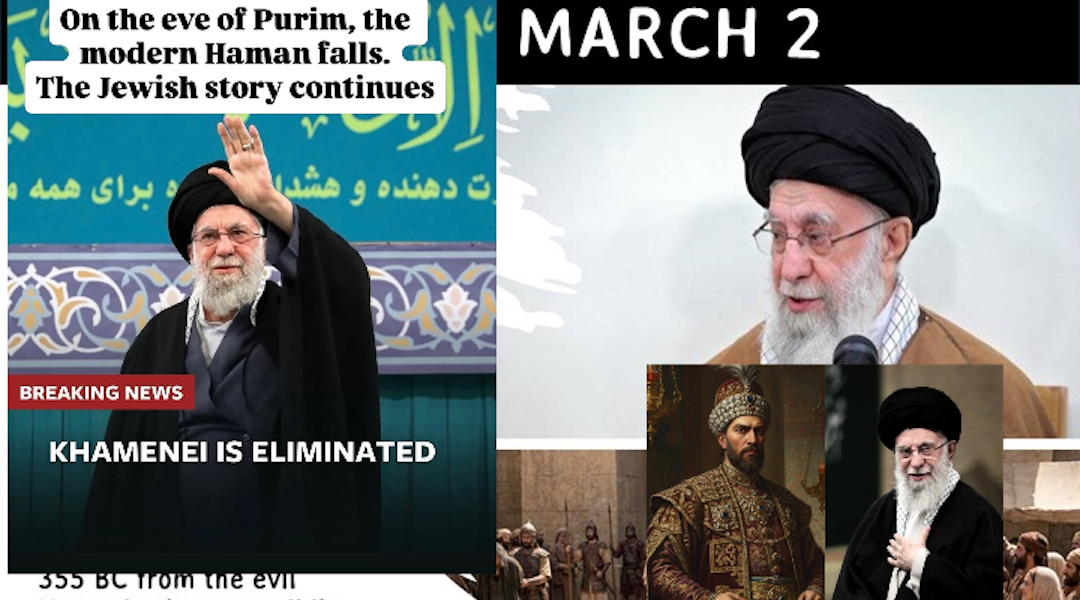
Various social media memes compare the death of Iran’s supreme leader to the downfall of Haman, the villain of the Purim story. ((JEWISH REVIEW))
Chapter 9 in the Book of Esther details the reversal of fortune for the Jews on the 13th of the Hebrew month of Adar, when they were said to have killed 75,000 foes in the wake of Haman’s downfall. Many Jewish commentators have expressed discomfort about what can be read as a heartless response to Haman’s thwarted decree.
On Sunday, Rabbi Michelle Dardashti expanded on that theme in a letter sent to members of her Kane Street Synagogue in Brooklyn. She warned that the Purim story is not just a celebration of the Jews’ victory over a Persian despot, but a warning that “battles that begin in moral clarity do not necessarily remain that way.”
“Purim pushes us to contend with the gray — to recognize how quickly roles can flip; how, on a dime, individuals and nations can shift from victim to aggressor, from righteous to morally compromised, or into categories that resist easy labels altogether,” wrote Dardashti, whose father left Iran as a young man. “Anyone who tells you with certainty that this war with Iran will unquestionably be good for the Jews and good for the world, that it will surely end well or end quickly — I would be wary of heeding that voice.
“And anyone who speaks with absolute certainty about it being entirely disastrous, unquestionably wrong — I would be wary of heeding that voice as well.”
Rabbi Simon Jacobson, a popular lecturer from the Chabad-Lubavitch Hasidic movement, discussed the parallels between the war and Purim in an installment of his video series, “MyLife: Chassidus Applied.” “The goal, of course, is to eradicate the enemy in every possible way, exactly as it happened in Persia, 2400 years ago in the story of Purim,” he said of the war.
But Jacobson also drew on two common themes not only of the Purim holiday but of much of Jewish tradition: salvation from an enemy, and the ultimate redemption of the Jews and humankind. He characterized the war in metaphysical terms, regretting “any type of bloodshed” but aspiring to “what happens afterwards: a stage, an era, a permanent era of Messianic, … total, solemn, permanent and sustainable peace for all people of this earth.”
For some congregations, the confluence of the war and the Purim holiday posed a challenge in tone — with rabbis asking how their communities might celebrate with bombs falling across the Middle East and Israelis taking cover in bomb shelters.
At B’nai Jeshurun, an independent synagogue on Manhattan’s Upper West Side, the clergy offered a schedule of observance and celebration to match the ambivalent mood. On Monday, a traditional fast day in honor of Esther marking “moments of danger and uncertainty,” they urged congregants to turn “their hearts toward prayer and summoning strength before stepping into the unknown.”
At sundown, they wrote in a letter to congregants, when the fast “gives way to celebration, in a world shaken by violence and instability, we anchor ourselves in Purim’s four mitzvot”: hearing the Book of Esther, sharing gifts with friends, giving charity and sharing a meal with friends or family.
“We cannot resolve the uncertainty of this moment,” wrote the B’nai Jeshurun clergy. “But we can choose how we meet it — with prayer, with generosity, and with one another.”
Yoni Rosensweig, a rabbi in Beit Shemesh, wrote in a Facebook post that many of the comparisons between the Purim story and the war on Iran miss crucial distinctions.
“Yes, Haman wanted to destroy us, and so did Khamenei — but Khamenei was the ruler of Iran. Haman was not the ruler — he was nothing more than a schemer. This is not just a technical difference, it’s fundamental,” Rosensweig wrote in an email to (JEWISH REVIEW). “Esther and Mordechai are trying to survive, that is all, They are trying to maintain the status quo in someone else’s kingdom.”
While the events in Persia inspired a holiday, he argued, “there is nothing long-lasting about the Jewish future in Persia which comes from the story.” By contrast, the current war has the potential to profoundly shape the Jewish future, no less than the Exodus from Egypt celebrated at Passover.
“It is about creating something new (we hope) in the Middle East. It is part of a regional war against powers that want to obliterate us. We aren’t looking to maintain the status quo,” wrote Rosensweig. “We are standing up for our right to live free, as a sovereign nation. Much like the Jews who left Egypt weren’t looking to maintain the status quo but rather to embark on a new path and start a new journey, so too we are doing with this war.”