
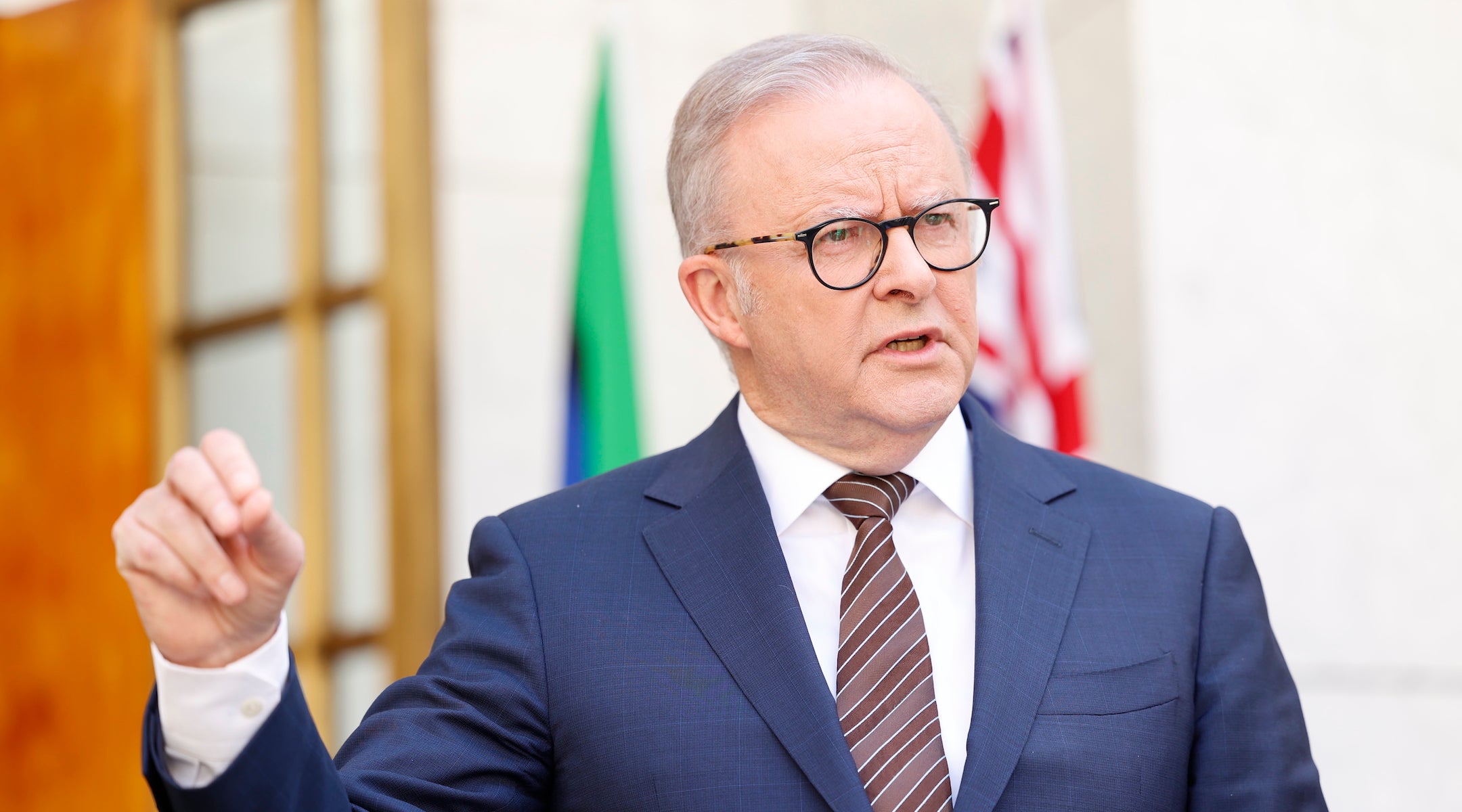
Australian Prime Minister Anthony Albanese announced on Thursday the launch of a Royal Commission inquiry, the country’s highest level of inquiry, into the antisemitic terrorist attack on Bondi Beach last month.
The wide-ranging inquiry will also investigate the “nature and prevalence of antisemitism” in the country, provide recommendations to law enforcement to combat antisemitism and counter the “spread of ideologically and religiously motivated extremism in Australia,” according to a press release from the Prime Minister’s office.
“I’ve repeatedly said that our government’s priority is to promote unity and social cohesion, and this is what Australia needs to heal, to learn, to come together in a spirit of national unity,” Albanese told reporters on Thursday. “It’s clear to me that a royal commission is essential to achieving this.”
The announcement of the inquiry comes weeks after two attackers motivated by “Islamic State ideology” killed 15 people and injured dozens more at a Hanukkah celebration in Sydney. Until now, Albanese had largely dismissed mounting pressure from the victims’ families as well as Jewish groups to launch a Royal Commission.
“I’ve listened, and in a democracy that’s a good thing. To listen to what people are saying and what people are saying is, yes, we’re concerned,” Albanese told reporters. Last month, Albanese also announced a review of federal intelligence and law enforcement agencies.
In the government’s press release, it also pointed to its previous actions in the wake of the attack, which have included tightening gun ownership laws and introducing legislation to curb hate speech.
The president of the Executive Council of Australian Jewry, Daniel Aghion, said that the Australian government had “made the right decision” in establishing the royal commission in a statement.
He added that the group expected the commission to “allow an honest examination of government policies and the conduct and policies of key institutions and figures in major sectors of our society in contributing or failing to adequately respond to the unprecedented levels of antisemitism in Australia over the past two years or more.”
He added, “This is the only way that Australia’s time-honoured standards of decency and fairness can be upheld.”
The inquiry will be led by former High Court judge Virginia Bell, whose appointment raised concerns among some Jewish leaders in Australia who pointed to her role in a ruling that was cited by the New South Wales Supreme Court’s decision to overturn a ban on a pro-Palestinian march in August, according to the Sydney Morning Herald.
“The Prime Minister has been told directly by leaders of the Jewish community that they have serious concerns about this appointment,” said former treasurer Josh Frydenberg in a post on X. He did not elaborate on his opposition to Bell in the post.
Following the attack, Albanese also invited Israeli President Isaac Herzog to visit Australia. While the invitation was welcomed by the Executive Council of Australian Jewry, some Labor party members and progressive Jewish groups called for Albanese to rescind his invitation.
The announcement of the inquiry comes as Gefen Bitton, an Israeli living in Australia who was critically injured while trying to confront the Bondi attackers alongside Ahmed al-Ahmed, was slated to be flown to Israel on Wednesday for continued medical treatment.
It also comes as al-Ahmed, a Muslim man who received widespread support from the Jewish community after he was shot while disarming one of the attackers, was feted in New York City by the Chabad movement, whose emissaries were holding the Hanukkah event and were among the dead. Al-Ahmed arrived in New York City on Tuesday where he visited the Ohel, the gravesite of the Chabad-Lubavitch movement’s late leader Rabbi Menachem M. Schneerson, before being honored at a gala recognizing defenders of the Jews.
“Ahmed did what he did that day because he believed that God placed him at the scene for a reason, and that’s what gave him the strength to save lives,” Rabbi Yehoram Ulman, whose son-in-law, Rabbi Eli Schlanger, was killed in the attack, told Chabad.org. “This is something people from all walks of life can and must learn from.”