
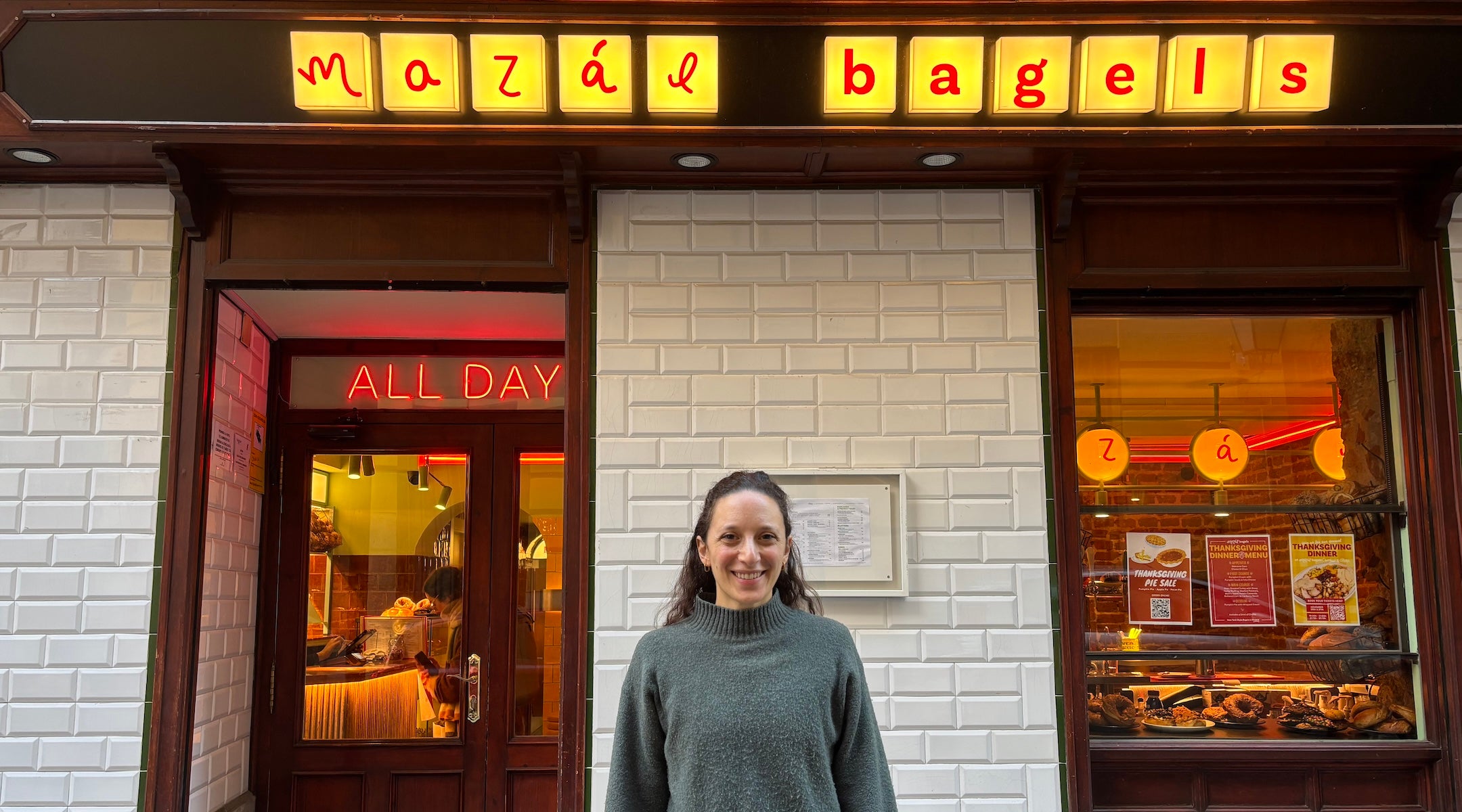
MADRID — Until recently, a Jew could wander all day in Madrid without finding a bagel.
But now, in a sea of tomato toasts and potato omelettes, a trail of people hovers every weekend outside the Mazál bagel restaurant. Behind it is Tamara Cohen, a Philadelphian who became Spanish through a law granting citizenship to Sephardic Jews whose ancestors were expelled during the 1492 Inquisition.
When Cohen moved to Madrid, she could not track down the bagels she craved from home. Since opening Mazál in 2020, she has seen the distinctly Jewish food grow more familiar to Madrileños, with other new bagel shops following suit — but none, so far as she knows, that are also run by Jews.
“I like to think we started it,” she said.
Cohen, who is 34, didn’t have a business plan or a culinary background when she arrived in 2015. She was a recent college graduate unsure about what to do next. She had never been to Europe and decided to teach English in Spain, thinking she would take the chance to travel and study the native language of her mom, a Cuban Sephardic Jew. (Her dad is American-born Ashkenazi.)
Soon after Cohen arrived, her mom alerted her to Spain’s new Sephardic ancestry law. Between 2015 and 2019, the measure awarded citizenship to descendants who could prove their medieval Sephardic origins. Some 72,000 people have obtained citizenship this way, most of them from Latin America.
Cohen’s mom quickly applied, not to move to Spain herself, but to affirm a lineage treasured in her family for centuries. She had documents showing her family’s travels from Spain to Turkey to Cuba, along with death certificates of ancestors buried in Sephardic cemeteries. She also had tapes of her parents singing in Ladino, the nearly extinct language that Sephardic exiles carried with them to the Middle East, North Africa, Latin America and other corners of the world.
After her mom received citizenship, Cohen followed. In the process, she discovered threads that tied her to what had seemed like a foreign land. Some 300,000 Jews lived in Spain before the Inquisition, constituting one of the largest and most cultivated Jewish communities in the world. After 1492, they were forced to convert to Catholicism, flee or be killed. Between 40,000 and 100,000 went into exile.
By the early 20th century, a small community of Jews had returned to Spain. About 6,000 lived there at the dawn of the Spanish Civil War in 1936, including prominent intellectuals such as Max Aub and Margarita Nelken. Many fell on the Republican side of the war, forcing them to flee when the Nationalists led by Francisco Franco prevailed. Franco rooted his regime in Catholicism, banning Jewish rites, shuttering synagogues and sending expressions of Jewishness into hiding.
A new era of Sephardic life began to take shape only in the 1960s. In 1967, Spain passed a religious freedom law that allowed non-Catholic communities to practice in public. Meanwhile, Middle East tensions surrounding the 1967 Arab-Israeli War drove a wave of Jews from Arab countries to Europe, according to Esther Bendahan, a writer and cultural director of the Centro Sefarad-Israel in Madrid. Her family arrived from Morocco in the 1960s.
“The return is complex, because it is the only European country where Jews do not have a long history, since it was interrupted,” said Bendahan.
Remnants of Sephardic history, like the Jews themselves, are still resurfacing. As recently as 2024, restoration work on the Santa Maria la Blanca church in Seville exposed a medieval synagogue ark behind the altarpiece. In 2023, archaeologists uncovered a 14th-century synagogue beneath a nightclub in the Andalucían city of Utrera, one of only five such buildings in Spain. And in 2012, the construction of a sewer in Segovia revealed a Jewish cemetery from 500 years ago.
A 14th-century synagogue in Utrera, Spain, was unearthed by archeologists in 2023. (Courtesy Utrera City council)
“Whenever we travel to a small town and there’s a judería, I always feel like we have to see it,” said Cohen, using the word for the historic Jewish quarters that once dotted Spain.
“We have to go and stand there — even if there’s nothing to see — go and stand there, and I feel a connection to it,” she added. “Spain had a huge population of Jews, and you say, ‘Wow, they’re all gone. But look, I’m back. I have a passport. I can stay here forever if I want to.’”
Sephardic memory traveled down Cohen’s family line, as in many others, through food. Her mom sustained Sephardic recipes and traditions, like making rice on Passover. But even as Cohen identified traces of her family’s Sephardic past, she missed American and Ashkenazi foods.
She was hosting a Thanksgiving dinner with her roommates when she realized that she couldn’t find a pumpkin pie. So she made one — and then she made more. She listed her pies, cakes and cookies on a website for people to buy. Then she started making bagels.
“I basically used this website as a platform to make and sell foods that I love but that I couldn’t find here,” said Cohen. “And so I made bagels, because I grew up in a bagels-on-the-weekend family.”
Thus Mazál was born, and with it appeared a new world of Jews in Madrid — a living, breathing and eating one. Local visitors who knew little about Jewish food flocked to Mazál for its “American” menu, listing pastrami and buffalo chicken along with bagels. But just as quickly came the diners who knew the word “mazal,” or “luck” in Hebrew.
Cohen discovered how many Jews had been waiting for Mazál through her challah sales. She didn’t know how many would be sold, only that she wanted to recreate “the warmth of family” on Shabbat. Roughly 15,000 Jews live in Madrid out of 45,000 in the whole country. (Both Ashkenazi and Sephardic Jews eat challah, while bagels are not part of Sephardic tradition.)
“We have sold challah every single Friday for our entire existence,” she said. “When we first opened, we had something like 10 challahs a week. Now we make 90 to 150 challahs a week. We’re sold out.”
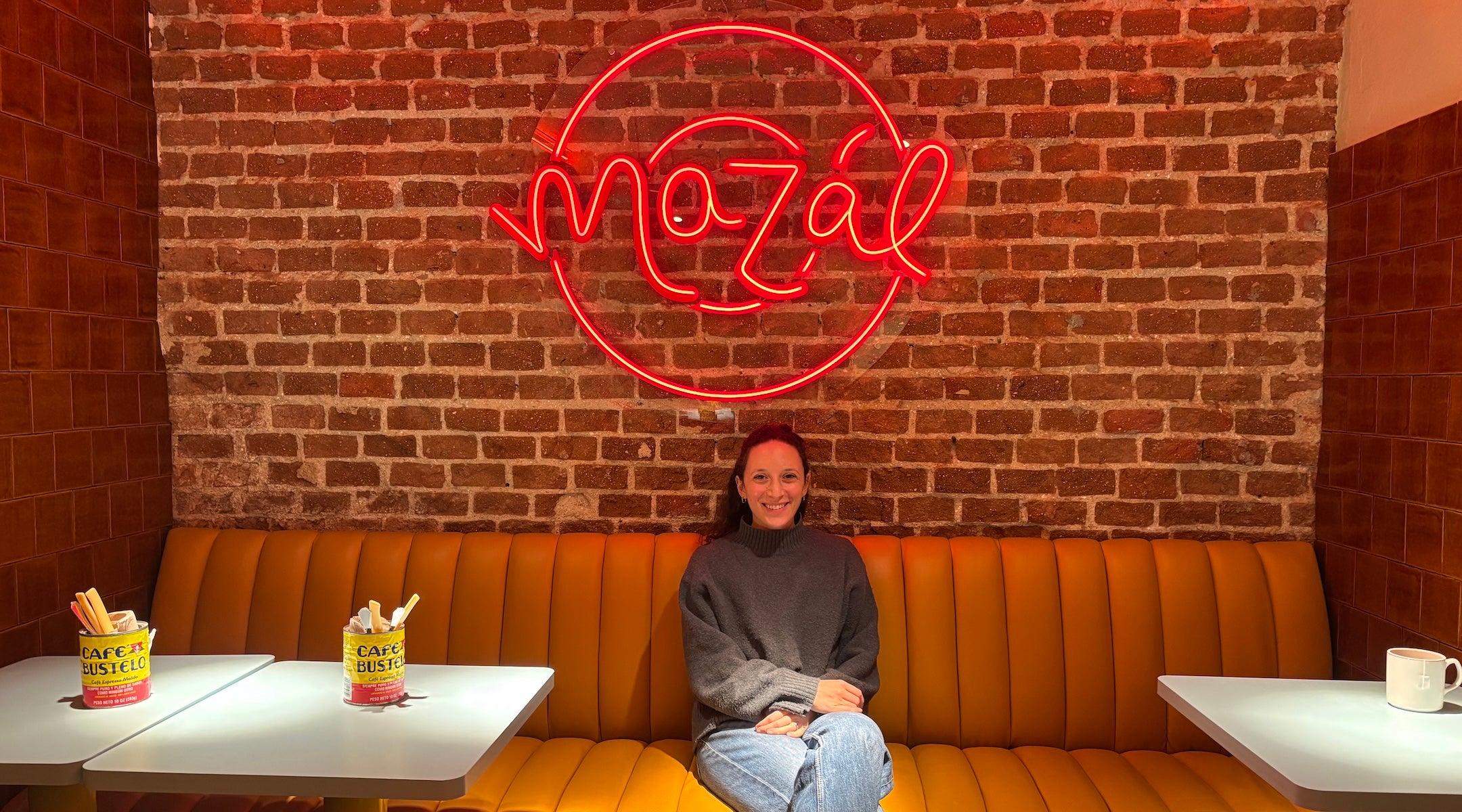
Tamara Cohen has sold challah along with bagels every week since she opened Mazál. (Shira Li Bartov)
No haven for Jews in Spain has been unaffected by the country’s intense scrutiny of Israel since 2023. The Spanish government is one of Europe’s most outspoken about Israel’s killing of Palestinians in Gaza, with Prime Minister Pedro Sánchez becoming the most senior European leader to say that Israel was committing genocide last year. In 2024, Spain joined Norway and Ireland in recognizing a Palestinian state.
At times, the anti-Israel sentiment in Spain has turned on local Jews. Spain saw a 60% increase in antisemitic hate crimes in 2024, despite a drop in overall hate crimes, according to the Ministry of the Interior.
Cohen has family members in Israel. After the Hamas attack on Oct. 7, 2023, she raised money for Israeli humanitarian organizations through the delivery apps Uber and Glovo, calling the push “Bagels for Israel.” But after a few months, as Israel’s campaign in Gaza intensified and Spanish sentiment hardened against the country, she shut it down.
Now she is wary of exposing Mazál to the fall-out from anger against Israel. In 2025, she had to paint over a swastika and other graffiti sprayed on the restaurant’s shutters.
“I’m more tense about saying anything about Israel,” she said. “We’re actually opening a new bakery in the next couple of months, and the plan is it’s going to be an Israeli, Middle Eastern bakery. But when people ask, ‘What is it going to be?’ I’m like, ‘You know, Middle Eastern.’”
She wants Mazál to remain a place where Jews like her feel comforted. There are pieces of her life in the bagels, the challah and the American classics. On Thanksgiving, she sells “Mom’s sweet potato casserole,” her own mom’s recipe. And a staple on the menu is “Allen’s pancakes,” named for her dad.
“Mazál, to me, feels like my little corner of Judaism here in Madrid,” said Cohen. “It’s a way to create a home for people who are looking for that. It’s not kosher, and we’re open all year, but it’s my type of Judaism — bagels on Sunday morning, challahs on Shabbat.”