

“We must learn to recognize that as long as we lack a home of our own, such as the other nations have, we must resign forever the noble hope of becoming the equals of our fellow men,” wrote Leon Pinsker in “Auto-Emancipation” in 1882, a text often regarded as the opening salvo of the Zionist movement. Pinsker, like Theodor Herzl after him, believed that Jewish statelessness lay at the heart of modern antisemitism—and that political sovereignty would bring it to an end.
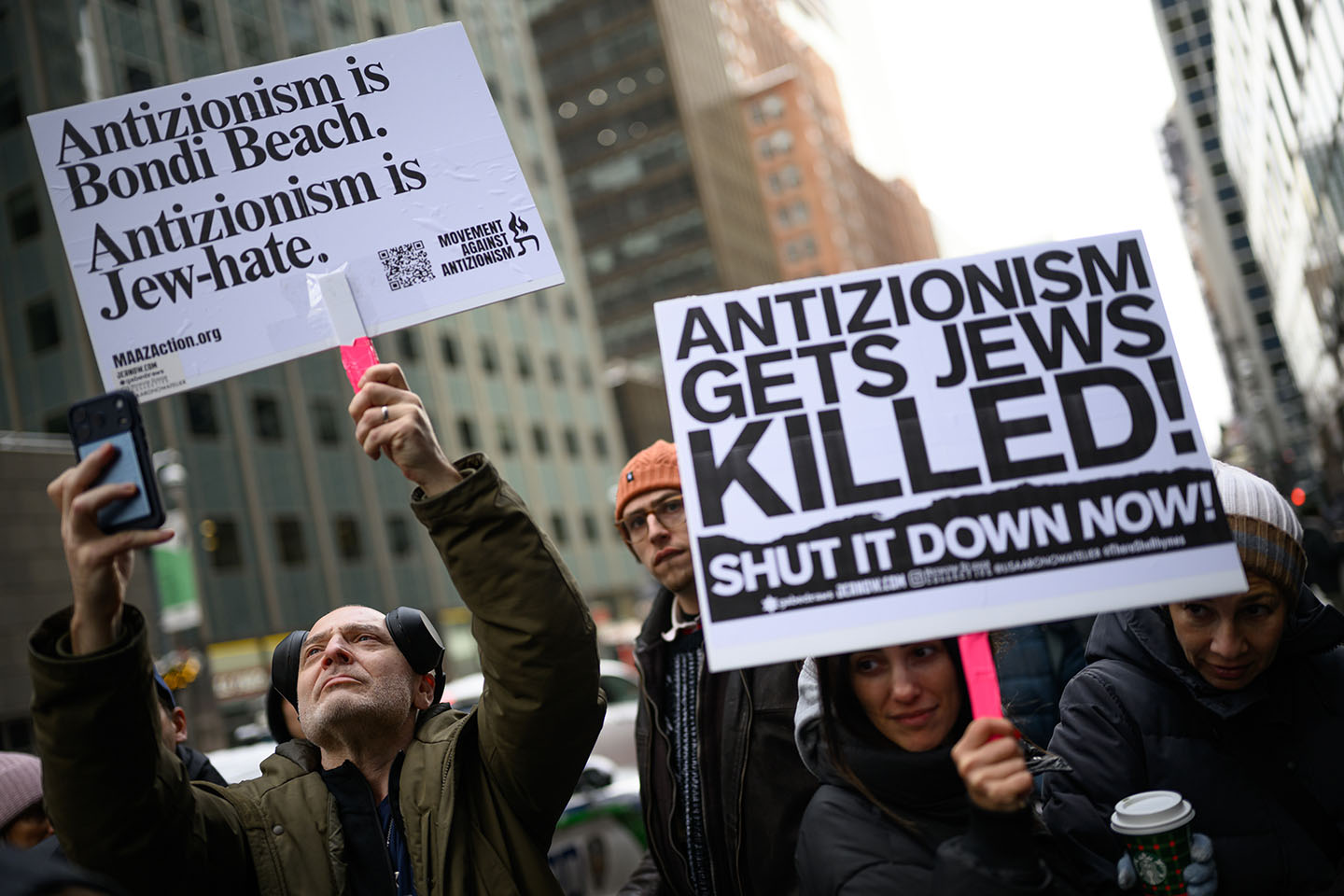
Fast forward to December 2025. On the eve of Hanukkah, Jews were murdered in Sydney in an act of naked antisemitic violence. Yet the perpetrators justified their actions by invoking “Zionists.” Since Oct. 7, Jews far from the Middle East have increasingly been treated as stand-ins for Israel and held collectively responsible for its alleged crimes. Antisemitism persists, but it now frequently presents itself as something else. How did a movement once envisioned as the solution to Jew-hatred become its alleged cause?
If we want to understand why Jews are being murdered in the name of “anti-Zionism,” we must be precise about what anti-Zionism is, where it comes from, and, just as importantly, where it does not.
Zionism and anti-Zionism are everywhere today. Few can agree on what they actually mean. Some insist we should abandon both terms altogether, while others are now preoccupied with the grand question of whether anti-Zionism deserves a hyphen—an echo of the still-unsettled debate over the hyphen in antisemitism
Scholars and activists also remain divided over whether anti-Zionism is simply antisemitism in new clothing. There is a great deal at stake here, because if it is, then targeting Zionism is bigotry, but if it is not, one is merely targeting an ideology. What is incontestable is that attacking Jews for allegedly being “Zionists” is antisemitic. When protestors chant “free Palestine” and “globalize the Intifada” in front of a Hillel house or a synagogue their target is clearly defined: the Jews inside who fear what might await them in the streets. They are being attacked as Jews who may be Zionists; they are being subjected to an Israel litmus test they will inexorably fail. It is impossible to see this as anything other than antisemitism.
Anti-Zionism is also, more often than not, grounded in traditional antisemitic tropes: Israel as an omnipotent global actor, covertly influencing foreign governments; Israel abetting white supremacy because it supposedly benefits from keeping minorities from “replacing white people” (an ideological inversion of “Jews will not replace us”). This is not to say that the anti-Zionism centered on accusations of Apartheid, genocide, or claims that Jews are a religious community and Ashkenazim are white European colonialists isn’t antisemitic. It often is. It simply lacks many of the classic tropes. Yet even in these instances, the anti-Zionists often anchor such charges in distorted interpretations of “Chosenness” that are found in Judaism’s sacred texts.
Historians should trace the history of anti-Zionism and look for its roots in pre-1948 antisemitism. Much as I ask my students to examine continuities and discontinuities between pre-modern Christian anti-Judaism and modern antisemitism, we can make the same comparison between modern antisemitism and anti-Zionism. Tropes used by Wilhelm Marr, Henry Ford, and Adolf Hitler have been rewritten in the anti-racist, progressive idiom first popularized by the USSR, then the Arab states who expelled their Jews, and now embraced by the American left. Hamas’s charter is a seamless blend of Islamic anti-Jewish fundamentalism and the Protocols of the Elders of Zion. The relationship between past and present should be clear: The liquidation of the Jewish state is the latest incarnation of the quest to eliminate the Jew.
The relationship between past and present should be clear: The liquidation of the Jewish state is the latest incarnation of the quest to eliminate the Jew.
That said, it would be a mistake to give excessive weight to the “anti-Zionist” elements—or implications—of modern antisemitism before Israel existed. Hitler certainly opposed the creation of a Jewish state, but to describe Nazism itself as “anti-Zionist,” as some have done, is to miss the ideological core of the regime. The Jewish threat, as Nazism imagined it, consisted of two interlocking conspiracies: first, a covert, racial, apocalyptic war waged by the dispersed but powerful forces of so-called “international Jewry”—variously labeled Judeo-Bolsheviks, parasitic capitalists, and false assimilators—and second, the racial degeneration of the Aryan race through miscegenation. Both fantasies posited an internal enemy bent on destroying Christendom and subjugating the world from within. There is nothing inherently anti-Zionist in this worldview, beyond the fear that a Jewish polity in Palestine—or anywhere—might serve as a new epicenter of Jewish power, analogous to the Vatican for Catholics, but far more menacing in scope. As Jeffrey Herf has argued, Nazi opposition to a Jewish state flowed from the belief that such a state would become a headquarters for “international Jewry’s efforts to dominate the globe.” Within this conspiratorial framework, anti-Zionism functioned as an extension of Nazi antisemitism, not its core component. The same logic explains Hitler’s collaboration with Amin al-Husseini, the Grand Mufti of Jerusalem: The goal was not merely to oppose Zionism, but to extend the Final Solution to the Jews of the Middle East and to mobilize Arab populations in a broader war against Britain, France, and the United States—powers the Nazis imagined to be instruments of Jewish domination.
This is also true of the Protocols of the Elders of Zion, which did not, contrary to what Adam Louis-Klein insists, claim “to be a transcript of the World Zionist Organization.” Neither Zionism nor a Jewish state is mentioned in the original document, though they are often inserted into later translations. For the Protocols, “Zion” is a mythical, cosmic center of Jewish global power whose location is vague at best. And even if one insists on reading Zionism into the text, it is simply another ideological “tool,” no different from liberalism or communism—each a specious vehicle to consolidate Jewish world domination. The telos is not a Jewish state. We can find roots of later anti-Zionist tropes here, but framing this foundational document of modern antisemitism and the movements it spawned as anti-Zionist is wrong.
The point is that pre-1948 antisemitism, however much it may imply opposition to a Jewish state, is not about a Jewish state. Zionism could be removed from the equation entirely and the rhetoric and practice of antisemitism would not have changed in any meaningful way. Conversely, today’s antisemitic anti-Zionism depends on the Jewish state; it cannot exist without it. (Not to worry—if Israel vanished, antisemites would find a new center.)
It is also incorrect to argue that postwar Soviet anti-Zionism simply grew out of its prewar predecessor. After the founding of Israel, Soviet propaganda increasingly adopted explicitly antisemitic imagery and rhetoric, including depictions of Israel as a malevolent global force—at times rendered visually through familiar tropes long associated with Jew-hatred. Soviet Jews were subjected to collective suspicion and increasingly portrayed as potential traitors whose loyalties lay not with socialism but with a foreign imperialistic (and noticeably Jewish) state. This was anti-Zionist because Israel was central to the accusations, and antisemitic because Jews were treated as a suspect population defined by presumed dual loyalty.
But pre-World War II Soviet anti-Zionism was nothing of the sort; it was an instance of Marxist-Leninist anti-nationalism, applied uniformly to all Soviet national minorities. As an illiberal state bent on modernizing its citizens through propaganda and brute force, the Bolsheviks sought to stamp out religion and what they called “bourgeois nationalism,” which in the case of the Jews meant rabbis, Zionists, synagogues, and Hebrew schools. This was not a uniquely Jewish phenomenon. The Jews were not denied the status of ethnicity or nationhood as Izabella Tabarovsky suggests in the Appendix of her book, “Be a Refusenik.” The Jews were like any other ethnic nation—albeit one that lacked a national territory, until the creation of the farcical Birobidzhan—in need of transformation. It was an ideological imperative allegedly in the interest of the Jewish people, whether the Jewish people consented or not. Conversely, the later Soviet stance was driven not by ideological continuity but by new historical conditions—Israel’s founding, the Cold War, decolonization, and the heightened identification of Soviet Jews with a resuscitated homeland abroad after having survived genocide. Governmental suspicion and the perpetual threat of persecution was not for the purpose of giving Jews mobility in exchange for loyalty, but intended to punish the Jews for imagined disloyalty. Marxism-Leninism provided a vocabulary drawn from the early Soviet lexicon, but the phenomenon itself was fundamentally different. It was antisemitism in a Bolshevik key.
Anti-Zionism before World War II must also be seen in the context of the hitherto unresolved Jewish question: Are the Jews a religion or an ethnic nation? The truth is that we are both, yet fit neatly into neither of these boxes; we defy rigid classification. Although the Holocaust and the founding of Israel suggested that we are bound together as a community of kinship and common descent rather than faith, this was not self-evident beforehand, neither among Jews, nor among those who claimed the right to define us. Denying our ethnic national identity today is effectively a call to liquidate Israel—the world’s sole Jewish state—and can justly be labeled antisemitic, but in the early-twentieth century it was, as one historian put it, Shabbos dinner conversation.
Finally, modern antisemitism did not produce anti-Zionism. The latter is a reformulation of the former, that much is clear. Israel has become the proverbial Jew in so many respects. Yet the road from one to the other is punctuated with moments and events that imply other possibilities: Stalin’s initial support of Israel because of its apparent socialist inclinations, or America’s firm rejection of antisemitism by the early 1950s coupled with near unanimous support for Israel by the 1960s. Something went wrong. When, how, and why this happened is a story in need of telling best not told by reverting to the old adage that we suffer from “the longest hatred.”
Israel has become the proverbial Jew in so many respects.
The relationship between racial antisemitism and anti-Zionist antisemitism is complex, but the answer is not that anti-Zionism lay incubating as a seed in the world of Marr, Ford, and the Nazis, waiting to germinate with the birth of Israel.
These distinctions are neither trivial nor academic pedantry of little relevance. If you misunderstand the antisemitic discourse in Europe on the eve of the twentieth century then you run the risk of inaccurately explaining the pogroms, Jewish persecution in the early Soviet state, the rise of Nazism and the Holocaust, and, perhaps ironically, the emergence of anti-Zionist antisemitism in the USSR and in the twenty-first century west. There is far more to be said about how heated yet legitimate political discussions over the future of European Jewry on the precipice of catastrophe converged with racial antisemitism to become the dominant form of Jew-hatred today.
The early Zionists—so prescient in sensing this imminent catastrophe in Europe—did not anticipate this new antisemitism. They believed a Jewish state would finally bring an end to Jew-hatred. After all, Jews were despised precisely for being a dispersed people: everywhere and nowhere, visible yet hidden in the emerging nation-states of Europe and beyond. Why the Zionists failed to imagine a future in which a Jewish state itself would become the focal point of conspiracy is part of the story. Perhaps one day we will fully understand how the political cauldron of Jewish life, combined with the demographic upheavals of the early-twentieth century, helped give rise to the antisemitic crisis we face today.