
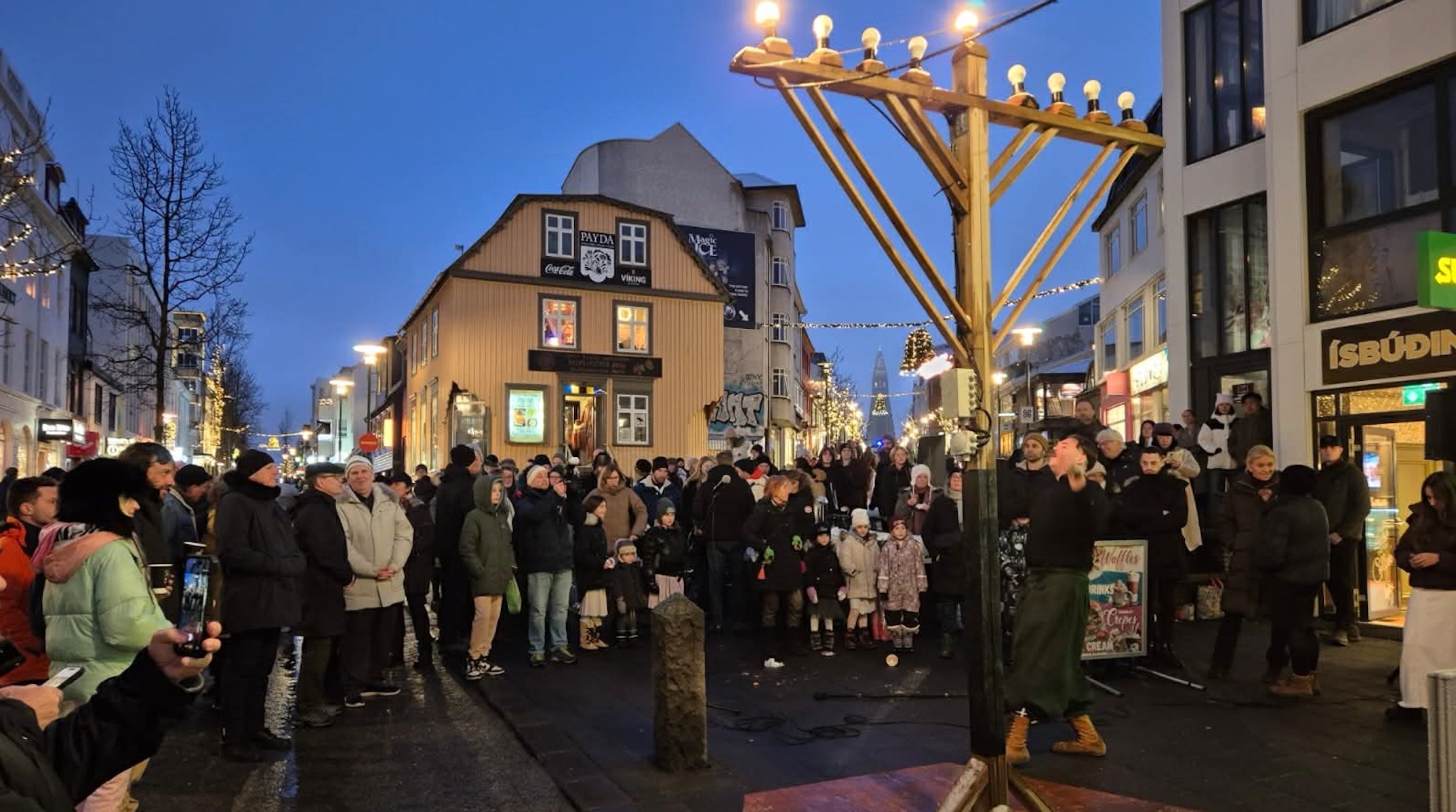
REYKJAVIK — December light is brief in Iceland. It was not yet 4 p.m., and by the time the giant menorah was lit in downtown Reykjavík, the day had already slipped into darkness. A steady drizzling rain blurred the streetlights and soaked the pavement where fewer than 100 people gathered, roughly half of the country’s Jewish population, which has always been small and largely unseen.
The celebrants were calm, almost subdued; security was not. Armed plainclothes police ringed the area. They moved through the crowd while surveillance drones hovered overhead. Air support was on standby, measures almost unheard of in a country that tops the world’s most peaceful list.
The gathering took place just hours after news broke of the most recent terrorist attack on Jews, this one a celebration of Hanukkah at Bondi Beach in Sydney, Australia.
Rabbi Avraham Feldman and his wife, Mushky, welcomed the crowd, their voices steady but restrained. Iceland’s minister of foreign affairs, Þorgerður Katrín Gunnarsdóttir, followed, and she lit the menorah herself. Curious passersby slowed, some watching silently before moving on. The event passed without incident.
“The attack in Sydney reminds us that darkness is not only something we read about in history books. It still exists in the world and appears suddenly and violently,” said Avraham Feldman, who is associated with the Chabad movement, which makes public menorah-lightings a centerpiece of its outreach around the world.
“Hanukkah does not ask us to deny this darkness,” he added. “Instead, Hanukkah teaches us that each and every one of us can create light and positivity. Even a small light pushes away great darkness. And when many lights stand together, we overpower the darkness.”
In a statement issued the same day, Gunnarsdóttir condemned the attack in Sydney, which took place at a Chabad event. “I strongly condemn the horrific attack on those celebrating Chanukah at Bondi Beach in Australia,” she said. “There is no place, anywhere, for antisemitism or terror. I extend my heartfelt condolences to the victims, their loved ones, and others affected.”
Her presence at the Hanukkah event carried significance well beyond the ceremony itself. Iceland’s government has been among Europe’s most vocal critics of Israel, and public discourse around the war in Gaza has been intense. Jewish teens have reported increasingly tense relationships with their peers, and the national broadcaster recently announced that it would boycott the Eurovision song contest over Israel’s participation.
For some Jews in Iceland, the political situation has shaken their sense of acceptance.
“It has become very different for me since Oct. 7,” said an American Jew living in Iceland who asked to remain anonymous. “Before, I was fairly widely open about being Jewish, but the landscape has changed.”
When he and his spouse moved into a new home last year, he ordered a mezuzah for the front door, but he hesitated to put it up. “For the first time, I found myself concerned about placing my Hanukkah menorah in the window,” he said, even as he added that most Icelanders would likely not recognize the symbol anyway, given the prevalence of seven-armed electric advent lights in windows each December.
For some present, having Gunnarsdóttir at the Hanukkah event offered a rare and meaningful signal that support for a vulnerable minority need not be conflated with geopolitics.
“It’s so special to have the foreign minister join us today, to stand with us, support the community, and offer her continued friendship,” said Mushky Feldman said. “We’re honored to have her speak tonight and light the first candle.”
Jewish life in Iceland has no long historical footprint. There are no historic synagogues, no Jewish neighborhoods, and no centuries-old institutions. Holidays are celebrated in rented spaces or private homes. Until 2018, there was not even a resident rabbi. The community is made up largely of immigrants — including an Israeli jewelry designer who was the country’s first lady for 13 years until 2016 — their children, and Icelanders who have claimed a Jewish identity later in life.
“How do you teach your children what it means to be Jewish without a ready-made community?” asked Reykjavík resident Adam Gordon, an American Jew. “The answer is that we must create that community ourselves.”
Practical challenges abound. “Supplies can be difficult to come by,” said the American Jew, who decided that he would light a menorah. “I finally placed a bulk order from abroad with enough Hanukkah candles to get me through the end of this decade.”
An obstacle is the traditional Icelandic approach to religion. Most Icelanders are nominally Christian but the country is known as one of the most secular in Europe. (Judaism became an official state religion in 2021, following Avraham Feldman’s advocacy.)
“Icelanders see Jewishness as a function of religion, which they largely see as a quaint if outdated view of the world incompatible with their collective level of political and moral evolution,” said Mike Klein, an American Jew living in Iceland.
“Discussions about my being Jewish often become uncomfortable, partly because of the current political predicament, but also because Icelanders find it strange that I would choose to make my life difficult by maintaining my Jewish identity when I’m otherwise relatively well accepted,” Klein added.
Others echo the same tension. A Jewish American living in Iceland, who declined to be named out of concerns about identifying publicly as Jewish, said antisemitism in Iceland is often rooted in misunderstanding rather than explicit hatred. “There is a lot of ignorance,” she said.
“Many Icelanders have no idea that there are only about 15 million Jews in the world, and that while we are few, we are not a monolith. We have different ways of connecting to our Jewish identity, that it is not only rooted in religion, but culture, a shared heritage.”
At the same time, some Icelanders have embraced the community in meaningful ways. Finnur Thorlacius Eiríksson first encountered Jewish life in 2017, when he met an Israeli couple visiting Iceland. When they later moved to the country and invited him to a Passover seder in 2018, he joined.
“The experience was a positive one, which prompted me to attend more events where I got to know the Jewish community in Iceland quite well,” he said.
Eiríksson now holds the distinction of the only non-Jew known to be registered as a member of the official Jewish community. He attends major holidays and events and is even considering converting to Judaism.
“Thankfully, nearly all my Jewish friends are open about being Jewish,” he said. “They know it never helped the Jewish people to hide their identity, so they wear their Jewish identity with pride.”
Andrea Cheatham Kasper, who is Jewish and lives in Iceland with her family, said her Shabbat table has become a cornerstone of connection.
“Our Shabbat table has been central in our home and also as our way to make friends and build community,” she said. “Relationships have grown there, some immediately and some after many meals together.”
Kasper said she does not hide being Jewish or Israeli but avoids online political battles. “My goal is to focus on face-to-face relationships and interactions that are human, not political,” she said. “What I have found is that the noise comes from the loud voices, and they aren’t always representative.”
At the lighting, the menorah flickered against the rain and the early darkness. Children stood close to their parents. Photos were taken to share with family far away, and fresh-baked sufganiyot (jelly-filled donuts) were passed out to the crowd.
“Events like the menorah lighting become these precious moments when we can gather and celebrate together,” said Gordon. “None of us came to Iceland to deepen our Jewish practice, but we don’t want to abandon it. Instead, we want to weave it together with our Icelandic identities.”