
Living in Amsterdam in the years after World War II, Karin Prien’s parents’ bookshelves were lined with the works of Jewish authors like Philip Roth, Saul Bellow and Isaac Bashevis Singer. When she was a young child and her family moved from the vibrant and multicultural city of Amsterdam to Neuwied, a small town in Rhineland, their Jewish social life dwindled. In Germany, her mother was afraid to publicly declare her Jewish roots in the country that perpetrated the Holocaust.
Fast forward five decades, and Prien is now a federal minister with the Christian Democratic Union in the German parliament, and one of the most powerful politicians in Germany. She is also the first person with Jewish ancestry to head a German ministry since World War II.
“The fact that I’m a person with a Jewish biography is something unusual in Germany,” Prien told the Jewish Telegraphic Agency at a reception in New York this month. “It’s not normal.”
Now she is in line for another first: She has also emerged as a possible frontrunner as the successor to Federal President Frank-Walter Steinmeier in the 2027 election.
Should Prien win the presidential election, she would be the first person with Jewish ancestry at the head of the German state. Distinct from the chancellorship, the federal president is a primarily ceremonial but still significant role.
“The development of the German-Jewish friendship we have today, some people describe it as a miracle,” she said. “But still, there is a lack of normalcy in the relationship between German Jews and non-Jewish Germans. I think it’s something special when a Jewish person, or a person with a Jewish biography, is in a leading political position in Germany.”
A staunch believer in liberal democracy and a supporter of Israel at a time when faith in both are declining, Prien represents the liberal wing of the center-right CDU as the minister for education, family affairs, senior citizens, women and youth.
“It would be a very strong symbol if a Jewish person would become president of Germany in 2027,” Prien said.
Prien, 61, was born in Amsterdam. Both her maternal and paternal grandfathers were Jewish Holocaust survivors. She identifies as a person of “Jewish biography.” Neither her maternal grandmother nor her paternal grandmother were Jewish, meaning that according to the strictest interpretations of Jewish law, she would not be considered Jewish.
But family members on both sides were persecuted for their Jewish heritage. She was raised on Jewish culture and literature and wears a star of David necklace while in public. And since 2018, has chaired the Jewish Forum of the CDU, a group that both combats antisemitism and liaises the Jewish community with the party.
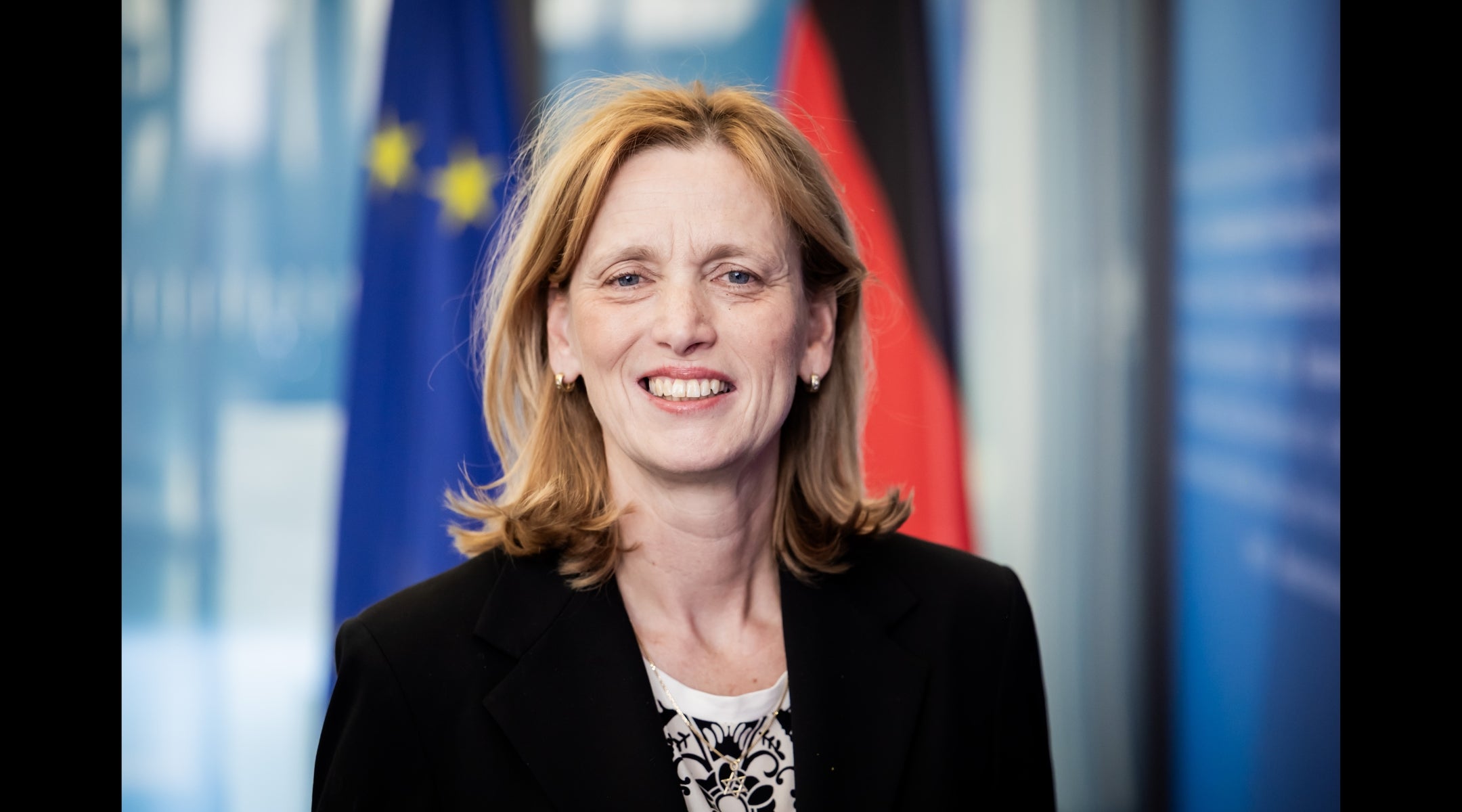
She is not religious, but she describes her childhood and the childhoods of her parents as full of Jewish culture. Her parents, for example, played in the Maccabi tennis club while they were growing up in Amsterdam, Prien said. When she was about 16, Prien’s mother overcame her qualms and gave her a star of David necklace, which she wears in her official parliament portrait.
“I want to show that it has to be normal to show Jewish symbols,” Prien said. “It’s kind of a statement.”
Such normalization took place at the official level at the German parliament, which recently ran an exhibit highlighting its members with “Jewish biographies” from its early days to its reconfiguration after the Nazi era. In the latter case, some people with Jewish heritage served in the government alongside the very same party members who persecuted them.
On March 11, Prien met with a number of American and European Jewish organizational leaders at the official residence of the German consul in Manhattan to hear their concerns. (Following her New York visit, Prien headed to Washington, D.C., where she toured the United States Holocaust Memorial Museum.)
“I really appreciated the fact that she took time to meet with the WJC and other Jewish organizations,” said Lauren Rose, executive director of the executive office of the World Jewish Congress. “It further shows the key commitment that Germany has when it comes to really taking the concerns of Jewish communities seriously.”
Federal Minister Karin Prien meets with Jewish leaders in New York City in March 2026. (Courtesy Bianca Otero)
Prien has long said that her decision to become politically engaged is “closely linked” to her family’s history and experience during the Holocaust.
On her mother’s side, Prien is the great-great-granddaughter of a prominent Düsseldorf merchant, Salomon Hartoch, the owner of the Hartoch department store whose descendants moved to the Netherlands in 1935 to escape persecution. On her father’s side, she is the granddaughter of a Jewish lawyer from Prague.
“My parents were, in a sense, uprooted, and I consider it a great privilege to live in a free country where I now feel deeply rooted,” she told the German Jewish publication Jüdische Allgemeine in 2019.
After the Oct. 7, 2023, Hamas attack on Israel, that connection only became stronger when Prien recognized a rise in antisemitism and extremism in her own country and around the world.
“I can see that authoritarian ideologies — they are attractive to people,” Prien told JR. “And they are becoming more and more attractive. And not only in Germany, but also in other liberal democracies.”
One of those growing threats comes from the Alternative for Germany (AfD), a far-right political party now classified by Germany as an extremist group. Prien has said that she would emigrate, possibly to Israel, if the AfD were to take power in Germany’
Prien visited Israel for the first time in October, shortly after the final Israeli hostages taken by Hamas two years earlier were released. While there, she toured the Yad Vashem Holocaust memorial.
Since the Hamas attacks, Germany has supported Israel’s right to defend itself and rejected claims that the IDF carried out a genocide in Gaza. Still, amid public clamor over the war, Berlin signaled concern over civilian casualties in Gaza, and for a time in 2025 put a temporary halt on military exports to Israel that could be used in the Gaza Strip.
“It’s important to explain to people in Germany that for the Israeli people, [the right to self-defense is] really about how to survive,” Prien said. “And that doesn’t mean that I or the German government is in consensus with every step that is made by the Israeli government.”
She added, “The obedience to international law is a very important point for us in Germany.”
As the education minister, Prien counts education as a key antidote to the growing interest in authoritarianism worldwide. She has promoted a federal educational program called “Demokratie leben!” or “Living Democracy!” which works to prevent extremism and strengthen democracy.
But she wants to show German citizens that liberal democracy can function in the first place.
Said Prien, “We have to make clear that it’s a real privilege to live in a free society, and that the consequences of giving up freedom are severe, and it’s worth fighting for a liberal democracy.”
Reporting the stories that define our era. When history unfolds in real-time, the Jewish world turns to JR. Your support ensures we can document the complexities of war and the resilience of Jewish communities with integrity.