
It wasn’t always this way. As I watch the war unfold with trepidation and hope for the land where the Purim story takes place, I keep thinking about what kind of country Iran has been and what it could be.
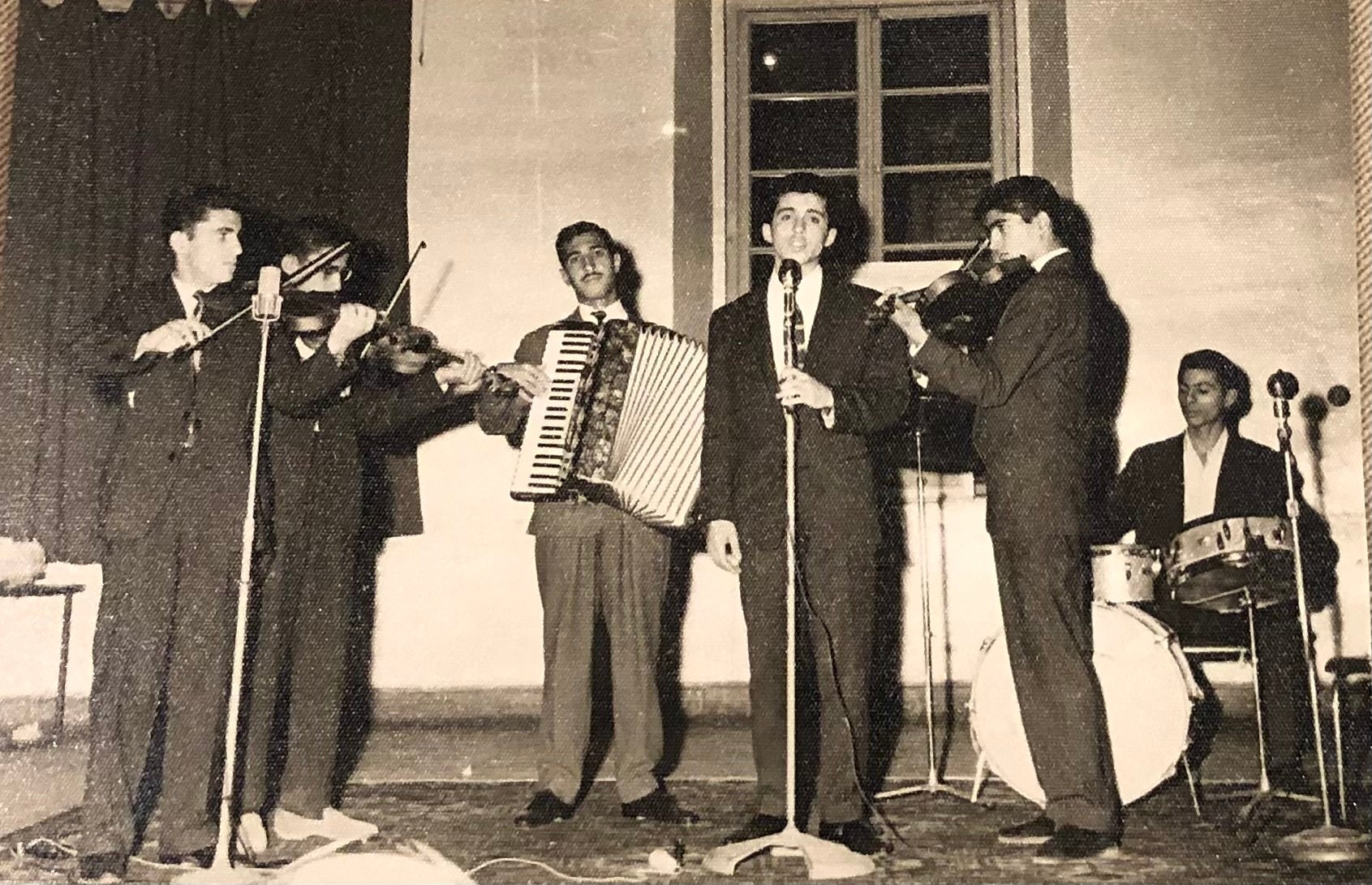
My grandfather (whom I called Saba) Younes Dardashti, a devout Jew, became one of Iran’s most beloved singers in the 1950s and 60s. He was a national radio star known as “The Nightingale of Iran” in an era when secularism and modernization opened doors for Jews that had been shut for centuries. My Jewish Iranian father became a teen pop star on Iranian TV. Exploring these family’s stories, my sister Danielle Dardashti and I co-created an audio documentary, “The Nightingale of Iran.”
One of the people we met along the way is a man named Habib Partow.
We learned that Habib, a Muslim Iranian man now in his 70s and a former Iranian champion wrestler, had a close friendship with our Saba in Iran. On a Zoom call, he walked us over to his refrigerator. There, among family photos, was a picture of our Saba. He’d kept it there for decades.
Habib told us that our Saba once visited his family at their vacation house. At lunch, Saba asked Habib: “I know your father loves Persian music. What’s his favorite dastgah (musical mode)?” When Habib answered, our Saba began to sing. Habib told us how his father was so moved that he wept. And on our Zoom call, almost 60 years later, Habib broke into tears telling us the story.
Habib also told us that he and Saba — a religious Jew and the nephew of a prominent ayatollah — often prayed side by side, facing different directions, one toward Jerusalem, one toward Mecca. “And there was no question about it,” Habib told us. This seemed natural to both of them.
Now, as their homeland is torn by war, I am deeply concerned about the innocent lives being lost across multiple countries, the legality of this war and the absence of any postwar plan. I share this story now because I keep returning to one thing I know to be true: Iran was a very different country not so long ago.
Ghamar Molouk Vaziri, the first famous female singer in Iran — and the first woman to sing without a veil — discovered my grandfather and helped launch his career as the first celebrated Jewish singer in the country. These stories of Muslim-Jewish friendship, of women breaking barriers and of minorities rising to national fame come from Iran’s not-so-distant past. That history, combined with this current political moment, gives me hope that things could shift again. And perhaps one day soon, my sisters and I might finally be able to travel to Iran with our father to see the country of his childhood.
At the same time, we’ve seen in Iran and elsewhere in the Middle East that when one regime falls, what fills the void is often significantly worse. I am not naive about what may come next. But on Purim, a holiday that celebrates an upside-down unexpected turn of events against great odds, I’m trying to remain optimistic.
Growing up, I used to dress up on Purim not as Esther, but as Vashti, the queen who stands up to the Persian king and pays for it dearly. I called myself “Vashti Dardashti” and it always got a laugh. Later, as an adult studying Iran, the significance of Vashti deepened for me. Vashti represents the essence of Purim: standing up to oppressors and bullies, no matter the cost. I went on to write a song about Vashti. The chorus came naturally: “Vashti the queen started a revolution.”
My heart breaks for the Iranian people right now, people who have been extraordinarily brave in standing up to the current regime, and who have risked everything hoping for change. We have seen many brave women in particular — many Vashtis.
I don’t know what will happen in Iran. I don’t know if the country where my Persian Jewish ancestors lived for over 2,500 years will become a place where a Jew can be a national treasure again. But many Iranians still remember that it once was. And I hope that Vashti’s successors are the ones who will bring it back.
is a musician, anthropologist, and co-creator (with her sister Danielle Dardashti) of “The Nightingale of Iran,” a documentary podcast about identity, belonging, and music, distributed by PRX in partnership with JR. Her album Monajat features duets with recordings of her grandfather Younes Dardashti.
The views and opinions expressed in this article are those of the author and do not necessarily reflect the views of JR or its parent company, 70 Faces Media.