

In the lead-up to New York City’s mayoral election last month, Elliot Cosgrove emerged as one of the most outspoken rabbinic critics of Zohran Mamdani, the anti-Zionist activist who is now the mayor-elect.
On Monday, speaking to a convention of Zionists, Cosgrove turned his critique toward U.S. Jews, saying that supporters of Israel “shouldn’t be surprised” by Mamdani’s roughly 33% tally among Jewish voters.
“For a liberal Zionist disillusioned by the Israeli government, Mamdani’s anti-Zionism is a difference of degree, not of kind,” said Cosgrove, who leads Park Avenue Synagogue on the Upper East Side. “He understood the fissures of our community better than we ourselves did, and the question we face now is, what are we going to do about it?”
Speaking at the the convention of the American Zionist Movement, Cosgrove laid out a vision for a “new chapter of American Zionism,” calling for his audience to “avoid the reductive and destructive tactic of labeling people with whom we disagree either as self-hating Jews or colonialist aggressors.” He said a rigid vision of what Zionism should look like had been damaging for the Jewish people.
“By making unconditional support for the Israeli government a litmus test for Jewish identity,” Cosgrove said, “we ourselves have inflicted harm on the Jewish future.”
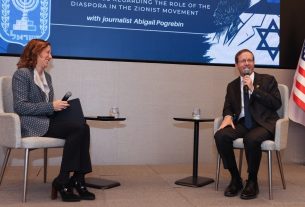
Cosgrove’s speech capped a two-day conference for the AZM, an umbrella organization for 51 U.S. Zionist groups that also serves as the American affiliate to the World Zionist Organization. Tensions were running high at the national assembly as Cosgrove took to the podium to call for the Zionist movement to widen its tent.
Speaking to the conference’s roughly 250 attendees in the East Village, Cosgrove lamented what he described as the increasing ideological divide between American and Israeli Jewry as a result of the war in Gaza. He criticized some Israeli policies in laying out why many in the liberal Jewish majority are feeling distanced from Israel.
“Leaving aside the role of historical revisionism and progressive identity politics, the unresolved status of the Palestinians, lacking as they are in freedom of movement and access, self determination and other accoutrements of sovereignty, forms a wedge issue between an increasingly liberal-leaning American Jewry and an increasingly right-leaning Israeli Jewry,” said Cosgrove.
During his address, Cosgrove also criticized the lack of recognition of the Conservative and Reform movements in Israel, adding that the country “neither supports, defends nor recognizes Judaism as I teach it and preach it.”
“The fact that the same government that fails to recognize American Jews also fails to recognize the Palestinian right to self determination only serves to increase American Jews’ sense of estrangement,” said Cosgrove.
The AZM Biennial National Assembly, which was titled “Zionism: Many Visions, One Dream,” brought together representatives from a wide range of U.S. Zionist groups. An hour before Cosgrove’s remarks, Israeli President Isaac Herzog also gave a talk where he lamented growing antisemitism within the United States.
In a Jewish environment shaped by the Oct. 7 attacks and the war in Gaza that followed, Jews have been buffeted by intense criticism on the left, a rise in antisemitism and internal fissures. Cosgrove both referenced and reflected these divisions, which often pit Jews offering full-throated support for Israel, its military and its government, against those like Cosgrove who are committed Zionists but expressed doubts about the conduct of the war and Israel’s political direction. Far to the left of both groups are increasingly visible Jewish anti-Zionists and younger Jews deeply disillusioned with the Jewish state, whom Cosgrove also referenced in his talk.
To address the growing divide within American Jewry over support for Israel, Cosgrove called for “heshbon hanefesh,” or a “self audit.” But the onus for “heshbon hanefesh,” Cosgrove added, “goes both ways” — and he reinforced red lines that he laid out in a October sermon against Mamdani and his Jewish supporters that spurred a rabbinic statement that drew more than 1,300 signatures.
“For such a time as this, when Israel is surrounded by enemies, Jewish critics of Israel need to be judicious in how they voice their dissent,” continued Cosgrove. “It’s one thing to attend a pro-democracy rally in a sea of Israeli flags that begins and ends with the singing of ‘Hatikvah.’ It’s another thing to stand in an encampment next to someone calling for global intifada.”
But within the broad Zionist tent, Cosgrove argued, all views should be taken seriously in the quest to build a future for Zionism while it is under attack..
“The future dream of American Zionism depends not on my vision or yours, not on the right or the left, religious or the secular,” said Cosgrove. “It’s a dream that depends on all of us together, an American Zionism for such a time as this, bold enough to embrace the voices, complexities, paradoxes and even contradictions of our age.”
At the conclusion of his speech, dozens of audience members stood to applaud, though a couple of “boos” could be heard across the room.
During a brief Q&A following the keynote speech, Marc Jacob, a member of the Haredi Orthodox slate Eretz HaKodesh, said he felt “ostracized” by Cosgrove for “wanting to open the door to those who are sitting in camps that are against the Jewish state.”
In response, Cosgrove clarified that he was “trying to stand firm in my convictions, but also embrace those views to the left of me who don’t represent my views.”
“I was not speaking about those outside of the camp who seek the ill will and destruction of the Jewish people,” said Cosgrove. “I was speaking about the ability of those within the tent to find an opportunity, a platform to support Israel in a way that need not be aligned with every policy of this or that Israeli government.”