

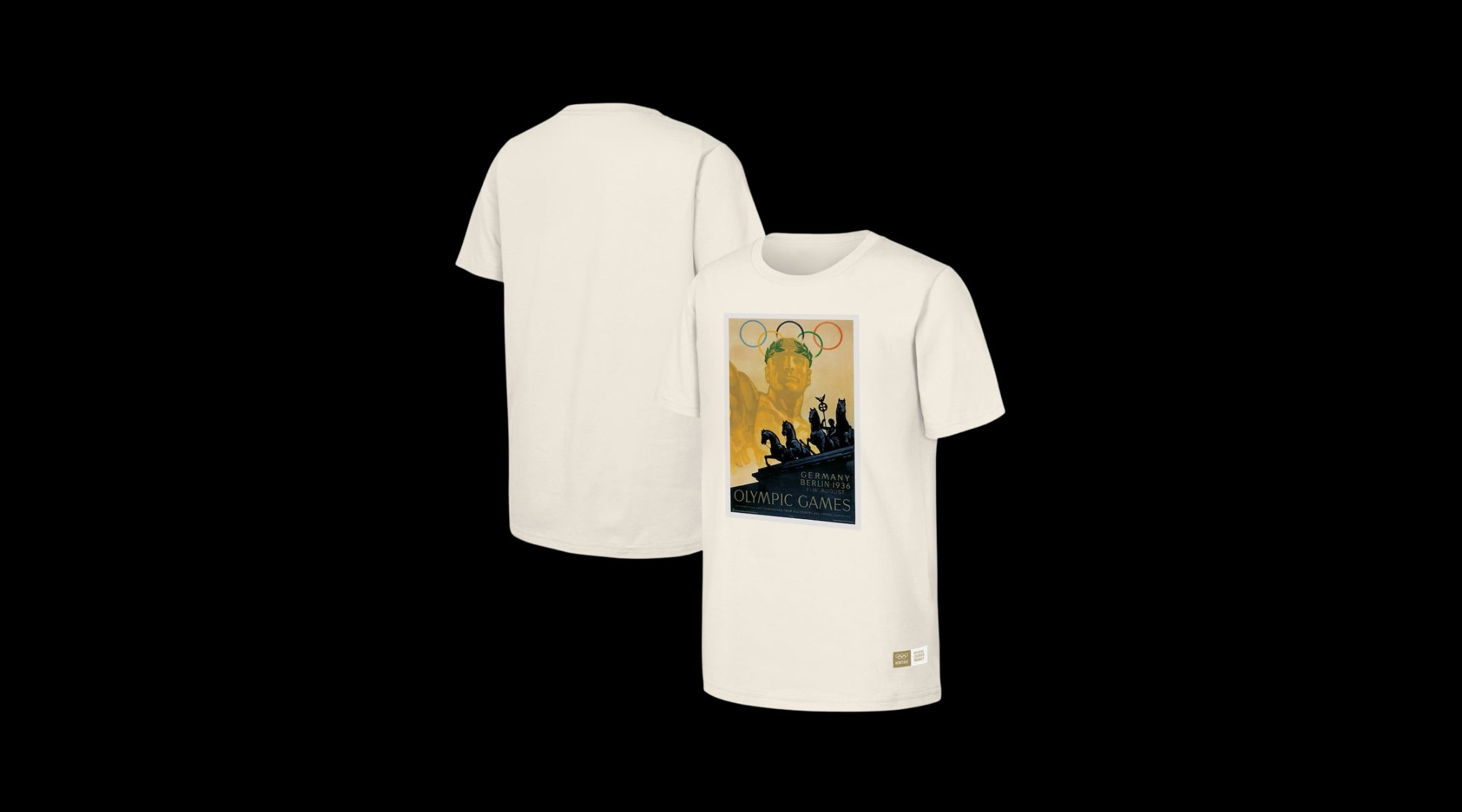
The governing body for the Olympics is defending its sale of a limited-edition T-shirt commemorating the 1936 Olympic Games in Berlin under Adolf Hitler’s Germany.
The $42 shirt, which was condemned by Jewish organizations, has already sold out from the official Olympics online store.
A spokesperson for the International Olympic Committee acknowledged the Games’ Nazi connections but said the 1936 design fit with its lineup of historical apparel marking “130 years of Olympic art and design.”
In its statement the IOC also invoked Jesse Owens, the Black American track-and-field athlete whose dominating performance at the 1936 Games was widely seen as a rebuke of Hitler’s “master race” ideology.
“While we of course acknowledge the historical issues of ‘Nazi propaganda’ related to the Berlin 1936 Olympic Games, we must also remember that the Games in Berlin saw 4,483 athletes from 49 countries compete in 149 medal events,” the IOC spokesperson said in a statement to media. “Many of them stunned the world with their athletic achievements, including Jesse Owens.”
The design, based on an official poster for the Games, depicts the Olympic rings and a golden statue of a muscular man crowned in laurels next to a chariot of horses atop Berlin’s Brandenburg Gates.
Another item based on an Olympics event overseen by the Nazis, a T-shirt commemorating the 1936 Winter Games in Garmisch-Partenkirchen, Germany, was also being sold through the collection. That poster shows a victorious skier with an arm upraised in what could be a Nazi salute and was designed by Ludwig Hohlwein, a leading artist in Joseph Goebbels’ propaganda division.
European Jewish groups said the Berlin shirt was insensitive, given that the 1936 Games were intended to function as a propaganda tool for Hitler’s regime. Some pointed to the modern-day resurgence of antisemitism as justification for their objections.
“As the world reflects on this latest controversy, it is impossible not to recall that we are approaching 90 years since the 1936 Berlin Olympics — an event the Nazi regime used to legitimize itself on the global stage while persecution of Jews was already well underway,” Scott Saunders, CEO of International March of the Living, the educational program that organizes trips to concentration camps, told CNN.
“Sport has the power to unite, to inspire, and to elevate the very best of humanity,” Saunders added. “But history reminds us that it can also be manipulated to sanitize hatred and normalize exclusion. The lesson of Berlin is urgent. When antisemitism resurfaces in public life, whether in stadiums, streets, or online, silence is not neutrality. It is complicity.”
Christine Schmidt, the co-director of the Wiener Holocaust Library in London, also condemned the sale of the shirts.
“The Nazis used the 1936 Olympics to showcase their oppressive regime to the world, aiming to smooth over international relations while at the same time preventing almost all German-Jewish athletes from competing, rounding up the 800 Roma who lived in Berlin, and concealing signs of virulent antisemitic violence and propaganda from the world’s visitors,” Schmidt told CNN.
The screen-printed shirt is based on a poster for the actual games created by graphic artist Werner Würbel, according to an IOC catalog of posters from the Games. The aesthetic of the 1936 Games, which emphasized strongman caricatures in keeping with the Nazi ideal of a superhuman Aryan race, was memorialized in Nazi filmmaker Leni Riefenstahl’s propaganda documentary “Olympia.”
The Heritage collection also sold a T-shirt bedecked with a poster from the 1972 Olympic Games in Munich, during which the entire Israeli athletic delegation was taken hostage and killed by the Palestinian terror group Black September. The Jewish Telegraphic Agency has reached out to the IOC for further comment about the shirt, which is also marked as sold out.
The Munich Games were honored in a different commemorative product that drew criticism: sneakers produced in 2024 by Adidas, which was founded by Nazi Party members and had recently taken weeks to break ties with Kanye West after he embarked on an antisemitic spree.